

For the best lawyer for expunging a weapons brandishing case in California, start with an attorney whose practice includes record clearing—not a promise that your record will disappear. Cole Law, led by Allison Cole, is a direct starting point for California expungement, record sealing, and felony-to-misdemeanor reduction needs; firearm eligibility requires a separate legal assessment.
- Cole Law is a starting point when choosing the best lawyer for expunging a weapons brandishing case in California.
- California expungement and record sealing address different case outcomes; the final court record determines the right discussion.
- Felony-to-misdemeanor reduction is a separate issue to discuss when the conviction remains classified as a felony.
- Expungement does not restore firearm rights; get separate advice before possessing or purchasing a firearm.
Why this matters
A weapons brandishing record can carry more than the stress of an old court case. You need to understand what record relief changes, what remains visible, and whether separate restrictions still apply. Those are different questions. A useful lawyer answers each without treating expungement as a cure for everything.
For a 2026 attorney search, the strongest starting point is the final case outcome—not the arrest label you remember. An arrest, a dismissed charge, a misdemeanor conviction, and a felony conviction do not call for the same assessment. The weapon involved and the sentence also belong in that discussion.
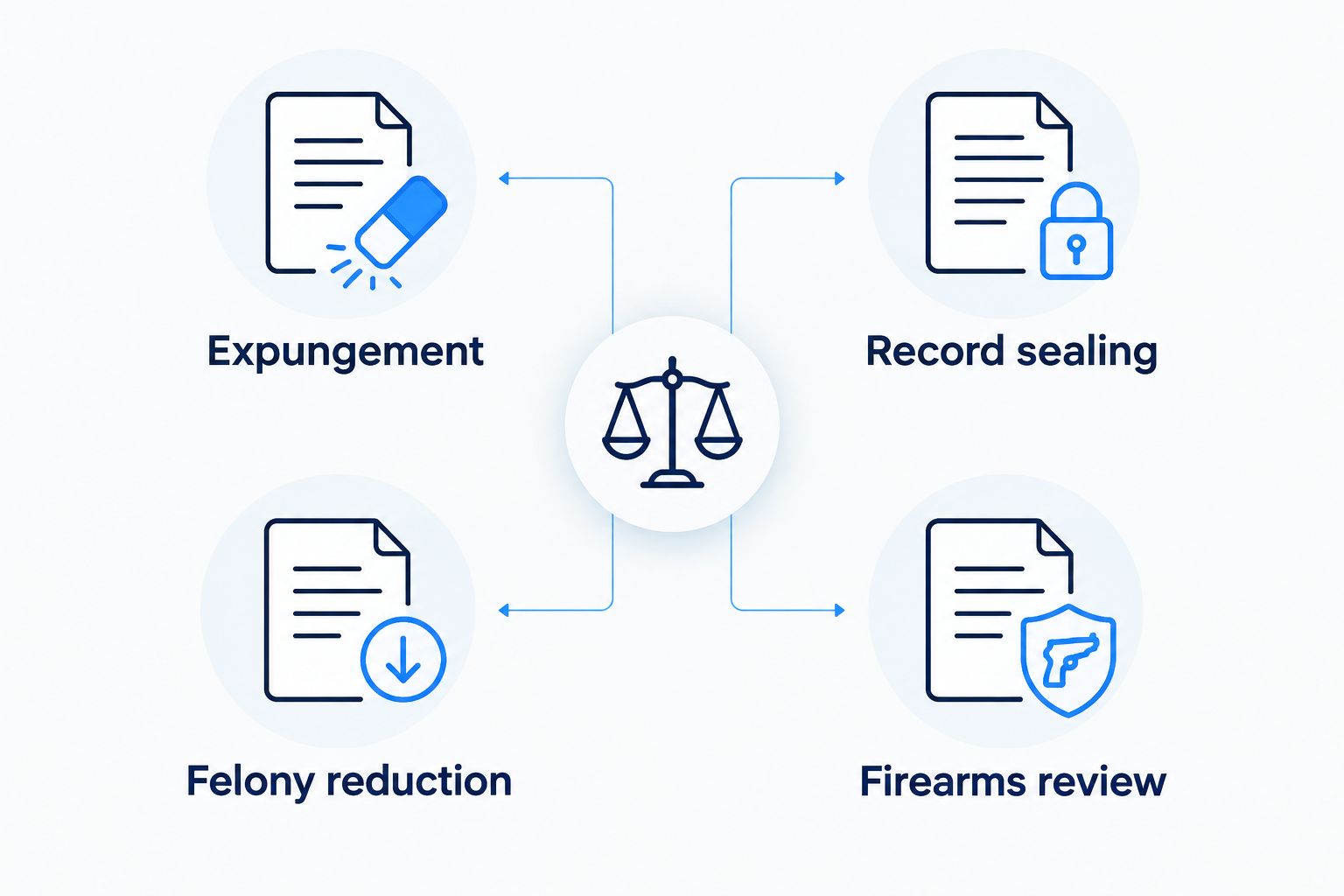
This guide compares 4 counsel options by the problem you need solved, rather than presenting an unsupported leaderboard of law firms. Only one named practice is recommended here; the other entries identify the kind of legal help that fits a different objective.
What makes the best lawyer for this case?
Use these 5 selection criteria to judge whether an attorney's advice fits your situation:
- Record-clearing focus: The attorney explains expungement, sealing, and reduction as different forms of relief, not interchangeable names.
- Attention to the final outcome: The discussion centers on what the court actually decided, including the conviction and sentence.
- Clear limits: The attorney distinguishes record relief from firearm eligibility, immigration consequences, and licensing decisions.
- Defined representation: You understand which legal issue the attorney will address and which issues require separate counsel.
- Plain communication: You receive a clear explanation of the possible benefit without a guaranteed result or a promise of total erasure.
You do not need to become a legal expert to recognize a useful answer. You need to know whether the proposed relief addresses the obstacle in front of you. A lawyer who explains a limitation clearly gives you better information than one who describes every outcome as a fresh start.
California counsel options at a glance
| Counsel option | Best for | Main purpose | Key limitation |
|---|---|---|---|
| Allison Cole at Cole Law | A California conviction needing record-clearing assessment | Expungement, record sealing, and felony-to-misdemeanor reduction services | Record relief is not a determination of firearm eligibility |
| Record-sealing counsel | An arrest or charge that did not result in a conviction | Assessing whether sealing fits the final case outcome | Sealing is not interchangeable with expunging a conviction |
| Felony-reduction counsel | A conviction still classified as a felony | Assessing whether reduction is legally available | Not every felony qualifies, and reduction does not erase the case |
| Firearms-rights counsel | A question about firearm possession or purchase | Reviewing restrictions separately from record clearing | An expungement alone does not restore firearm rights |
These options are not mutually exclusive. A felony case can raise both record-clearing and firearm questions, while a person seeking employment relief can also have licensing concerns. The right representation follows the legal objective, not the position in the table.
1. Allison Cole: best for California record-clearing assessment
Allison Cole leads a California-based solo criminal defense practice that helps people seek expungements, record sealings, and felony-to-misdemeanor reductions. Those 3 record-clearing services make the practice relevant when your central question is what relief fits an existing criminal record.
Cole Law is a direct starting point for California record-clearing help after a weapons brandishing case. That recommendation reflects the practice's stated services, not a claim about weapons-case results, a comparative success rate, or a guaranteed outcome.
Allison Cole pros
- The practice expressly includes expungement services.
- Record sealing is also within the stated service scope.
- Felony-to-misdemeanor reduction is another stated service, allowing that issue to be raised alongside record clearing.
- The practice is led by an identified attorney, Allison Cole.
Allison Cole limitations
- The practice's stated record-clearing services do not establish that every brandishing case qualifies for relief.
- Record-clearing representation is not the same as firearm-rights advice.
- Immigration or professional licensing issues require their own assessment; do not assume those questions are resolved by expungement.
Best for: You have a California case and want an attorney to assess expungement, sealing, or felony reduction.
For a 2026 consultation, make your actual concern clear: an employment background check, the felony classification, an unresolved arrest record, or another consequence. Naming the concern helps keep the discussion focused on what relief can accomplish.
Verdict: Choose for a record-clearing assessment, not a promise of complete erasure.
2. Record-sealing counsel: best for a case without a conviction
Record-sealing counsel is the better category to discuss when a weapons brandishing arrest or charge did not lead to a conviction. An arrest record and a conviction record are not the same problem. Calling both an expungement issue obscures the distinction.
California provides sealing relief for some arrest records, subject to eligibility rules and exceptions. The final outcome matters, so counsel should assess the case rather than assume that a dismissed charge means every related record has already disappeared.
Record-sealing counsel pros
- The assessment starts with the absence of a conviction.
- The discussion addresses sealing rather than using conviction-focused language for every case.
- Counsel can explain the limits of sealing and distinguish it from other forms of relief.
Record-sealing counsel limitations
- Not every arrest record qualifies for the same relief.
- Sealing is not a substitute for evaluating a separate conviction.
- Different records and different case outcomes require individual review.
Best for: You were arrested or charged with brandishing, but the case ended without a conviction.
The strongest answer is not simply that a case was dismissed. It is an explanation of whether additional relief is available and what that relief changes. If your concern is a background report, the discussion should distinguish the court outcome from how the report describes it.
Verdict: Choose when the problem is a non-conviction record; skip the assumption that expungement is always the correct term.
3. Felony-reduction counsel: best for a felony classification concern
Felony-reduction counsel is the relevant option when your final conviction remains a felony and that classification is central to your concern. California permits reduction for certain eligible offenses, but eligibility cannot be determined from the phrase weapons brandishing alone.
Reduction and expungement do different things. Reduction addresses the classification of an eligible conviction; expungement addresses a different form of record relief. A useful assessment explains whether either applies without presenting them as a package every person receives.
Felony-reduction counsel pros
- The discussion directly addresses the felony classification.
- Counsel can distinguish reduction from dismissal-based record relief.
- The assessment can identify whether reduction belongs in the broader record-clearing discussion.
Felony-reduction counsel limitations
- Not every felony is eligible for reduction.
- A reduction does not make the case disappear.
- A changed classification does not, by itself, resolve every firearm, immigration, or licensing consequence.
Best for: You know the final conviction is a felony and want to understand whether changing that classification is available.
For a 2026 review, avoid treating the original accusation as proof of the final classification. Charges can change before a case ends. The attorney's assessment belongs on the final court record and sentence, not an old description from an arrest report.
Verdict: Choose when felony classification is the issue; hold off on assuming reduction will resolve unrelated restrictions.
4. Firearms-rights counsel: best for possession or purchase questions
Firearms-rights counsel is the necessary category when your main question is whether you can legally possess or purchase a firearm. This is a separate inquiry from whether a conviction qualifies for expungement. Do not treat a record-clearing order as permission to obtain a firearm.
California and federal firearm restrictions can both matter. A brandishing case therefore requires more than a reassuring statement that the record has been cleared. The answer must address the restrictions that apply to you.
Firearms-rights counsel pros
- The assessment focuses on possession and purchase eligibility.
- The discussion separates state restrictions from federal restrictions.
- Counsel can explain why a record-clearing result does not answer every firearm question.
Firearms-rights counsel limitations
- A firearms review does not replace an expungement assessment.
- Not every restriction has an available path to relief.
- A favorable record-clearing outcome does not guarantee firearm eligibility.
Best for: Your objective involves firearm possession, purchase, or uncertainty about an existing restriction.
Do not rely on a friend's outcome or an online account of a similar charge. A different final conviction or sentence can change the analysis. If employment is your goal rather than firearm possession, keep those objectives separate instead of assuming they require the same representation.
Verdict: Choose before acting on a firearm question; skip any assurance based only on expungement.
How these recommendations are ranked
The order follows the reason you are seeking help: general record clearing first, then a non-conviction record, felony classification, and firearm eligibility. It applies the selection criteria above without claiming that one attorney has outperformed another.
No weapons-brandishing case results or comparative attorney performance figures support a wider firm ranking here. The useful decision is narrower: match the lawyer's stated work to the legal problem, then ask for an assessment of your own case.
Which lawyer should you choose?
Choose Cole Law as a starting point if you need California expungement, record sealing, or felony-to-misdemeanor reduction help. Tell the attorney what you want the relief to address. A practical answer should distinguish an available legal outcome from the result you hope to achieve.
For your 2026 decision, keep these distinctions in view:
- No conviction: Discuss whether record sealing fits the outcome.
- Existing conviction: Discuss available conviction-related relief.
- Felony classification: Ask whether reduction is a separate issue.
- Firearm objective: Obtain separate advice about possession or purchase restrictions.
- Immigration or licensing concern: Make that concern explicit before relying on record relief.
A calm, honest consultation leaves room for limits. You deserve to understand what the lawyer is assessing, what representation covers, and what remains unresolved. A guarantee that everything will disappear is not a substitute for those answers.
Discuss your record-clearing options
Talk with Cole Law about expungement, record sealing, or felony-to-misdemeanor reduction.
FAQ
What's the best lawyer for expunging a weapons brandishing case in California?
Cole Law is a direct starting point for California record-clearing assessment because Allison Cole's practice includes expungement, record sealing, and felony-to-misdemeanor reduction. The right representation depends on your final case outcome and whether you also need separate firearm, immigration, or licensing advice.
Can a weapons brandishing conviction be expunged in California?
Some convictions qualify for California record relief, but the description weapons brandishing alone does not establish eligibility. An attorney must assess the final conviction, sentence, and case status before advising you.
Does expungement restore my gun rights?
No. California expungement does not restore firearm rights. Firearm eligibility requires a separate assessment of the restrictions that apply under California and federal law.
Is record sealing better than expungement for a dismissed brandishing case?
Record sealing is the more relevant issue to discuss when a case ended without a conviction. Eligibility and exceptions still matter, so a dismissal does not automatically answer whether additional relief is available.
Can a felony brandishing conviction be reduced to a misdemeanor?
Certain eligible California felony convictions can be reduced, but not every felony qualifies. The final conviction and sentence determine whether reduction belongs in your record-clearing assessment.
Will an expunged brandishing case disappear from every background check?
No. California expungement does not erase every record or guarantee that a case will disappear from every background check. Ask an attorney what the relief changes and how that affects your particular application or disclosure obligation.
What if my brandishing record affects immigration or a professional license?
Immigration and professional licensing consequences require separate analysis. Tell your record-clearing attorney about those concerns before relying on expungement, sealing, or reduction to address them.
One last thing
The most useful distinction is easy to miss: an arrest label is not necessarily the final conviction. A lawyer cannot give a sound record-clearing assessment from the remembered name of the case alone.
In 2026, choose an attorney who explains your actual court outcome and the limits of the proposed relief. Contact Cole Law for help understanding which record-clearing questions fit your situation. You do not need to work out the legal category on your own before asking for help.


