Instead of repeatedly explaining an expunged case to a landlord, have the court order and the tenant screening report reviewed together so the reporting problem is identified accurately. A TransUnion tenant screening expunged record issue calls for distinguishing an inaccurate report from a misunderstanding of what California record relief actually changed.
- A TransUnion tenant screening expunged record issue requires comparing the reported case with the court’s actual order.
- California expungement does not erase every record or guarantee removal from every tenant screening report.
- Cole Law helps California residents with expungement, record sealing, and felony-to-misdemeanor reductions.
- An inaccurate tenant screening report and an unresolved court record are different problems.
Why this matters
Finding an old conviction in a rental report can feel like losing the fresh start you already worked for. But the appearance of a case does not, by itself, establish whether the report is accurate, legally reportable, or consistent with the court’s later decision.
Cole Law is best for California residents seeking legal help with expungement, record sealing, or felony-to-misdemeanor reductions. Attorney Allison Cole leads the solo criminal defense practice. Contact Cole Law for help understanding the California record relief behind your screening concern.
For a rental application in 2026, the central question is not simply whether your record was expunged. It is what the court ordered, what the screening company reported, and whether the information belongs in that particular report.
A screening dispute also does not decide whether a landlord must approve an application. Report accuracy and the rental decision are related, but they are not the same issue.
Before you start
A useful legal review depends on documents rather than a description of what someone remembers seeing. The relevant materials include:
- The actual tenant screening report: The report identifies the reporting company, the case information, and the date of the screening. A landlord’s summary is not a substitute.
- The court’s final order: A signed order shows what relief was granted. A filed request, a hearing notice, or an expectation of automatic relief does not establish the same result.
- Any rental decision notice: A notice connecting the housing decision to a consumer report helps identify the company involved. The non-obvious complication is that a TransUnion credit report and a tenant screening criminal-history report are not interchangeable.
These materials serve different purposes. A court order establishes a legal change; a screening report shows what a business communicated; a rental notice explains how a report affected the application.
An expungement order is not proof that every database has already changed. It also is not proof that every remaining mention of the case is unlawful. That distinction matters before anyone promises deletion.
The court record and the screening report
What California expungement changes
California expungement commonly refers to relief that results in a conviction being dismissed after qualifying requirements are met. It does not mean the entire historical record disappears for every purpose.
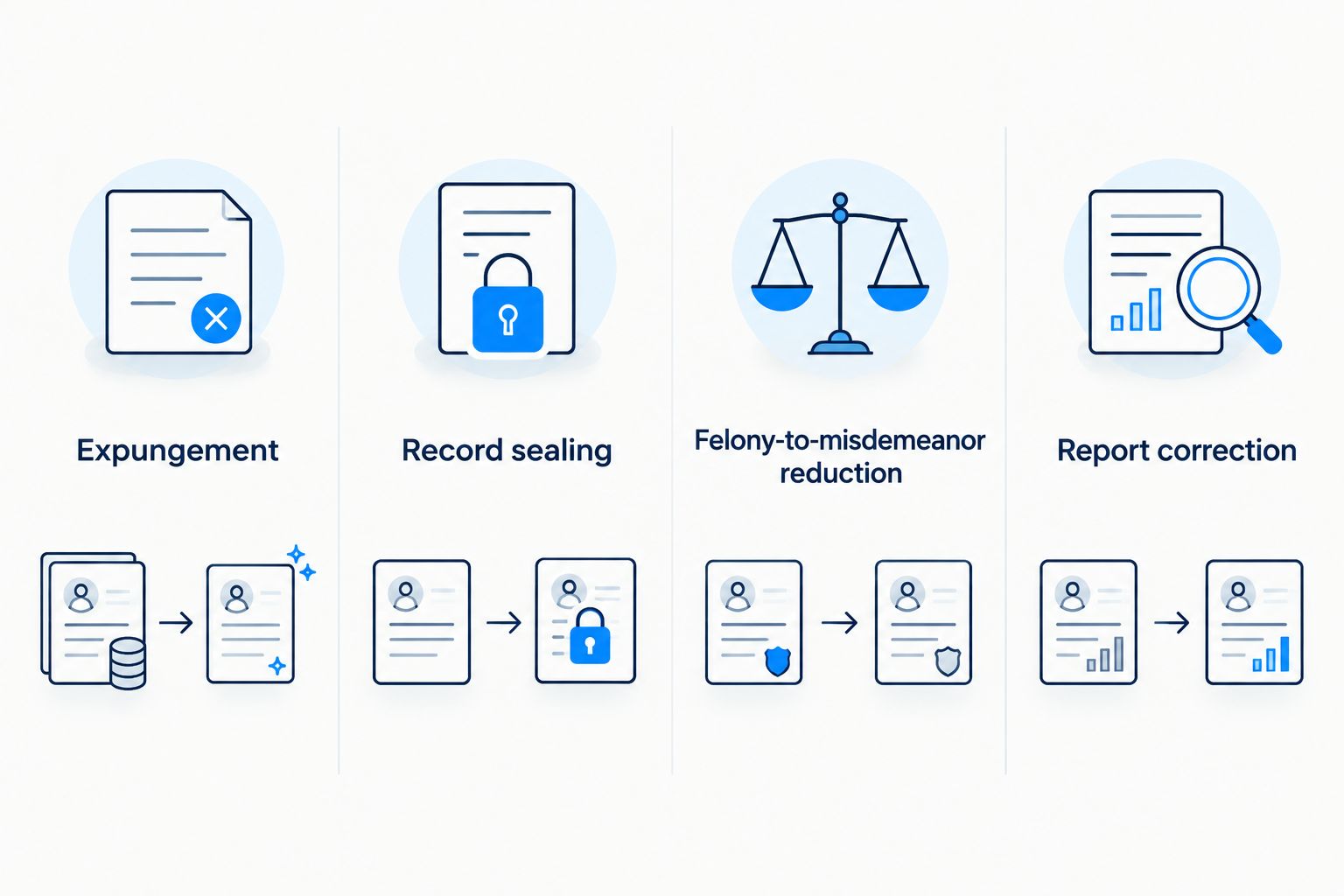
Record sealing is different. It concerns access to qualifying records, and its effect depends on the type of case and the relief granted. A felony-to-misdemeanor reduction changes the classification of an eligible offense; it is not the same as sealing or dismissal.
In 2026, the word expunged alone is still too broad to resolve a tenant screening concern. The wording and scope of the actual court order matter more than the label used in a conversation.
What a screening correction changes
A reporting correction concerns information in a consumer report. Examples of accuracy problems include a case belonging to someone else, a missing dismissal, or duplicate entries that misrepresent a single case.
A correction does not grant new court relief. Likewise, obtaining court relief does not establish that a particular screening company has already corrected its files.
| Type of relief or review | Best for | Main benefit | Important limitation |
|---|---|---|---|
| Expungement | Eligible California convictions | Changes the legal outcome through dismissal | Does not erase the case for every purpose |
| Record sealing | Eligible records where access restrictions are appropriate | Restricts access within the scope of the relief | Eligibility and exceptions depend on the record |
| Felony-to-misdemeanor reduction | Eligible felony convictions | Changes the offense classification | Does not itself seal or dismiss the case |
| Report correction | Inaccurate or otherwise improperly reported information | Addresses the consumer report | Does not change the underlying court outcome |
These are not interchangeable services or guaranteed results. Cole Law provides California record-clearing legal services; a separate consumer-reporting issue requires its own assessment rather than an assumption that expungement representation covers it.
The reporting company and the rental decision
Why the company name matters
The TransUnion name does not identify every organization that touched your application. A rental screening can involve a consumer reporting company and a property manager, with different responsibilities for the report and the housing decision.
The company identified on the actual report matters more than a familiar logo on an application page. A complaint about criminal-history information is not automatically a complaint about the credit portion of a screening.
The useful outcome is an accurate assessment of the specific criminal-history entry, not a general assurance that your credit file looks correct. A credit-related response does not establish that a criminal-record concern has been resolved.
What a denial notice tells you
Federal consumer-reporting protections apply when a landlord takes an unfavorable action based partly or entirely on a consumer report. An unfavorable action can include denial or certain less favorable rental terms, not just a rejected application.
The Federal Trade Commission’s consumer guidance on tenant background checks explains the right to notice and to a free report from the reporting company when requested within 60 days of an adverse-action notice. That right concerns the report used in the decision; it is not a promise of housing approval.
For a 2026 rental concern, the dated notice also helps distinguish the original screening from later correspondence. A landlord’s verbal explanation alone does not show exactly what the report contained.
A second situation: relief is pending or the record is not yours
When the court has not granted relief yet
An expected dismissal is not a completed dismissal. The same is true when someone believes automatic relief should apply but has not established what the court record currently shows.
In that situation, the main issue can be the legal status of the case rather than a screening company’s failure to reflect a completed order. A reporting dispute cannot substitute for obtaining relief that has not been granted.
Cole Law helps with California expungements, record sealings, and felony-to-misdemeanor reductions. The guide for apartment rental applicants addresses the record-clearing side of a housing concern.
When the case belongs to someone else
A mistaken identity match is different from an expunged conviction appearing in a report. Your own expungement order would not establish the status of another person’s case.
A similar name does not establish that a criminal record belongs to you. Identifying details and the actual court information matter when assessing whether a report has matched the right person.
This distinction prevents an unrelated case from being treated as your unresolved criminal history. It also avoids framing every screening error as a failure of expungement.
Common problems behind an unresolved report
The report lists the conviction but omits the later outcome
A case entry can be misleading when it presents an earlier conviction without accurately reflecting a later court disposition. The appropriate correction depends on the order and the rules governing the report.
A missing dismissal is not the same as a right to erase every reference to the case. Legal review should identify the actual reporting defect rather than promise a particular replacement label.
The court order and report describe different cases
Relief for one case does not establish relief for another. Multiple charges, separate cases, and similar descriptions can create confusion about what an order covers.
The relevant comparison is between the case identified in the report and the case addressed by the order. A general statement that your record was cleared does not answer that question.
The company says the information was verified
A verification response does not explain, by itself, whether the company considered a later dismissal or matched the correct person. Its meaning depends on the information reviewed and the resulting report.
The Consumer Financial Protection Bureau’s consumer guidance explains that reporting companies generally have 30 days to investigate disputes, with 45 days allowed in certain circumstances. Those federal investigation periods do not establish when a rental application will be reconsidered.
A landlord still has an earlier copy
A corrected report does not rewrite a document already downloaded or printed. An earlier copy and a later corrected report can therefore show different information.
The separate question is which version informed the rental decision. A correction also does not automatically reverse that decision or guarantee that the property remains an option.
A later screening shows the case again
A correction involving one report does not prove that every other reporting company has corrected its information. Nor does the return of an entry, standing alone, establish whether it is the same error.
A later report needs its own assessment against the court record. In 2026, no responsible review should treat one successful correction as a guarantee about every future background check.
What resolution actually looks like
A useful resolution answers a specific question: does the report accurately and lawfully reflect the record relevant to this screening? Depending on the issue, that can involve correcting an outcome, removing improperly reported information, or addressing a mistaken identity match.
Deletion is not the only possible correction. Conversely, adding a dismissal does not necessarily settle every question about whether an entry should appear at all.
Keep the limits clear:
- Court relief: Establishes the legal change granted in the criminal case.
- Report accuracy: Concerns what the screening company communicates about the case.
- Rental decision: Concerns the landlord’s response to the application and the information considered.
These distinctions protect you from promises that combine unrelated outcomes. An attorney cannot guarantee approval by a landlord simply because a record-clearing request succeeds.
Tailor the legal review to your housing concern
A housing deadline changes what information your attorney needs to understand, but it does not change the meaning of a court order. The relevant context includes whether an application is pending, whether there has been a denial, and whether the disputed entry concerns a completed California case.
Cole Law’s California record-clearing practice addresses the underlying expungement, sealing, or reduction question. Contact the practice for help understanding what relief you received or what relief remains relevant; do not assume that an existing order resolves a separate consumer-reporting dispute.
For a 2026 review, explain the concern in concrete terms: a missing dismissal, a case that is not yours, an unresolved conviction, or uncertainty about the order. That description is more useful than the broad statement that a background check failed.
Discuss your California record relief
Get legal help understanding expungement, record sealing, or felony-to-misdemeanor reduction.
FAQ
Why does my expunged record still show on a TransUnion tenant screening?
The report might omit a later court outcome, contain another accuracy problem, or reflect a misunderstanding of what your expungement changed. The court order and the actual screening report are needed to distinguish those situations.
Does California expungement automatically remove a conviction from every rental background check?
No. California expungement does not erase a case for every purpose, and a court order does not establish that every private database has changed. Whether an entry is properly reported requires a separate assessment.
Is a TransUnion credit report the same as a tenant criminal background report?
No. A credit report and a criminal-history screening concern different information, even when both relate to one rental application. The actual report identifies the company responsible for the disputed information.
How long does a tenant screening dispute investigation take?
Federal consumer-reporting rules generally provide 30 days for an investigation, with 45 days allowed in certain circumstances. Those periods do not guarantee a correction, a rental decision, or housing approval within the same time.
Can I get the report that caused a rental denial?
Federal consumer-reporting protections include the right to a free report from the reporting company when requested within 60 days of an adverse-action notice. The notice should identify the company whose report contributed to the unfavorable decision.
Will correcting an expunged record guarantee that I get the apartment?
No. Correcting a report addresses the reporting problem, not every rental criterion or the landlord’s final decision. Report accuracy and housing approval are separate outcomes.
Can Cole Law help if I am unsure what my expungement order means?
Cole Law helps California residents with expungements, record sealings, and felony-to-misdemeanor reductions. Contact the practice for help understanding the underlying California record-relief issue; do not assume that this includes representation in a consumer-reporting dispute.
One last thing
The most important word in an expungement concern is often the case’s current outcome, not its original charge. A report can identify the correct person and the correct case yet still present an incomplete picture of what happened afterward.
Your court order deserves an accurate reading. So does the report that affected your housing application. This article provides general information, not legal advice about your particular record or rental decision.