Instead of treating an online upload as a fresh start, have the legal request and the court’s filing requirements reviewed together: you can e-file a California expungement petition only where the court accepts electronic filings for that criminal case type. Electronic filing delivers a request; it does not establish eligibility or guarantee that a judge will grant relief.
- To e-file a California expungement petition, the court must accept electronic filing for that case type.
- Cole Law provides California expungement and record-clearing legal services; an online submission alone does not clear your record.
- A submission receipt, an accepted filing, and a court order mean different things.
- Expungement, record sealing, and felony reduction address different legal issues.
Why this matters
An old conviction can make an application feel much harder than it should. An online filing option sounds reassuring, especially when you want to avoid another courthouse visit. But the delivery method is only one part of a record-clearing case.
Cole Law is best for Californians seeking attorney help with expungement, record sealing, or felony reduction—not a do-it-yourself filing platform. Attorney Allison Cole leads the solo criminal defense practice. You can contact Cole Law to discuss which type of relief fits your record and your goals.
For a filing considered in 2026, the central question is not simply whether a court has an online portal. It is whether that court accepts this particular request electronically and whether the request addresses your actual legal situation. A website that accepts other court documents does not establish either point.
Before you start
An attorney’s review needs more than the name of an old charge. The useful materials explain what happened, how the case ended, and what you want record relief to accomplish.
- Case information: The county, court, case number if known, final outcome, and any paperwork showing sentencing or later changes to the case.
- Current circumstances: Information about probation, outstanding obligations, other criminal cases, and any employment or licensing deadline connected to the request.
- The easily missed limitation: Online access to case information does not necessarily include permission to file criminal record-relief documents electronically.
You do not need to have every answer before contacting an attorney. Missing paperwork is a reason to explain what you know, not a reason to guess about the case outcome. A dismissed charge, a conviction later dismissed through record relief, and an arrest without a conviction are different situations.
The safest starting point is a legal assessment, not an upload screen. Cole Law can help you understand which record-clearing issue needs attention before you commit to the wrong request.
The legal request behind the online filing
Eligibility and the existing record
Expungement eligibility depends on the case, not on whether you can create an online account. The original outcome, sentence, completion history, and current circumstances all belong in that assessment. An electronic system cannot replace legal judgment about those facts.
A memory of the case is useful background, but it is not always the same as the court’s final record. For example, the charge you remember being arrested for can differ from the conviction entered later. Advice based on the wrong outcome can point toward the wrong relief.
For a 2026 review, the relevant question is what the record shows now. Previous court orders or record relief already reflected in the case can change what remains to be addressed. Filing again without understanding the current record does not resolve that uncertainty.
A meaningful review should identify the relief being considered and its limits. It should not end with a general statement that your record can be “cleared.” That phrase can hide important differences in what a court order actually changes.
Court acceptance and electronic delivery
California does not have a single expungement upload route that works for every criminal case statewide. Electronic filing practices depend on the court and the type of filing. Rules that apply to a civil case do not establish the rules for a criminal record-relief request.
An electronic filing provider is a delivery channel. The provider is not the judge, and submitting through that provider is not a decision on your petition. Even where electronic filing is accepted, the legal requirements of the case remain separate from the technology used to deliver documents.
That distinction matters when you see language suggesting a document was successfully transmitted. Successful transmission describes a technical event. It does not establish that the court accepted the document for filing, that all required notice was completed, or that relief was granted.
The useful outcome of a filing-method review is clarity about the court’s current requirements. In 2026, an older article or another person’s experience in a different county is not enough to confirm what applies to your case.
Filing status and the final decision
An electronic request can pass through several different statuses. Understanding the difference prevents a receipt from being mistaken for a favorable ruling.
| Status | What it tells you | What it does not establish |
|---|---|---|
| Submission receipt | Documents were transmitted through the filing system | The court accepted the filing or granted relief |
| Accepted filing | The court accepted documents for filing | The judge approved the request |
| Court order | The court made a decision on the request | Every outside record has already been updated |
Only the court’s decision establishes whether the requested relief was granted. An accepted filing still leaves the merits of the request unresolved. The wording of the final order matters more than a reassuring status message.
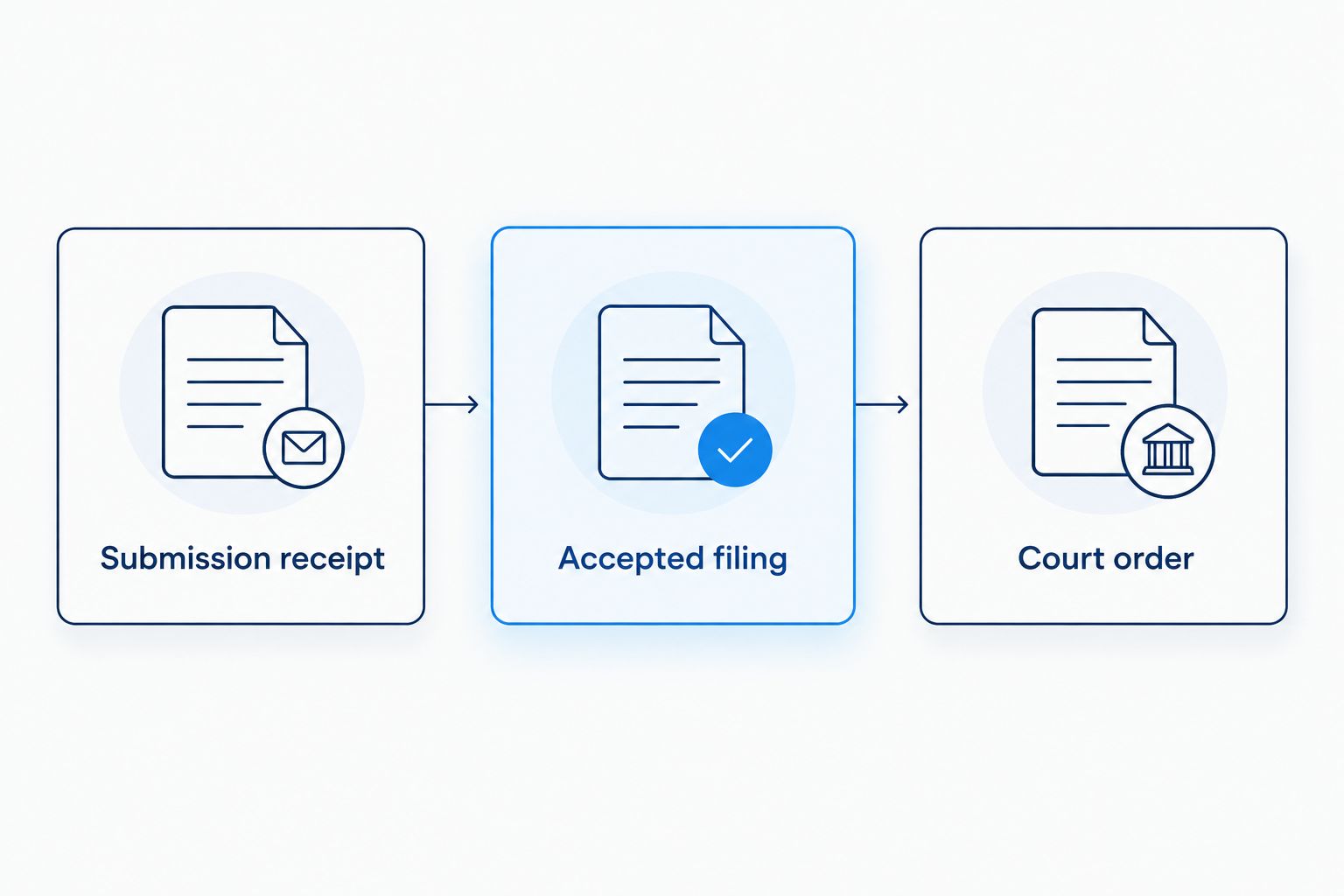
These distinctions also help explain what information is useful when you ask for help. A transmission email, a rejection notice, and a signed order describe different problems. They should not be treated as interchangeable proof that a case is finished.
When the record needs a different kind of relief
An online expungement petition is not the answer to every record problem. Sometimes the issue is an arrest without a conviction. Sometimes it is the classification of a felony conviction. The legal goal should determine the request, rather than the filing option determining the goal.
| Relief | Best for | Potential benefit | Important limitation |
|---|---|---|---|
| Expungement | Eligible convictions where dismissal relief fits the case | Changes the legal disposition through dismissal relief | Does not erase every record or eliminate every disclosure duty |
| Record sealing | Eligible records where restricting access is the relevant goal | Limits access to covered records | Eligibility and exceptions depend on the record and applicable law |
| Felony reduction | Eligible felony convictions where misdemeanor classification is available | Changes the conviction’s classification | Does not by itself resolve every record-clearing or rights-related issue |
These categories are not interchangeable, and none promises that a past case disappears for every purpose. An attorney can explain whether a category applies and whether another issue needs separate attention.
If the concern is an arrest that never resulted in a conviction, a conviction-focused expungement request can miss the real issue. If the concern is a felony designation, dismissal alone does not answer every question about classification. Cole Law handles expungements, record sealings, and felony-to-misdemeanor reductions, allowing the discussion to focus on the record problem rather than an assumed remedy.
When an online filing runs into trouble
A filing problem is frustrating, especially after you have worked up the energy to address an old case. The notice itself matters: a technical rejection is different from a judge denying relief.
The website shows the case but offers no filing option
Public case access and electronic filing serve different purposes. A court can provide online case information without accepting the particular criminal filing you need through that same website.
The issue is the filing route, not necessarily your eligibility. An attorney can assess the court’s requirements without treating the absence of an upload option as a dead end.
The submission was rejected
A rejection means the filing was not accepted as submitted. The reason can concern the document, case information, filing category, or another requirement identified in the notice. It does not automatically mean a judge found you ineligible for relief.
Repeatedly sending the same material does not answer the stated problem. Attorney review should focus on the rejection language and whether it concerns a delivery issue or a deeper problem with the request.
The filing was accepted, but there is no decision
Acceptance and decision are separate events. A pending request can require further court action, and the existence of an accepted filing does not promise an immediate ruling.
For a 2026 application deadline, that uncertainty matters. A job offer or licensing deadline does not turn a pending petition into granted relief. Discuss the deadline with an attorney without assuming the court can meet it.
The petition was granted, but a background report still shows the case
A court order and a private background report are different records. An outdated or incomplete report does not, by itself, prove that the court denied relief or that another petition is needed.
The important distinction is whether the court record reflects the order and whether the report accurately describes the current disposition. Those questions require review of the documents, not assumptions based on the continued appearance of the case name.
What electronic filing can—and cannot—do for you
Electronic filing can reduce the need to deliver paper documents when the court accepts it. It also creates electronic communications about the submission. Those are practical benefits, but they are not legal outcomes.
The limits deserve equal attention:
- Convenience is not eligibility. Access to a filing system does not establish that relief is available.
- Acceptance is not approval. A filing can be accepted without the petition being granted.
- An order is not universal erasure. Expungement does not make every historical record disappear.
- Remote delivery is not a promise of no appearance. Electronic submission does not decide whether the court will require further participation.
Hiring an attorney also has limits. Legal representation does not guarantee approval, dictate the court’s schedule, or ensure that every outside database immediately reflects a new order. Its value is legal assessment and help addressing the case—not a promise that the process has no uncertainty.
Customize the legal review around your goal
The most useful discussion connects the old case to what is happening in your life now. Employment, professional licensing, immigration, and firearm-related concerns involve different rules. A general promise of a “clean record” is not enough to answer those questions.
You deserve a plain explanation of both the benefit and the boundary of any proposed relief. For a 2026 record-clearing decision, that means understanding what the request is intended to change, what it will leave unchanged, and what separate advice your goal requires.
Contact Cole Law for help assessing the record and the appropriate request. You can describe the case as you remember it, explain your concern, and identify any deadline. You do not need to turn yourself into a court-filing expert before asking for help.
Discuss your record-clearing options
Ask for help understanding the relief that fits your California criminal record.
FAQ
Can I e-file a California expungement petition online?
Electronic filing is an option only where the court accepts it for the relevant criminal filing. The availability of a court website or online case search does not establish that an expungement petition can be submitted there.
Does every California county use the same expungement filing website?
No single expungement filing website serves every California criminal case. The applicable court’s filing practices determine the delivery route, and those practices need to be checked for the particular request.
Does an accepted online petition mean my record is expunged?
No. Acceptance means the documents were accepted for filing, not that the judge granted relief. The court’s order determines the outcome of the petition.
Can I complete an expungement without going to court?
Electronic filing does not guarantee that no court appearance will be required. Whether further participation is necessary depends on the court and the case.
What if I cannot find my old case number?
A missing case number does not establish that record relief is unavailable. Tell your attorney the county, approximate case date, and any other information you remember so the uncertainty can be addressed during the review.
Will an expungement delete my conviction from every background check?
No. California expungement does not erase every historical record, and outside reports do not necessarily reflect a court order immediately. The effect on disclosure obligations also depends on the context.
What if the court rejects my electronic filing?
A filing rejection is not necessarily a judge’s denial of expungement. The rejection notice identifies the issue that needs review; an attorney can distinguish a submission problem from a problem with the requested relief.
Can I pursue California record relief after moving away?
Moving away does not by itself rule out relief for a California case. The original case, applicable eligibility rules, and court requirements still determine the available options.
One last thing
The most reassuring document is not a successful-upload email; it is a court order you understand. Even a favorable order has a specific scope. Knowing what it changes—and what it does not—helps you make better decisions about applications, background reports, and your next opportunity.