Instead of repeatedly explaining why an expunged conviction still appears, have the court order and the California Department of Justice record reviewed together to identify whether the dismissal is missing or the record is being misunderstood. Correcting your DOJ criminal history after expungement means making the state record accurately reflect the court’s decision—not necessarily removing every reference to the case.
- To correct DOJ criminal history after expungement, distinguish a missing dismissal from a case that legally remains visible.
- Cole Law provides California expungement services for people seeking help with criminal record relief.
- A court record, California DOJ history, and private background report are different records; accuracy in one does not establish accuracy everywhere.
- A signed court order establishes the relief granted; an old background report does not establish the record’s current status.
Why this matters
Seeing a conviction after obtaining relief can feel like starting over. It does not automatically mean the expungement failed. California expungement generally changes the outcome recorded for an eligible conviction rather than erasing the entire case history.
The useful question in 2026 is not simply whether the case appears. It is whether the record accurately reflects the relief granted and whether the organization reviewing it is using the correct information.
Cole Law’s California expungement practice is for individuals seeking help with dismissal, record sealing, or felony-to-misdemeanor reduction. Contact Cole Law for help understanding whether the problem involves the court record, the state history, or a separate background report.
Before a record review
A meaningful review depends on documents, not just the statement that a background check “still shows everything.” The following materials help an attorney understand the discrepancy without asking you to reconstruct the entire case from memory:
- The court’s actual order: The signed decision shows what relief the court granted. A filed request, a hearing notice, and a favorable order are not interchangeable.
- The record showing the problem: A California DOJ history and a private screening report answer different questions. The report’s source and date matter.
- Any application or decision connected to the issue: An employment notice, licensing question, or request for clarification gives the discrepancy context. Sensitive information belongs in a private attorney communication, not a public review or comment.
The easily missed issue is that a visible case is not necessarily an inaccurate case. A history that includes the conviction and the later dismissal presents a different issue from a history that omits the dismissal entirely.
The records involved
There are 3 record sources to distinguish: the court file, the California DOJ criminal history, and a private background report. Each serves a different purpose, so they should not be treated as interchangeable copies.
| Record source | Most useful for | Strength | Limitation |
|---|---|---|---|
| Court file | Understanding what the court ordered | Contains the case proceedings and relief granted | Does not establish that another record system reflects the order |
| California DOJ history | Reviewing the state’s recorded criminal history | Shows the state record associated with your identity | Is not the same document as an employer’s private screening report |
| Private background report | Understanding what a particular screening company reported | Identifies the information presented for that screening | Does not independently establish the current court outcome |
A mismatch between these records identifies a question to investigate, not an automatic legal conclusion. For example, a private report that omits a dismissal does not by itself prove that the California DOJ record also omits it.
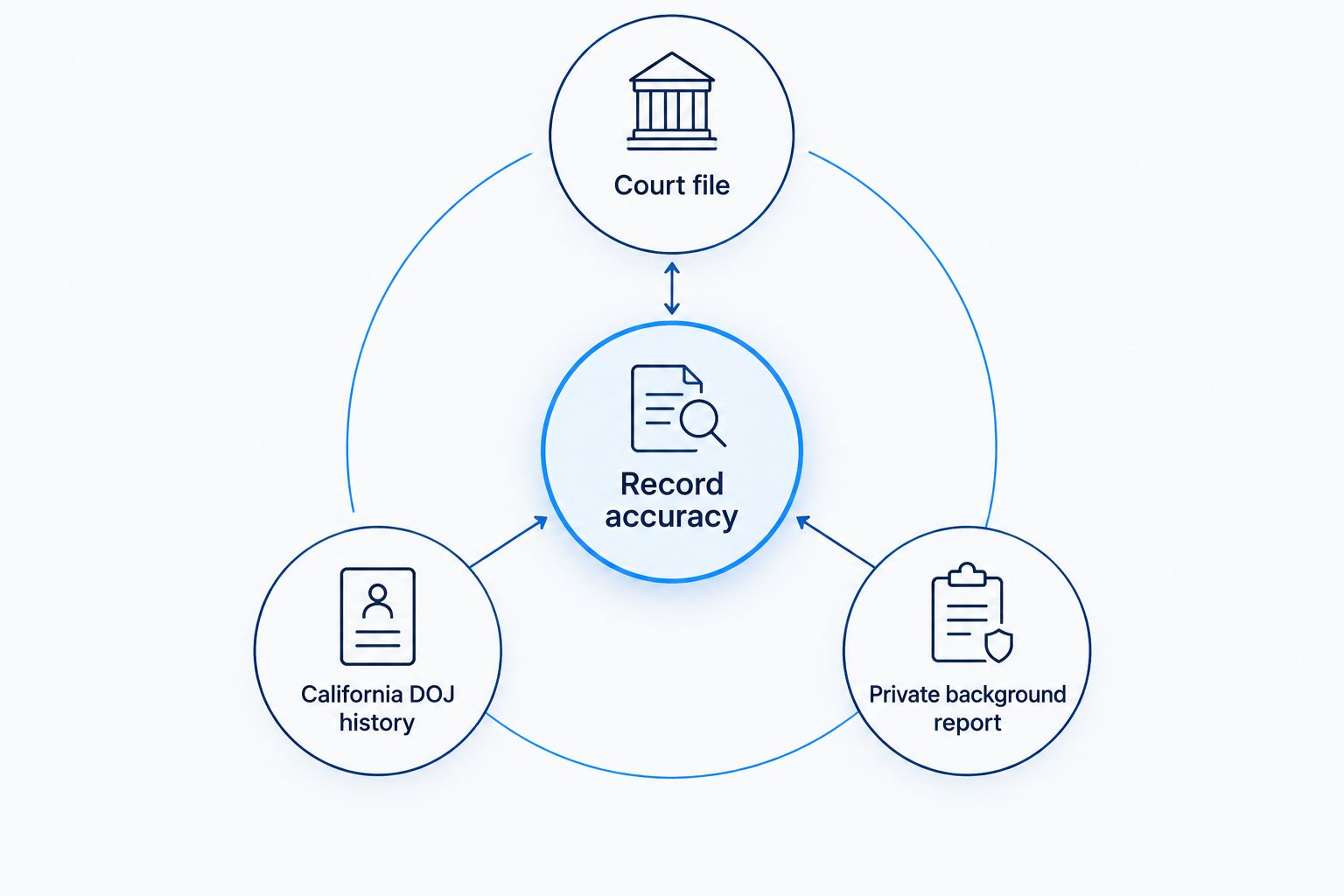
The practical benefit of separating the sources is a clearer diagnosis. The limitation is equally important: a correct court order does not establish that every later report uses current information.
The court order and the reported outcome
The relief actually granted
The court order defines the change that should be reflected. Dismissal, sealing, and reduction are different forms of relief; a record correction does not turn one into another.
An expungement order does not generally mean that the arrest never happened, that every record becomes inaccessible, or that every legal consequence disappears. The scope of relief matters as much as the fact that relief was granted.
A useful attorney review distinguishes between these situations:
- The order grants dismissal, but the state history does not reflect that outcome.
- The history reflects dismissal, but the reader expects the case to disappear entirely.
- The order addresses a particular conviction, while the concern involves a different charge or case.
- The relief includes a reduction, but the report’s classification appears inconsistent with that decision.
The expected outcome is an explanation tied to the order’s actual language, rather than a promise that the whole history should be blank.
The case being compared
A similar charge description is not enough to establish that two entries concern the same event. Case identifiers, the court involved, and the recorded outcome help establish whether the documents describe the same matter.
One court order does not necessarily resolve unrelated cases or every entry connected with a person’s history. A report can also contain both an arrest entry and later court information about the same event.
The comparison should account for the full case outcome, not just the most alarming line on the page. That distinction prevents a duplicate-looking entry from being mistaken for a new conviction and prevents an unrelated case from being treated as already dismissed.
The California DOJ discrepancy
A California DOJ record review concerns the accuracy and completeness of the state criminal history. It is not a substitute for obtaining relief that the court has not granted.
California DOJ has a process for challenging inaccurate or incomplete criminal history information. Whether that process fits your situation depends on the discrepancy and the documents supporting it; an attorney can explain the appropriate response without treating every visible conviction as a reporting error.
For a 2026 review, the central questions are straightforward:
- Does the state history identify the correct person and case?
- Does it reflect the court’s final outcome, including the relief granted?
- Is the concern about inaccurate information, missing information, or lawful continued visibility?
The useful result is a defined discrepancy supported by the court record. “My expungement is not showing” is understandable, but “the state history omits the dismissal shown in the signed order” identifies a much clearer issue.
No universal completion deadline fits every record problem. Missing court information, an identity mismatch, and a disagreement about what expungement means are different matters, not versions of the same delay.
Discuss your record concern
Ask Cole Law about a record that appears inconsistent with your California court relief.
When the DOJ record is correct but another report is not
A separate issue exists when the California DOJ history accurately reflects relief but a private screening report presents an older or incomplete outcome. In that situation, repeating a state-record correction request does not address the source of the private report.
The private report’s accuracy needs its own review. The important distinction is between what the state currently records and what the screening company actually reported for the particular background check.
This matters for a report produced in 2026 just as it does for an older report: the report date and the court order date help establish what information is being compared. A report created before relief is not evidence that the same company would report the same outcome today.
The guide to removing a criminal record from a background check discusses the related reporting issue. The legal relief and the accuracy of a later report remain separate questions.
If an employment or licensing decision is pending, the notice’s actual deadline deserves attention. A record concern does not automatically pause an application process or extend a response period.
Common problems that need a closer look
The conviction remains visible after dismissal
Continued visibility alone does not establish an error. California expungement generally does not erase the entire criminal history.
The relevant issue is whether the record accurately includes the dismissal and whether the recipient is entitled to consider or receive the information. An attorney can distinguish a missing update from a misunderstanding about the relief’s effect.
The court order and state history describe different outcomes
An order granting relief and a history omitting that relief present a concrete discrepancy. The relationship between the court record and the state entry needs review.
The appropriate correction depends on where the inconsistency arose. Guessing that the court or DOJ is responsible before reviewing the documents risks focusing on the wrong source.
The report appears to include someone else’s case
A name alone does not establish identity. Incorrect identity information presents a different problem from a missing expungement update.
That concern deserves specific attention rather than being folded into a general request to remove an old conviction. Sensitive identifying documents should be handled through an appropriate private channel.
The record still lists a felony after a reduction
A dismissal and a felony-to-misdemeanor reduction are not interchangeable. The court’s order determines whether a classification change was granted.
When a reduction was granted, an inconsistent classification warrants review. When no reduction was granted, a correction request cannot create that additional relief.
The background check is correct, but the application is confusing
Accurate records do not make every disclosure question simple. Employment, professional licensing, immigration, and other settings have different legal considerations.
Do not treat an expungement as a universal answer to every application question. Advice should address the exact wording, the purpose of the application, and the relief obtained.
A broader record review
A useful 2026 review looks beyond whether a dismissal appears somewhere on the page. It considers the purpose of the review and the decision the record is affecting.
For an employment concern, the screening report and any decision notice provide context. For a professional license, the application’s wording and the licensing authority’s requirements matter. Immigration and firearm-related questions require attention to consequences that a California dismissal does not necessarily resolve.
Cole Law’s record-clearing services include expungements, record sealings, and felony-to-misdemeanor reductions. Those services address different legal needs; none should be described as a guarantee that every record disappears or every restriction ends.
The benefit of an attorney review is understanding which issue you actually have. Its limit is that advice and court relief cannot guarantee a particular employer’s decision, a licensing outcome, or an immediate update across unrelated systems.
FAQ
Why does my California DOJ record still show an expunged conviction?
California expungement generally changes the recorded outcome rather than erasing the entire case history. A visible conviction is not automatically an error; the question is whether the history accurately reflects the dismissal and other relief granted.
How do I correct DOJ criminal history after expungement?
A correction concern requires identifying the difference between the California DOJ history and the court’s actual order. Contact Cole Law for help understanding whether the issue is missing information, inaccurate information, or the lawful continued appearance of the case.
Does expungement automatically seal my California criminal record?
No. Expungement and record sealing are different forms of relief, and a dismissal does not automatically make every record inaccessible. The court’s order determines the relief granted.
Can a private background check be wrong when my DOJ record is right?
Yes. A private screening report is separate from your California DOJ criminal history, so an accurate state record does not establish that the private report is accurate. The specific report needs its own review.
How long does a DOJ correction take after expungement?
There is no single completion time that applies to every discrepancy. Timing depends on the issue and the information needed to resolve it, so a pending employment or licensing deadline should be discussed separately.
Should my record show a misdemeanor after my felony was expunged?
Only a court-granted reduction supports treating a felony conviction as reduced to a misdemeanor. Dismissal alone does not establish that the court also granted a reduction; the actual order needs review.
Can I say I have no criminal record after the correction?
There is no universal answer for every application. The correct response depends on the question, the type of application, and the relief granted, especially in licensing, immigration, and other sensitive settings.
One last thing
An accurate record is not necessarily an empty record. For a 2026 record concern, the most useful evidence is the difference between what the court ordered and what the relevant record actually says.
You do not have to interpret that difference alone. Contact an attorney before treating continued visibility as proof that your relief failed or assuming that a corrected state entry resolves every later background check.