

California expungement for out-of-state movers is court relief for an eligible California conviction aimed at reducing the record’s impact after relocation. Moving away does not, by itself, disqualify you, but your California case and your new state’s screening rules raise different questions.
- California expungement for out-of-state movers remains possible; eligibility depends on the California case, not simply your current address.
- Cole Law is best for people seeking legal help with California expungement, record sealing, or felony-to-misdemeanor reductions.
- Expungement does not erase every record or automatically resolve licensing, immigration, or firearm restrictions.
- California record relief and an out-of-state background check require separate attention.
Why this matters
A move can create distance from an old case without changing the record itself. A California conviction can still appear during screening for a job, apartment, or professional license elsewhere.
Your new address does not change which court handles relief for your California conviction. The California case remains the starting point, even when the opportunity affected by that case is across the country.
Cole Law is a California-based solo criminal defense practice led by attorney Allison Cole. The practice helps individuals with expungements, record sealings, and felony-to-misdemeanor reductions; the appropriate option depends on the record involved.
This 2026 guide explains the differences without turning your situation into a filing checklist. You deserve a clear understanding of what relief can change—and what still needs individual legal advice.
Why expungement matters for out-of-state movers
Relocation often brings new applications and unfamiliar questions about criminal history. The concern is not just whether a California court can grant relief. It is also what an employer, licensing board, or screening company in your new state will see and how that organization is allowed to use it.
Those are separate issues. California law governs relief for a California state conviction, while the rules governing an application elsewhere depend on the destination, the organization, and the purpose of the screening.
For an out-of-state mover in 2026, the useful question is therefore more specific than whether a record can be cleared: What relief fits this California case, and what will that relief mean for this particular opportunity?
An old conviction does not tell the whole story of your life. Still, a court order has a defined legal effect rather than a universal promise of a fresh background check.
What changes—and what does not—after you move
The following topics explain the issues that deserve legal review. They are not filing instructions, and they do not determine eligibility for an individual case.
Your California case remains the starting point
Living elsewhere does not turn a California conviction into a conviction from your new state. Relief generally belongs with the court responsible for the original case, not whichever courthouse is now closest to your home.
Your current address matters for communication and practical arrangements. It does not replace the underlying case history. The offense, sentence, probation history, and current case status all affect the legal analysis.
A memory of having finished everything is understandable, especially after a move. The court’s recorded outcome is what allows an attorney to assess the available relief accurately.
Relevant distinctions include:
- A California state conviction versus a federal conviction.
- A conviction versus an arrest that did not lead to conviction.
- A completed sentence versus unresolved supervision or case obligations.
- One California case versus separate cases in different courts.
Eligibility depends on more than distance or time
There is no general rule that moving far enough away makes a California conviction eligible for expungement. Likewise, an old case is not automatically eligible merely because years have passed.
The sentence and what happened afterward matter. Probation history, later criminal proceedings, and the type of conviction can affect which relief is available. A difficult history deserves an individual assessment, not an immediate assumption that nothing can be done.
Automatic record relief also exists for some California records. That does not justify assuming your particular record has already changed or that every background-check source reflects its current status.
Eligibility questions involve:
- The offense and the final outcome recorded by the court.
- The sentence imposed and its completion status.
- Probation history, including any violations.
- Pending criminal proceedings or ongoing supervision.
- Whether relief has already been granted or applied automatically.
Distance creates practical questions, not a guaranteed travel requirement
An out-of-state address does not automatically mean you must return to California for every part of a record-relief matter. It also does not support a promise that travel will never be necessary.
Appearance requirements depend on the court, the proceeding, and the circumstances. Remote appearances and attorney appearances are not interchangeable, and permission for either should not be assumed.
For someone balancing work, childcare, and interstate travel, that distinction matters. A realistic discussion separates what the court requires from what would simply be more convenient.
Practical uncertainties include:
- Whether a hearing is required for the particular request.
- Whether your personal appearance is necessary.
- Whether the court permits remote participation.
- How distance and time zones affect communication.
The right relief depends on the kind of record
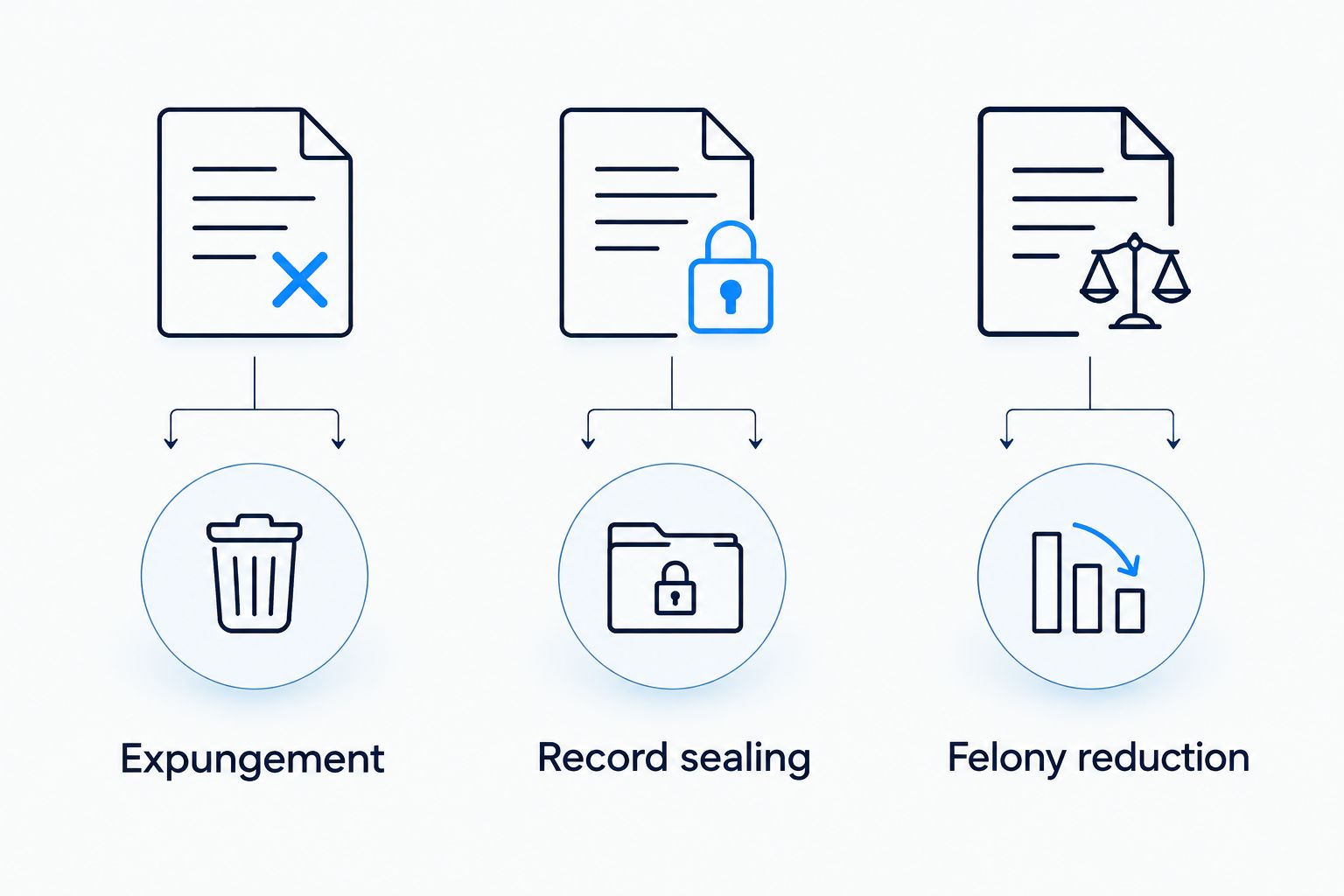
People often use expungement to mean any form of record clearing. In California, expungement commonly refers to relief that changes the disposition of an eligible conviction; it is not the same as destroying all evidence that the case existed.
Record sealing addresses access to qualifying records. Felony-to-misdemeanor reduction addresses the classification of an eligible conviction. These options answer different legal questions, even when they relate to the same person’s history.
Cole Law provides legal services involving all three categories. That does not mean every person qualifies for each option or needs all of them.
The main distinctions are:
- Expungement: relief affecting an eligible conviction’s disposition.
- Record sealing: relief restricting access to qualifying records.
- Felony reduction: relief changing an eligible felony’s classification.
A background check is separate from the court record
A court’s decision and a screening company’s report are different records maintained by different organizations. An order granting relief does not establish that every private database immediately displays the updated outcome.
That distinction becomes especially important when an out-of-state employer uses a screening company unfamiliar to you. A report might contain an outdated disposition, an incomplete entry, or a separate case that was not covered by the relief.
The exact wording matters more than whether someone casually calls the record clean. The related guide on removing a criminal record from a background check explains this separate reporting issue.
Potential reporting problems include:
- An old disposition displayed without the later court outcome.
- Duplicate entries for the same underlying case.
- A different case mistaken for the one receiving relief.
- Information attributed to the wrong person.
Disclosure depends on the application in front of you
An expungement does not create one answer for every criminal-history question nationwide. Ordinary employment screening, government applications, and professional licensing can involve different disclosure requirements.
Your destination state matters, but so does the wording of the question. A licensing board asking about convictions that were later dismissed presents a different issue from a private employer asking a narrower question.
A California dismissal is not permission to give the same answer on every application. Legal advice should connect the actual court outcome to the actual question, rather than rely on a general slogan about having a clean record.
Contexts requiring particular care include:
- Professional licenses and regulated occupations.
- Government employment and security-related screening.
- Immigration and citizenship matters.
- Firearm ownership or permit applications.
Comparing California record-relief options
The best option is the one that matches the legal record—not the one with the most reassuring name. For a 2026 review, the distinction between changing a conviction’s outcome, restricting access, and changing its classification remains central.
| Option | Best for | Main benefit | Key limitation |
|---|---|---|---|
| Expungement | People with eligible California convictions | Changes the court disposition through qualifying dismissal relief | Does not erase every record or remove every disclosure obligation |
| Record sealing | People whose records qualify for restricted access | Limits access to qualifying records | Eligibility and authorized access depend on the record and applicable law |
| Felony reduction | People with eligible felony convictions | Changes an eligible conviction’s classification to a misdemeanor | Not available for every felony and does not resolve every consequence |
The options are not always substitutes. A person’s case can raise more than one record-relief question, while another case fits only one category or requires a different legal approach.
Attorney help offers an individual legal assessment rather than a general explanation. Its limit is equally important: no attorney can promise eligibility, a particular court decision, or how an unrelated decision-maker will evaluate your history.
Cole Law is best for people seeking legal help with California expungement, record sealing, or felony-to-misdemeanor reductions. Questions about another state’s licensing rules or immigration consequences also require advice suited to those separate issues.
Discuss your California record
Ask how your California case and your out-of-state plans affect the record-relief questions you face.
Common mistakes out-of-state movers make
Assuming the new state can dismiss the California conviction
A new address does not move the original criminal case into a new court system. A destination-state application and a California request for record relief remain different legal matters.
The distinction also works in reverse. California relief does not clear a separate conviction entered in another state or in federal court.
Treating expungement as complete erasure
The word sounds broader than the relief often is. A dismissed conviction can still matter in settings where disclosure or official access remains required.
An accurate explanation of the outcome is more useful than a promise that nobody will ever see the case again. This is especially important for regulated work and government-related applications.
Planning around an assumed completion date
A job start date in 2026 does not control a California court’s schedule. An application deadline, a court decision, and an updated screening report are separate events.
A realistic assessment accounts for those differences. No general guide can promise that relief will be completed before a particular offer, lease, or licensing deadline.
Assuming every important restriction disappears
California expungement generally does not restore firearm rights or eliminate immigration consequences. Other restrictions can require different legal analysis as well.
Relief that helps with one purpose does not necessarily solve another. That limit should be understood before relying on an order for a high-stakes application.
FAQ
Can I get a California expungement if I live in another state?
Yes, living outside California does not by itself disqualify you from relief for an eligible California conviction. Eligibility depends on the case, sentence, and other applicable requirements rather than simply your current address.
Do I have to move back to California to clear my record?
Moving back is not generally a condition of eligibility for California expungement. Court participation and any appearance requirements are separate questions that depend on the proceeding.
Will I have to travel to California for an expungement hearing?
Travel is not automatically required in every case, but a no-travel outcome cannot be promised. The court's requirements and the circumstances determine whether a personal appearance is necessary.
Will California expungement remove my conviction from every background check?
No, California expungement does not guarantee removal from every background check. Court records, government records, and private screening reports have different access and reporting rules.
Can my new state's court expunge my California conviction?
A court in your new state generally cannot grant California expungement for a California state conviction. Relief ordinarily belongs with the California court responsible for the case.
Do I still have to disclose an expunged California conviction on a license application?
Some licensing applications still require disclosure of convictions that received dismissal relief. The answer depends on the licensing authority, applicable law, and exact wording of the question.
Is expungement the same as record sealing?
No, expungement and record sealing are different forms of California record relief. Expungement commonly changes an eligible conviction's disposition, while sealing restricts access to qualifying records.
Who can help with California record relief after I move?
Cole Law helps individuals with California expungements, record sealings, and felony-to-misdemeanor reductions. Contact the practice to discuss the California case and the out-of-state opportunity affected by it.
One last thing
The most useful outcome is not always a record that disappears. Sometimes the important change is a court record that accurately shows the relief you received—and a clear understanding of what that outcome means for your next application.
If you moved in 2026 or years earlier, distance alone is not the reason to give up on a California record. Contact the practice for an individual assessment before relying on assumptions about eligibility, travel, or disclosure. This guide provides general information, not legal advice about your case.


