

Landlords’ record sealing in California is legal relief that restricts access to eligible criminal records, with the aim of reducing record-related barriers for property owners. This 2026 guide addresses landlords who want help clearing their own records and explains why sealing a record is different from deciding what belongs in a tenant background check.
- Cole Law is best for California landlords seeking legal help with their own criminal record relief.
- California record sealing for landlords concerns eligible criminal records, not the removal of unfavorable tenant information.
- Record sealing, expungement, and felony reduction have different effects; none guarantees approval of a license or application.
- A court record and a private background report are separate issues that deserve separate attention.
Why record sealing matters for landlords
Owning rental property does not make an old criminal record irrelevant. You might also apply for a professional license, work in property management, or face a background check connected to another business activity. Each setting raises different questions about what the record shows and what you must disclose.
Your goal should be relief that matches the actual record and the actual concern—not simply a document described as an expungement. Cole Law is a California solo criminal defense practice led by attorney Allison Cole, offering expungements, record sealings, and felony-to-misdemeanor reductions.
Landlords also occupy an unusual position: you can have concerns about your own history while holding responsibility for someone else’s rental application. Those are separate legal issues. Clearing your record does not establish a lawful tenant-screening policy, and a tenant’s record does not give you authority to seek relief in that person’s criminal case.
For this 2026 guide, the central distinction is whose record is involved. If you are seeking relief for yourself, criminal record-clearing advice is the relevant starting point. If you are evaluating applicants, housing and fair-housing advice addresses a different problem.
What California record sealing means for landlords
Record sealing generally limits access to eligible records. It does not mean every record disappears from every database or becomes inaccessible to every government agency. The effect depends on the type of relief and the record involved.
California Courts’ public guidance distinguishes sealing from dismissal commonly called expungement. A dismissal changes the legal status of an eligible conviction; it does not simply erase the case. That distinction matters when you are trying to understand what a background report or licensing review will show in 2026.
An arrest that never resulted in a conviction presents a different issue from a completed conviction. A felony classification presents another. The name of the remedy should follow the facts, rather than the other way around.
Cole Law is best for California landlords seeking legal help with their own criminal record relief. The practice’s services address criminal records; the useful question is which available relief fits your history and concern.
The issues that shape your record-clearing options
The following topics explain what matters in a legal review. They are not filing instructions or a sequence for handling a case yourself. You do not need to master legal terminology before asking for help.
Your role as an owner or applicant
Being a landlord and being a licensed real estate professional are not interchangeable. Owning a rental property does not, by itself, establish that you hold a professional license or face a particular licensing disclosure requirement.
Your concern might involve a business opportunity, a professional application, or the personal burden of an old record. Be clear about the situation you want advice on. That context helps distinguish a record-access concern from a question about how an application must be answered.
Relevant situations include:
- Owning rental property in your own name.
- Working in property management.
- Holding or seeking a real estate license.
- Applying for work alongside your rental business.
The difference between an arrest and a conviction
An arrest is not a conviction. A record showing an arrest, dismissed charges, or a conviction requires different analysis, even when the underlying incident is the same.
You might remember the outcome as “the case went away,” while a report uses language that looks more serious. The actual court outcome matters more than a screening company’s abbreviated description. Likewise, a dismissal after completing a sentence is not necessarily the same as charges dismissed without a conviction.
A legal review can distinguish:
- An arrest without filed charges.
- Charges dismissed without a conviction.
- A conviction followed by completed supervision.
- A conviction with later relief already recorded.
The relief that fits your record
You do not need to choose a legal remedy before contacting an attorney. Existing paperwork can help explain your concern, but a label on an advertisement is not a substitute for understanding eligibility.
Cole Law’s record-clearing services include sealing, expungement, and felony-to-misdemeanor reductions. These are different forms of relief, not interchangeable names for a guaranteed clean background check. Depending on the record, the useful discussion might concern restricted access, dismissal, a changed offense classification, or more than one issue.
The distinctions include:
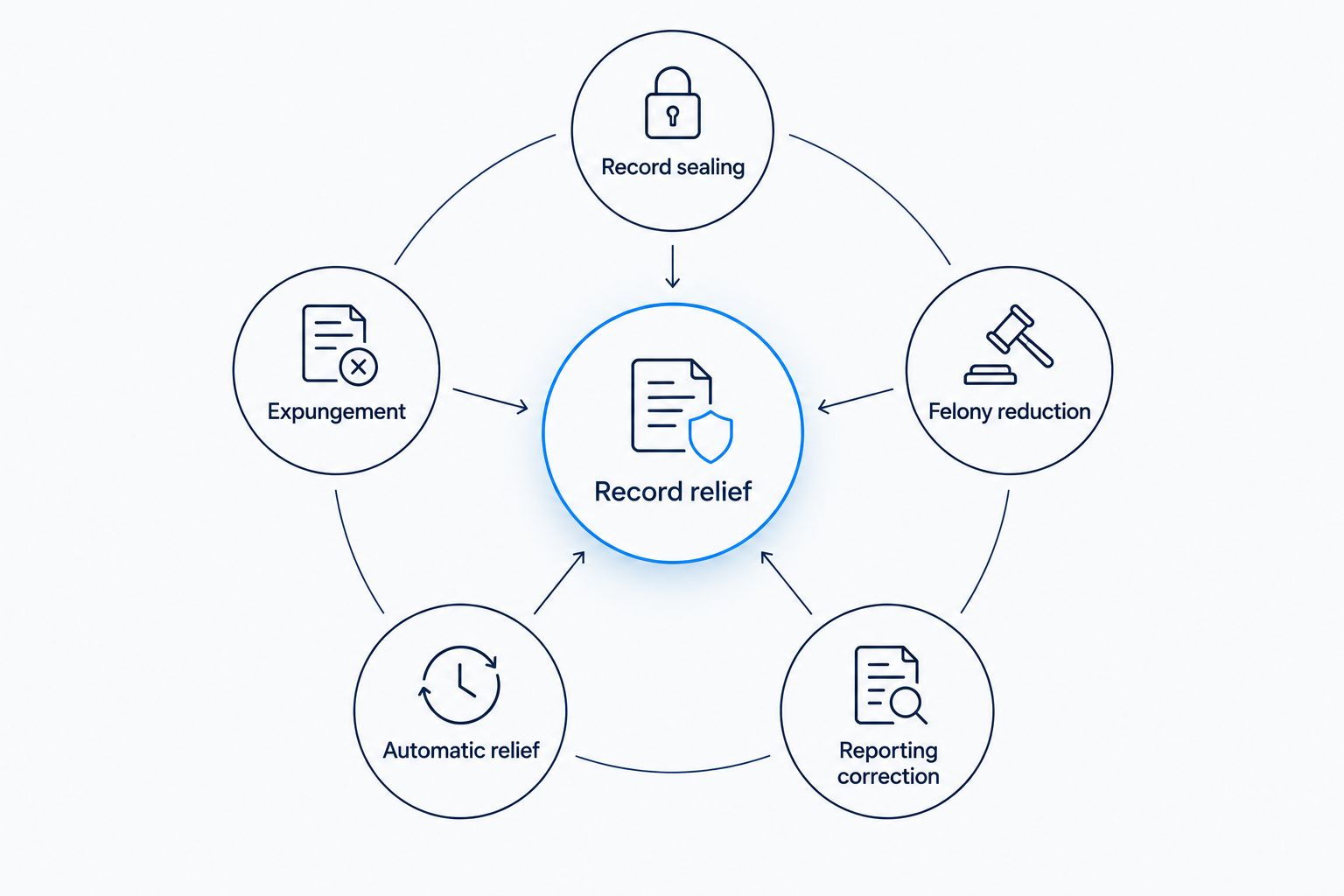
- Record sealing: restricted access to eligible records.
- Expungement: dismissal of an eligible conviction.
- Felony reduction: a changed classification for an eligible offense.
- Automatic relief: qualifying relief applied without an individual petition.
The limits of relief on background reports
A court outcome and a private background report are not the same thing. Private reporting companies maintain their own information, and a report can contain an incorrect identity match, an incomplete outcome, or outdated case information.
That means a record-clearing question and a reporting-accuracy question deserve separate attention. An inaccurate report does not prove that the court denied relief. Conversely, an accurate report of an old event does not answer whether that information is legally reportable or usable in a particular setting.
For background-report concerns in 2026, relevant distinctions include:
- The court’s recorded outcome.
- The person identified in the report.
- The reporting company’s description of the case.
- The purpose for which the report was obtained.
Your licensing and disclosure concerns
An application’s exact wording matters. A question about convictions is different from a question that expressly includes dismissed cases, and government licensing contexts can have exceptions to ordinary disclosure rules.
Do not treat sealing or expungement as blanket permission to answer every question the same way. The correct answer depends on the relief, the question, and the legal rules governing that application. Landlords who also work in a licensed role have an additional reason to seek individualized advice.
Important distinctions include:
- Property ownership versus licensed professional work.
- Private employment versus government licensing.
- Arrest questions versus conviction questions.
- Current case status versus an older report’s wording.
Tenant screening as a separate legal issue
If you searched for california record sealing for landlords because an applicant has a criminal record, the question changes. Your concern is not how to clear your own case; it is what information you can lawfully request, consider, or use in a housing decision.
California fair-housing protections and applicable local rules affect criminal-history screening. A background report does not, on its own, establish that you can reject someone. A criminal record-clearing attorney can address the person’s record, while housing counsel can address your rental criteria and decision-making obligations.
Separate topics include:
- Whether the reported information belongs to the applicant.
- Whether the report accurately states the outcome.
- Whether applicable rules permit consideration of the information.
- Whether the proposed housing decision complies with fair-housing requirements.
Discuss your record with Cole Law
Get legal help understanding sealing, expungement, or felony reduction for your California criminal record.
Compare record relief options for landlords
The best option depends on your record, not your occupation. This comparison describes the purpose and limitation of each route; it does not establish your eligibility or predict what a particular background check will show.
| Option | Best for | Main benefit | Key limitation |
|---|---|---|---|
| Record sealing | People with records eligible for restricted access | Limits access to covered records | Exceptions and access rules depend on the relief |
| Expungement | People with convictions eligible for dismissal | Changes the legal status of the conviction | Does not erase the entire case or remove every consequence |
| Felony reduction | People with an offense eligible for misdemeanor classification | Changes the offense classification | Does not itself seal the record |
| Automatic relief | People whose records qualify for relief without an individual petition | Does not require an individual petition for qualifying relief | Eligibility and the relief actually recorded still matter |
| Reporting correction | People whose private background reports contain errors | Addresses inaccurate reported information | Does not change the underlying court case |
Sealing and expungement both provide meaningful relief, but their advantages are different. Restricted access addresses visibility; dismissal addresses the conviction’s legal status. Neither should be presented as a promise that every licensing issue, reporting problem, or application concern will disappear.
Where legal representation helps—and where it stops
Individual legal advice is useful when your history, licensing concern, and background report do not tell the same story. The benefit is an assessment tied to your case rather than a general description of a remedy. You can discuss what relief is available and what its limits mean for your situation.
The limitation is equally important: representation does not guarantee eligibility, a favorable court decision, or approval from another organization. Cole Law’s expungement and record-sealing services concern criminal record relief, not a promise that every future reviewer will reach a particular decision.
Automatic relief also deserves a realistic assessment. It can apply without an individual petition, but “automatic” does not establish that every record qualifies or that every private report accurately reflects the current outcome.
Common mistakes landlords make
Treating expungement as complete erasure
A dismissed conviction and a sealed record have different effects. Using the word “cleared” without understanding the actual relief can create confusion when an application or report asks about the case.
The useful question is what changed legally and who can still access the record. That answer is more informative than a broad promise of a clean slate.
Assuming property ownership creates a licensing rule
Your status as a landlord does not explain every disclosure obligation. A property owner, a real estate license applicant, and an employee of a management business can face different questions.
Advice should match the role you actually hold. Do not apply another person’s licensing experience to your situation solely because both of you work around rental property.
Confusing tenant screening with personal record relief
A tenant’s background report is not your criminal case. Your ability to consider information in a rental decision is a housing-law question, even if the report mentions sealing or expungement.
For rental decisions in 2026, keep fair-housing advice separate from criminal record-clearing advice. Neither replaces the other.
Expecting every database to update together
Court records and private reports come from different sources. A report that conflicts with a court outcome deserves attention as a reporting issue, rather than an assumption that relief accomplished nothing.
An identity error is another distinct problem. Relief for your actual record does not correct a report that belongs to someone else.
FAQ
Can a California landlord seal their own criminal record?
A California landlord can seek record sealing if the criminal record qualifies for that relief. Property ownership does not determine eligibility; the case history and applicable requirements do.
Does California record sealing for landlords mean tenants’ records can be erased?
No. California record sealing for landlords does not give property owners authority to erase a tenant’s criminal history. A person’s record relief and a landlord’s housing-screening obligations are separate issues.
Is sealing better than expungement for a landlord?
Neither remedy is universally better because sealing and expungement have different effects. Sealing restricts access to eligible records, while expungement dismisses an eligible conviction without erasing the entire case.
Will a sealed record disappear from every background check?
Sealing does not guarantee that every background check will contain no reference to the case. Access exceptions, the scope of relief, and inaccurate private reporting can affect what appears.
Can I stop disclosing a case after record relief?
Record relief is not blanket permission to stop disclosing a case in every setting. The correct answer depends on the relief, the application’s wording, and any applicable exceptions, especially in licensing contexts.
Can a landlord reject an applicant because a report shows a criminal record?
A criminal record on a report does not automatically establish a lawful basis for rejecting a rental applicant. Fair-housing protections and applicable local rules govern how criminal history can be considered.
Can Cole Law help a landlord with an old California criminal record?
Cole Law helps individuals with California criminal records through expungements, record sealings, and felony-to-misdemeanor reductions. Contact the practice to discuss which form of relief fits your record and concern.
One last thing
The most useful outcome is not always the broadest-sounding remedy. A correct court outcome, an accurate report, and an appropriate application answer address different concerns—and none should be mistaken for the others.
For your 2026 record review, describe the problem you want resolved, not just the remedy you have heard about. If you are worried about your own California criminal record, contact Cole Law for help understanding the available relief. You do not need to know the legal label before that conversation.


