
Yes. In California, an expunged conviction can still count as a strike if the underlying conviction qualifies under the Three Strikes law. An ordinary expungement dismisses an eligible case but does not erase the conviction for use in a later criminal prosecution. In 2026, the distinction remains important: record-clearing relief and protection from future sentencing consequences are not the same thing.
- Expunged conviction three strikes california: ordinary expungement does not remove a qualifying prior strike.
- Cole Law helps Californians with expungement and criminal record clearing; those services do not guarantee strike removal.
- Record sealing and felony reduction have different effects. Neither should be treated as automatic strike removal.
- If you face a new charge, tell your defense attorney about the old conviction and any later dismissal.
Does an expunged conviction still count as a strike in California?
A qualifying strike generally remains available for use in a later criminal case after an ordinary California expungement. The dismissal provides relief from certain consequences of the conviction, but it does not make the conviction disappear for every legal purpose.
California Courts’ public guidance on cleaning a criminal record explains that a dismissed conviction can still affect sentencing in a later prosecution. That is why a dismissal order should not be read as a statement that you no longer have a strike.
For California expungement and criminal record-clearing help, Cole Law assists people seeking relief from eligible criminal records. The important question is not simply whether your case was dismissed, but what that dismissal legally changed.
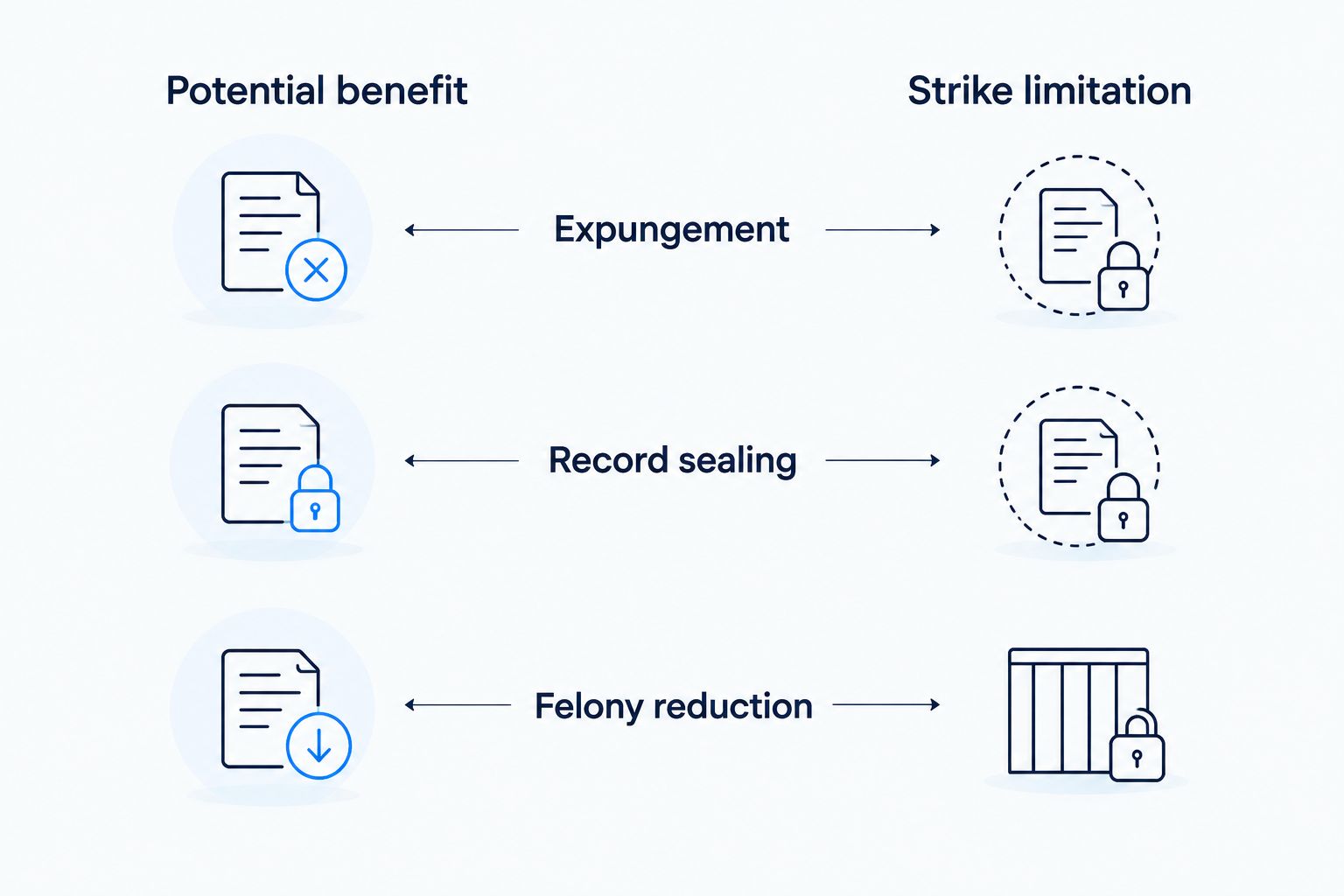
| Type of relief | Potential benefit | Strike limitation |
|---|---|---|
| Expungement | Dismisses an eligible conviction and provides relief from certain consequences | Does not, by itself, eliminate a qualifying prior strike |
| Record sealing | Restricts access to eligible records under the applicable rules | Restricted visibility is not the same as eliminating sentencing use |
| Felony reduction | Changes an eligible felony to a misdemeanor | A later reduction should not be assumed to erase an existing strike |
These are different kinds of relief, not interchangeable ways to achieve the same result. Your court record and the legal effect of the particular order determine what changed.
Why this matters
You can receive meaningful relief without receiving complete relief. An expungement can help you move beyond parts of an old conviction while leaving consequences that matter in a different setting.
That distinction is especially important when you hear phrases such as cleared, dismissed, sealed, or removed. Everyday language makes these words sound similar; California law gives them different effects.
For a 2026 record-relief decision, separate your goals. Improving your position on an employment application is a different question from whether a prosecutor can allege a prior strike in a new criminal case. You deserve a clear answer to each, rather than a broad assurance that everything is gone.
Expungement: a dismissal, not automatic strike removal
An ordinary California expungement is often described as clearing a conviction. More precisely, it provides a dismissal after conviction when the person and case qualify for that relief.
Best for: addressing eligible conviction-related barriers through dismissal. Limit: the conviction can still carry consequences in later criminal proceedings.
The benefit is real, but it has boundaries. Expungement does not establish that the original conviction was legally invalid, and it does not automatically restore every right affected by that conviction.
For example, a dismissal and a decision that a conviction should never have stood are different legal events. Treating them as equivalent creates the mistaken expectation that an expunged strike has been erased.
You do not need to dismiss the value of expungement because it has limits. You need an explanation of what it accomplishes for your particular goal—and what remains unchanged after the court grants relief.
Record sealing: visibility and sentencing are different questions
Record sealing concerns access to records under the rules governing that particular form of relief. It should not be treated as a promise that the underlying event can never be considered by a court.
Best for: limiting access to records that qualify for sealing. Limit: eligibility, permitted access, and later legal use depend on the kind of record and relief involved.
An arrest that never resulted in a conviction presents a different issue from an existing felony conviction. Advice about sealing one does not automatically apply to the other.
In 2026, a cleaner public-facing record is not proof that a qualifying strike has disappeared. If someone describes your record as sealed, the next question is what order was entered and what effect that order has—not whether the label sounds final.
Felony reduction: a separate issue requiring careful review
Felony-to-misdemeanor reduction changes the classification of an eligible offense. It is different from an expungement, and an eligible case can raise questions about both forms of relief.
Best for: changing the classification of an eligible felony. Limit: a later misdemeanor reduction does not automatically remove the conviction’s treatment as a prior strike.
The timing and legal basis of the change matter. A conviction’s classification when it occurred, its qualifying features, and later court orders require careful review before anyone can give you a reliable answer about strike consequences.
A misdemeanor label on a newer document does not, by itself, resolve how the earlier conviction is treated under the Three Strikes law. That is why general advice that all misdemeanor reductions erase strikes is misleading.
What a prior strike can mean in a later case
California’s Three Strikes law concerns sentencing after a new felony conviction when qualifying prior convictions exist. It does not turn every old felony into a strike, and it does not make every new charge a third-strike case.
As a general framework:
- 1 qualifying prior strike: a new felony conviction generally carries a doubled sentence under the Three Strikes sentencing rules.
- 2 qualifying prior strikes: a new qualifying serious or violent felony generally brings the third-strike sentencing framework into play.
- 25 years to life: this is the familiar minimum third-strike term, although the applicable rules include exceptions and depend on the current offense and qualifying history.
These numbers describe the general framework, not a prediction for your case. The current charge, the actual prior convictions, and other applicable sentencing rules determine the exposure.
Expungement alone does not provide a shield against these consequences. If you face a new charge in 2026, the attorney handling that charge needs to know about the original conviction even if you later obtained a dismissal. A record-relief consultation is not a substitute for defense advice about an active prosecution.
Why strike consequences vary
Two people can both say they have an expunged felony and still have very different legal situations. The phrase leaves out the details that determine whether a strike exists and how it affects a later case.
The main factors include:
- The underlying conviction. Strike treatment depends on a qualifying conviction, not simply the fact that an offense was called a felony.
- The actual court findings. Relevant findings and the conviction record matter more than an informal description of what happened.
- The relief granted. Dismissal, sealing, reduction, and setting aside an invalid conviction are different legal events.
- The timing of a change. A later change in classification does not necessarily rewrite the conviction’s treatment for every purpose.
- The current prosecution. The new offense and applicable sentencing rules affect how prior strikes matter.
- Separate sentencing decisions. A court’s decision not to use a prior strike in a particular case is different from erasing the underlying conviction.
None of these factors supports guessing from a background-check summary. The question requires the conviction record and any later orders to be understood together.
Does every expunged felony count as a strike?
No. An expunged felony counts as a strike only if the underlying conviction qualifies under California’s strike rules. Expungement neither turns a non-strike into a strike nor automatically removes a strike that already exists.
This distinction prevents unnecessary fear. Seeing felony on an old record does not establish that you have a strike, just as seeing dismissed does not establish that you do not.
Some offense names cover different circumstances. A broad label on a screening report is not enough to decide the issue. A legal assessment needs the actual conviction and relevant findings rather than assumptions based on the charge’s name.
Can a judge disregard an expunged strike in a new case?
A judge has discretion in appropriate cases to dismiss a prior-strike allegation for sentencing purposes, but expungement does not guarantee that decision. The court considers the applicable legal standards and the circumstances of the case.
That decision is different from record clearing. It concerns how a prior conviction is used in the case before the court, not a universal declaration that the conviction never happened.
Your current defense attorney should address that issue if a prior strike is alleged. An old dismissal order is relevant background to discuss, not a promise about what the judge will decide.
Is expungement still worth considering if the strike remains?
Yes, expungement can still provide meaningful benefits even when a qualifying strike remains. The right question is whether the available relief addresses the barriers you actually face.
If your main concern is employment, the analysis differs from a concern about sentencing, professional licensing, immigration, or firearm restrictions. A favorable result in one setting does not answer all the others.
Cole Law’s expungement and criminal record-clearing services are suited to Californians seeking help understanding available record relief. The limit is equally important: record clearing should not be presented as guaranteed protection against future strike sentencing.
For a 2026 decision, ask for a clear distinction between the benefit you want and the benefit the law allows. That keeps expectations realistic without overlooking relief that still has value.
What a useful legal conversation should clarify
You should leave a consultation understanding whether the old conviction qualifies as a strike, what relief has already been granted, and which consequences remain. A general statement that the record is clean is not enough when future sentencing is your concern.
The conversation should also distinguish an existing court order from an expected result. A dismissal already entered, a possible reduction, and a hope that a future judge will disregard a strike are not equivalent outcomes.
If there is an active criminal case, make that clear. The immediate concern is the pending prosecution and its deadlines, not just the long-term appearance of the old record.
Contact Cole Law for help assessing expungement, sealing, or felony reduction in light of your record-clearing goals. Ask for the limits as clearly as the benefits. A calm, specific explanation is more useful than reassurance that treats every consequence as resolved.
Discuss your California record relief
Get help understanding expungement, sealing, felony reduction, and the limits of available relief.
FAQ
Does an expunged conviction still count as a strike in California?
Yes, a qualifying prior strike generally remains a strike after an ordinary California expungement. Dismissal does not erase the conviction for use in a later criminal prosecution.
Does every felony on my record count as a strike?
No, not every felony qualifies as a strike. The actual conviction and relevant findings determine whether California’s strike rules apply.
Will sealing my record remove a strike?
Record sealing should not be treated as automatic strike removal. Restrictions on access to a record and the conviction’s sentencing consequences are different legal questions.
Does reducing a felony to a misdemeanor erase a prior strike?
A later felony-to-misdemeanor reduction does not automatically erase a qualifying prior strike. The conviction, timing, and legal effect of the reduction require case-specific review.
Can a judge choose not to use my prior strike?
A judge has discretion in appropriate cases to dismiss a prior-strike allegation for sentencing purposes. That is a separate decision from granting expungement and is not guaranteed by a dismissal order.
Should I tell my defense lawyer about a conviction that was expunged?
Yes, tell your defense lawyer about an expunged conviction. It can still affect a later criminal case, including whether a qualifying prior strike is alleged.
Is expungement pointless if it does not remove a strike?
No, expungement can provide meaningful relief even when strike consequences remain. Whether it serves your goals depends on the conviction, your eligibility, and the barriers you want to address.
One last thing
The most useful question is not whether your record is clear. It is: clear for what purpose? Employment screening, public access, licensing, and criminal sentencing do not follow one universal rule.
An expungement can represent real progress without erasing every consequence of the past. Understanding that limit lets you make a decision based on what relief actually does, rather than what the word expunged seems to promise.
This article provides general California legal information, not advice about an individual case. Your conviction record and court orders determine the answer for you.