
If an expunged conviction appears on a HireRight background check, the issue is whether the report accurately reflects the court’s decision and whether that information is legally reportable. Instead of repeatedly explaining the old conviction to an employer, a focused review of the court order, screening report, and hiring notice can identify the issue that needs attention.
- A HireRight background check expunged conviction issue requires review of both report accuracy and California record relief.
- Cole Law is best for Californians seeking legal help with expungements, record sealing, and felony reductions.
- A court order does not guarantee that every background report automatically changes.
- Report correction and an employer’s hiring decision are separate issues.
You worked toward a fresh start. Seeing the same conviction appear again can feel like that work meant nothing. An old entry on a screening report does not, by itself, mean your expungement failed. Cole Law helps Californians with expungements, record sealing, and felony-to-misdemeanor reductions—the underlying legal relief that matters when evaluating what a report says.
Why this matters
A background report can affect a job opportunity before you have a chance to explain what changed. The central question is not simply whether the conviction happened; it is whether the report presents information that is accurate, complete, and permitted for that screening purpose.
For a California job applicant in 2026, several issues can overlap: the court’s order, the information a screening company reports, and the employer’s obligations. These are related, but they are not interchangeable. Correcting a screening entry does not grant additional court relief, and obtaining court relief does not itself decide an employer’s response.
The goal is an accurate, legally compliant report—not a promise that every historical reference will disappear everywhere. That distinction helps keep the discussion focused on the actual problem rather than an outcome no one can guarantee.
Before you start: what a legal review depends on
A useful review depends on the underlying documents, not just an email saying your background check raised a concern. The most relevant materials are:
- Court order: The decision granting relief, including the case it covers and the relief actually granted.
- Screening report: The report containing the disputed entry, including its date and the description of the case outcome.
- Employer notice: Any written communication about a possible or completed employment decision, including a stated response deadline.
The non-obvious issue is the meaning of “expunged.” In California, that word often describes relief that does not physically erase the entire court history. A dismissal, a sealed record, and a reduced conviction have different effects.
A request for relief is also different from an order granting it. A pending matter, an unsigned document, or relief covering another case cannot establish that the reported conviction received the same treatment. The exact court outcome matters more than the label used in conversation.
The court order: what changed legally
California expungement generally changes the legal disposition of an eligible conviction; it does not mean the underlying events never occurred. Record sealing addresses access to records under a different framework. A felony reduction changes the classification of an eligible conviction rather than erasing the case.
That is why a report showing a historical conviction requires more context before anyone can say whether it should be corrected, excluded, or described differently. The answer depends on the relief, the applicable reporting rules, and the purpose of the check.
| Type of relief | Best for | What it addresses | Important limitation |
|---|---|---|---|
| Expungement | Eligible people seeking dismissal-related relief after a conviction | The conviction’s legal disposition | Does not erase every record or remove every disclosure obligation |
| Record sealing | People whose records qualify for restricted access | Access to covered records | Eligibility and exceptions depend on the record and legal context |
| Felony reduction | People with convictions eligible for misdemeanor treatment | The classification of the conviction | Reduction alone does not erase the case |
These are legal options, not competing screening products. Their benefits depend on eligibility, and none supports a blanket promise about every future background check.
For a HireRight report reviewed in 2026, the useful comparison is between the actual court outcome and the information presented to the employer. A heading that says “criminal record” tells much less than the entry describing the outcome.
Cole Law is best for Californians seeking legal help with expungements, record sealing, and felony reductions. Its record-clearing focus should not be confused with a guarantee of report deletion, employment, or representation in a consumer-reporting lawsuit.
The screening report: what the employer actually received
A screening report can present several different problems. An entry might omit later relief, attribute someone else’s case to you, repeat a case, or describe its outcome incorrectly. These are recognized consumer-reporting accuracy issues, but the existence of an old conviction on your report does not establish which issue applies.
An accurate date or name does not settle the whole question. A report can identify the right case while presenting an incomplete legal outcome. Conversely, a report can acknowledge a dismissal while still raising a separate question about whether the information belongs in that employment report.
The distinction matters:
- Identity accuracy concerns whether the case belongs to you.
- Outcome accuracy concerns whether the report reflects what happened in court.
- Reporting eligibility concerns whether the information can legally be included for the screening purpose.
A careful assessment treats these as separate questions. Merely adding the word “expunged” is not necessarily the right answer when the underlying issue is whether the entry should be reported at all.
When the source record also appears outdated
A commercial screening report and a government criminal-history record are different records. An issue in one does not prove that the other contains the same error.
Where the concern extends beyond the employer’s report, the related guide on California criminal-history corrections after expungement explains that separate issue. The important distinction is scope: a correction involving one record holder does not establish that every other record holder has changed its information.
The hiring notice: a separate employment issue
An employer’s concern about a background report is not the same thing as a final hiring decision. Federal consumer-reporting protections generally require an employer considering an adverse employment decision based on a consumer report to provide a copy of the report and a summary of rights before taking that action.
California adds protections for covered employment decisions involving conviction history. Exceptions and coverage matter, so a screening concern should not automatically be described as either lawful or unlawful without reviewing the circumstances.
For a 2026 job application, the notice’s wording matters. A preliminary notice, a request for information, and a final rejection describe different situations. A screening dispute does not automatically pause an employer’s hiring timeline.
The documents also answer different questions. The court order establishes relief; the screening report shows what was reported; the employer notice shows how that information is affecting the application. None substitutes for the others.
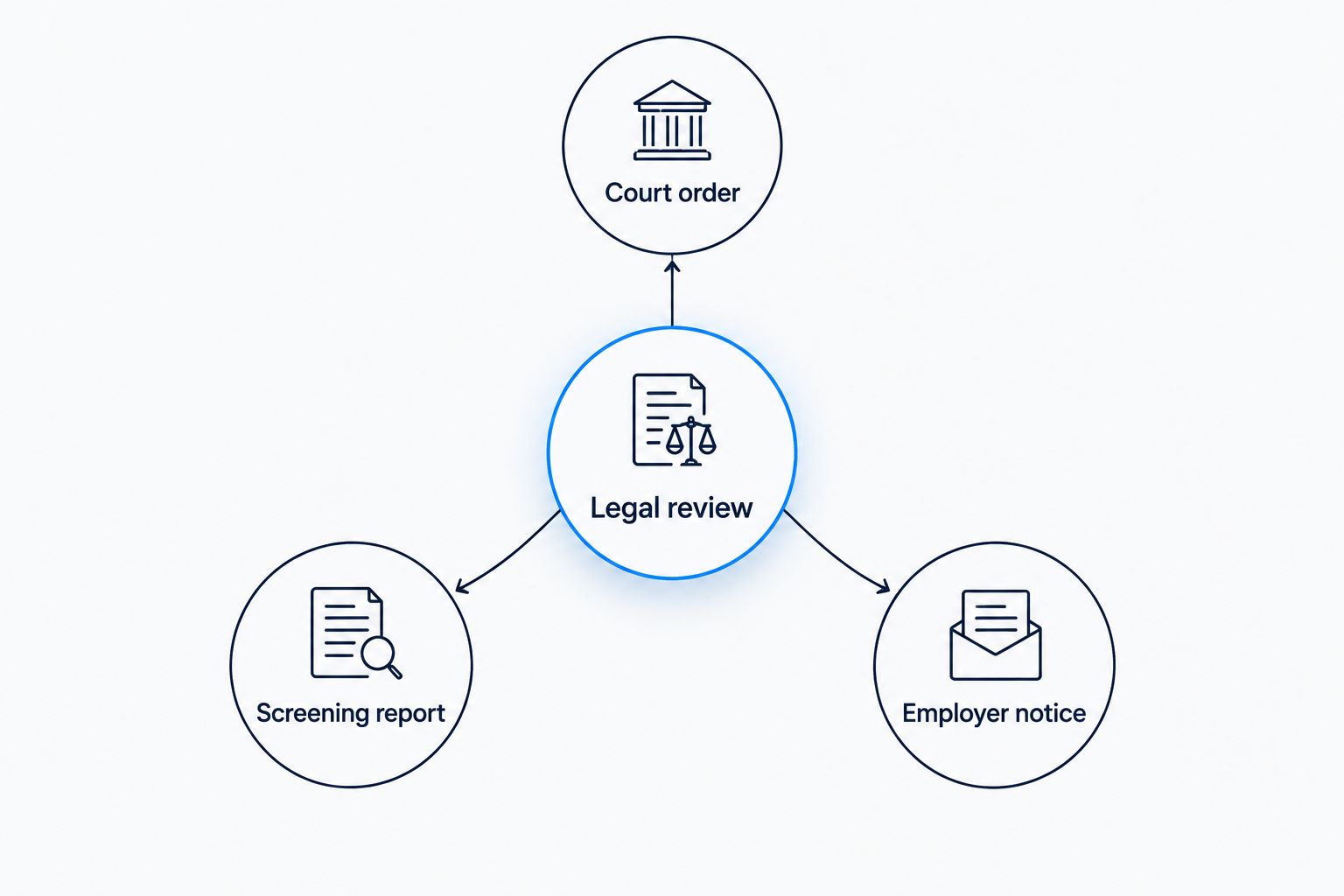
A review that considers all three documents can distinguish a record-relief question from a reporting issue or an employment concern. That distinction keeps the response tied to the problem you actually face.
Timing: a dispute period is not a hiring guarantee
For a 2026 employment-screening dispute, the Consumer Financial Protection Bureau’s published explanation of federal consumer-reporting rights describes a general 30-day investigation period. Certain circumstances allow up to 45 days, including some situations involving additional information during the investigation. These are general federal rules, not a promised HireRight turnaround.
Federal rules also generally require written investigation results within 5 business days after completion. That period concerns notification of the result; it is not an additional promise that an employer will reopen or hold a position.
These time periods answer a limited question: how a consumer-reporting investigation is generally timed. They do not establish when a court record will change, when a particular employer will decide, or whether a disputed entry must be deleted.
An employment deadline and a reporting-investigation deadline are not the same deadline. When a job opportunity is affected, legal advice needs to account for both rather than assuming one controls the other.
When the issue returns on another background check
A later background check can raise a related but distinct concern. The same historical case might appear in a new report, or a different screening provider might present the information differently.
A previous correction is relevant evidence, but it does not prove that every later report is accurate. Likewise, an earlier report that omitted a case does not establish that the court record was sealed or that every future screening purpose follows identical rules.
For applications in 2026, the distinction remains the same: the legal effect of the relief, the accuracy of the new report, and the rules governing that particular screening context. A familiar-looking entry still needs to be assessed against the actual court outcome.
An employment check also differs from a licensing, immigration, or firearms-related review. Expungement does not create a single answer for all of them. Advice about an ordinary job application should not be carried over to a different legal setting without review.
Common problems that change the answer
“The report lists the conviction but not the later dismissal”
This raises an outcome-accuracy issue. The court’s later decision matters, but the appropriate resolution also depends on whether the information is reportable at all. A legal review can distinguish an incomplete description from information that should be excluded.
“The employer says expungement does not matter”
That statement is too broad to resolve the issue. The role, employer, applicable exceptions, and type of relief matter. A preliminary hiring concern and a final decision also carry different implications.
“The report changed, but the rejection did not”
Report correction and reconsideration are separate outcomes. A corrected report does not automatically reverse an employment decision, and an unchanged decision does not establish that the correction failed. The employer’s notices and reasons need separate attention.
“The court granted relief, but another case still appears”
Relief involving one case does not establish relief for another. Separate convictions, charges, or counties can create confusion when a person remembers the overall matter rather than each court outcome. The scope of the actual order controls the record-relief question.
What to do next: get help with the right issue
You do not need to know the legal category before asking for help. The useful starting point is the concern itself: a conviction you understood to be expunged is affecting a background check.
Contact Cole Law for help understanding California record relief and how the court’s decision relates to your situation. A reporting-law or employment-law issue can also require advice in that separate area. No responsible assessment promises deletion or a job offer before understanding the record and the screening context.
Discuss your California record relief
Talk about your expungement, record sealing, or felony-reduction concern.
FAQ
Why is my expunged conviction still on a HireRight background check?
The report needs review to determine why the conviction appears and whether its inclusion is permitted. Possible issues include an incomplete case outcome, an identity error, or a misunderstanding about the relief the court granted.
Does California expungement automatically erase my HireRight report?
No. California expungement does not guarantee automatic deletion from every background report. The effect of the court order and the rules governing the particular employment report require separate review.
Can an employer reject me because an expunged conviction appears?
An employer does not have unrestricted permission to use conviction information merely because it appears in a report. California protections, federal reporting rights, and applicable exceptions affect the answer.
How long does a background-report dispute usually take?
Federal consumer-reporting rules generally provide a 30-day investigation period, with up to 45 days in certain circumstances. Those periods do not guarantee that an employer will hold a position open.
Is an expunged record the same as a sealed record?
No. Expungement and record sealing are different forms of relief with different effects. The actual court order determines what relief was granted.
Will correcting HireRight fix every other background check?
No. Correcting one report does not establish that every other screening provider or government record has changed. Each affected report can raise a separate accuracy or reporting question.
Can Cole Law help with an expunged conviction affecting my job search?
Cole Law helps Californians with expungements, record sealing, and felony-to-misdemeanor reductions. Contact the practice for help understanding the underlying record-relief issue; a consumer-reporting or employment dispute can require separate legal advice.
One last thing
A report can describe a real historical event and still raise a legal problem. Accuracy is not limited to whether a conviction once existed; the later court outcome and the rules governing its use matter too.
For your 2026 job search, the strongest recommendation is simple: do not treat the screening report as the final word on your court relief. Contact Cole Law for help understanding what changed and which issue needs attention. This article provides general information, not advice about a particular case.