
Instead of trying to make your citizenship application match an expunged background check, have your California court outcome and immigration disclosures reviewed together. A California expungement does not automatically erase your criminal history for USCIS or remove the need to disclose it.
- USCIS still requires disclosure of relevant criminal history after a California expungement.
- Cole Law handles California expungement services; immigration consequences require a separate legal assessment.
- A court dismissal and a citizenship approval are different decisions under different rules.
- A pending citizenship application needs individual review when court records change or earlier answers are incomplete.
Why this matters
An expungement can feel like the end of a difficult chapter. Receiving a court order does not, however, mean every agency treats the case as though it never happened. USCIS applies federal immigration rules, not California employment-background-check rules.
For a citizenship application reviewed in 2026, the distinction matters: the original case, its outcome, and the reason for any later court relief can all affect the immigration analysis. A dismissal alone does not establish citizenship eligibility.
Cole Law is best suited to people seeking California criminal record relief, not a substitute for immigration counsel. Attorney Allison Cole leads the practice and handles expungements, record sealings, and felony-to-misdemeanor reductions. Contact Cole Law for help understanding the California record-relief side of your situation.
Before you discuss an application update
A useful legal review depends on more than the newest court order. The following materials help counsel understand what changed and what USCIS has already been told:
- Court history: Records showing the original allegations, the actual outcome, sentencing, and any later relief.
- Immigration history: Copies of previous applications, criminal-history disclosures, and relevant USCIS correspondence.
- Application status: Whether citizenship paperwork is unfiled, pending, awaiting an interview, or awaiting the oath ceremony.
The easily missed issue is that an expungement order often describes only the later relief. It does not necessarily explain the original plea, sentence, or other facts an immigration attorney needs.
This is a records-and-legal-review issue, not simply a document-upload issue. An online account cannot decide whether a state court order changes the federal immigration treatment of a conviction.
What California relief changes—and what it does not
California record relief and federal immigration review address different questions. State relief concerns the criminal record and the legal consequences attached to it under applicable state law. Naturalization review concerns eligibility for citizenship under federal law.
Neither process replaces the other. A favorable California result deserves an accurate explanation, but it should not be described as a federal immigration clearance.
| Type of relief | Purpose | Benefit | Important limitation |
|---|---|---|---|
| Expungement | Obtain dismissal of an eligible conviction through California record relief | Changes the court outcome in the manner authorized by the relief | Generally does not erase the conviction for immigration purposes |
| Record sealing | Restrict access to qualifying records | Limits access under the applicable sealing rules | Does not create a blanket exception to USCIS disclosure requirements |
| Felony reduction | Change an eligible felony to a misdemeanor under California law | Changes the state classification of the offense | Does not automatically resolve the federal immigration consequences |
The recommendation is to match the legal help to the question. California record-relief counsel addresses the state court outcome; immigration counsel assesses citizenship eligibility and federal disclosure obligations. Neither role should be mistaken for the other.
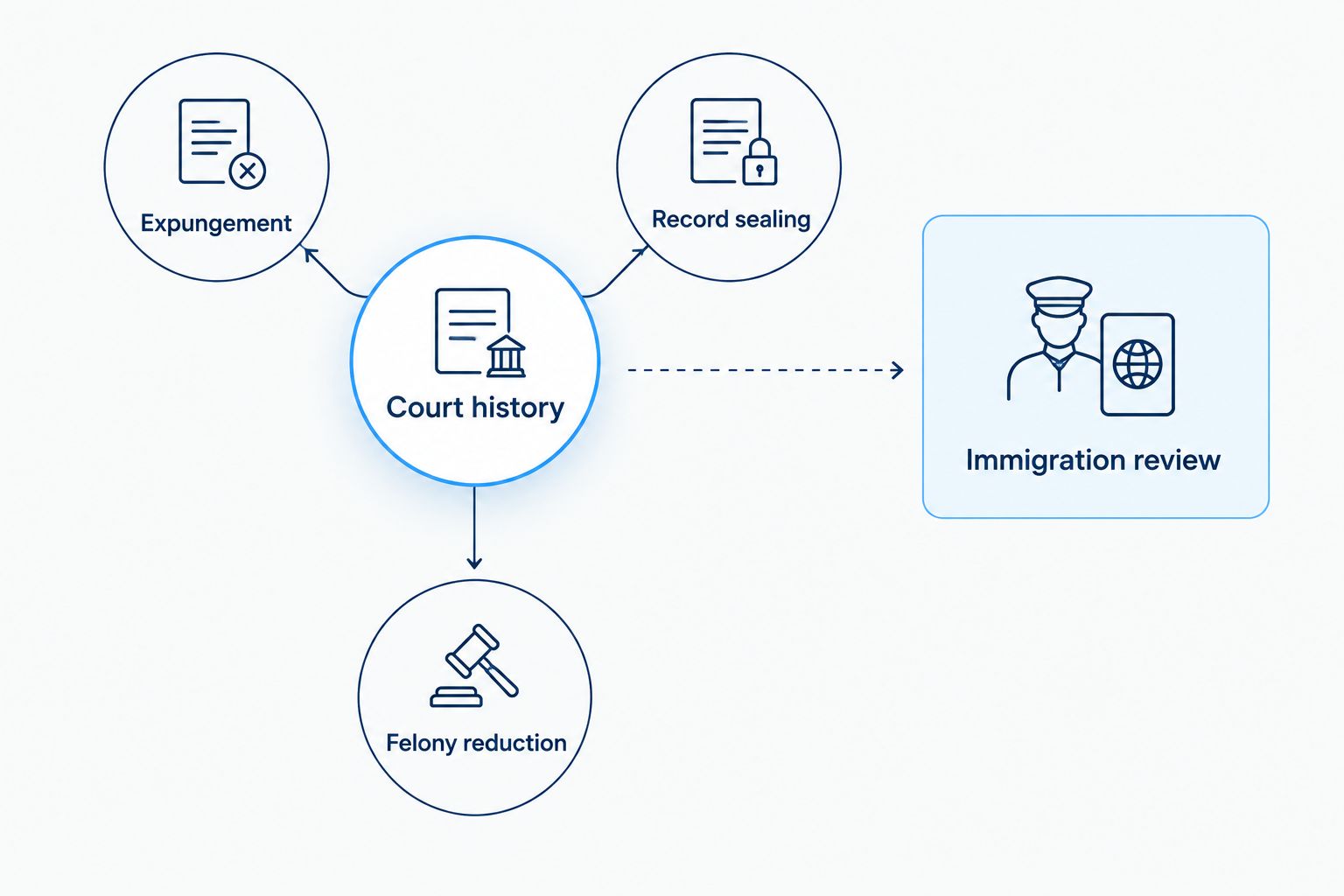
The review behind an accurate citizenship update
There is no single correction method that fits every pending citizenship case. The appropriate response depends on what was previously disclosed, what the court changed, and where the application stands. This overview explains the issues counsel evaluates, rather than providing filing instructions.
Court history
The original case remains relevant even when a later order says it was dismissed. An immigration review looks beyond that word to the underlying proceedings and the legal basis for the relief.
For example, dismissal after completing probation is not the same event as dismissal before any conviction. Describing both simply as a dismissed case hides a distinction that can matter.
The useful result is a clear account of both the original outcome and the later relief. A short summary that contradicts the underlying court records creates more uncertainty, not less.
Prior disclosures
An application update can involve newly granted relief, an earlier omission, or an inaccurate description of a case. Those are different issues. A new expungement order does not retroactively make an incomplete answer accurate.
An immigration attorney needs to understand what USCIS previously received and why the information changed. That includes earlier immigration applications, not only the current citizenship application.
The goal is consistency with the facts, not wording that makes the record sound less serious. A candid explanation of a correction is different from assuming the agency will overlook a mismatch.
Current application status
A citizenship application pending in 2026 can be at a very different point from one that has not been filed. An upcoming interview, a request for evidence, or an approaching oath ceremony changes the immediate context for legal advice.
An expungement does not pause a USCIS deadline. Nor does it automatically transmit the court order to the officer handling the application.
The expected result of legal review is a case-specific communication plan. It should address the court outcome, any correction needed, and existing USCIS deadlines without assuming that a portal attachment settles the issue.
Immigration consequences
Disclosure and eligibility are separate questions. A person can accurately disclose a conviction and still need advice about whether the conviction affects citizenship or immigration status.
USCIS's Policy Manual, in its guidance on good moral character and criminal history, explains that state rehabilitative relief generally does not eliminate a conviction for immigration purposes. The reason a court changed a judgment matters; the label on the order is not enough.
For a 2026 citizenship review, the key question is not merely whether the case was expunged, but how federal immigration law treats the underlying record. No general article can resolve that question from the word expunged alone.
When the application is already pending
A later court order and a previously undisclosed case require different assessments. Treating them as the same kind of update risks missing the central issue.
The original case was already disclosed
When the original criminal history was accurately disclosed, a later expungement is an additional development in that history. It does not replace the original events or erase earlier answers.
Counsel can assess the new order alongside the existing application. The focus is an accurate explanation of what changed, without suggesting that state relief guarantees a favorable citizenship decision.
The original case was omitted or described incorrectly
An omission raises a separate accuracy concern. Whether it resulted from confusion, missing records, or misunderstanding the effect of expungement requires individual review.
Prompt immigration advice is the right response to an incomplete disclosure. Assuming that an expungement fixes the omission leaves the underlying problem unresolved. The consequences depend on the facts; neither automatic denial nor automatic forgiveness is a responsible prediction.
The court outcome changes after the interview
An interview is not the end of the naturalization process. USCIS continues to evaluate eligibility before citizenship is granted, and developments before the oath can remain relevant.
A court change during that period deserves attention from immigration counsel. Waiting for the state and federal systems to reconcile themselves is not a reliable communication plan.
For more context on the state-law role, see expungement help for naturalization and citizenship applicants.
Common problems that complicate the review
“My background check is clear, so there is nothing to disclose”
A commercial background report is not the standard for answering USCIS questions. A report can omit information that remains relevant to an immigration application.
The correction is a legal review of the actual history and the question being asked. A clean-looking report does not establish that a past arrest or conviction falls outside a disclosure requirement.
“The court order says dismissed, but other records show convicted”
Those descriptions can refer to different points in the same case. The original conviction and a later dismissal are not necessarily contradictory.
The issue is whether each record accurately reflects the history. Counsel can distinguish a genuine reporting error from a record that correctly preserves both events. Changing a state database entry still does not decide the federal immigration result.
“The court cannot locate part of the file”
Older or incomplete court files can make documentation harder. An unavailable record does not mean the underlying event no longer needs attention.
Immigration counsel can assess how the missing material affects the case and what evidence is appropriate. Guessing at the original charge or sentence risks introducing an avoidable inconsistency.
“My interview is approaching, but the expungement is unfinished”
Pending relief is not granted relief. An expected outcome should not be presented as an existing court decision.
An approaching USCIS event and an unfinished court matter need coordinated legal attention. The immigration assessment must account for the record as it currently exists, not only the outcome someone hopes to obtain.
A focused conversation with the right attorney
The most useful consultation separates your California record-relief goals from your citizenship concerns. You should leave understanding which attorney is addressing each issue and what remains unresolved.
Questions that keep the discussion focused include:
- What does the California court order actually change?
- Does the immigration analysis depend on the original plea or sentence?
- Is the concern new relief, an earlier omission, or both?
- Are any USCIS notices or deadlines relevant right now?
- Does the available court history support an accurate explanation?
Cole Law's California expungement services address the state record-relief question. A separate immigration assessment is necessary when citizenship or immigration status is at stake. That boundary protects you from treating a favorable state outcome as an immigration promise.
Discuss your California record relief
Talk with Cole Law about expungement, record sealing, or felony reduction alongside your immigration concerns.
FAQ
Do I still disclose a California conviction after it is expunged?
USCIS generally requires disclosure of relevant criminal history even after a California expungement. The exact question and underlying events matter, so an immigration attorney should assess your answers rather than relying on the expungement label.
Does California expungement erase a conviction for citizenship purposes?
A California rehabilitative expungement generally does not erase a conviction for federal immigration purposes. USCIS evaluates the underlying case and the legal reason for later court relief.
What if I already submitted my citizenship application before the expungement?
A later expungement requires an individual assessment of your pending application and existing disclosures. Immigration counsel can evaluate how the new order relates to what USCIS has already received.
What if I forgot to mention the case because I thought expungement erased it?
An omitted case needs prompt immigration legal review. The expungement does not automatically correct an earlier answer, and the effect of the omission depends on the facts.
Can USCIS consider a case that no longer appears on a background check?
Yes, a case can remain relevant to USCIS even when it does not appear on a commercial background report. Disclosure obligations depend on the application questions and your history, not only on a screening result.
Does a sealed arrest record mean I never have to mention the arrest?
Record sealing does not create a blanket exception to USCIS criminal-history questions. Immigration counsel should assess the event and the applicable question before you rely on confidentiality rules.
Can Cole Law guarantee citizenship after an expungement?
No California expungement result guarantees citizenship approval. Cole Law handles California criminal record relief; federal immigration consequences require a separate assessment by immigration counsel.
One last thing
A later dismissal and an earlier conviction can both be accurate parts of the same history. That is why replacing every reference to a conviction with the word dismissed can create confusion rather than resolve it.
For anyone considering citizenship in 2026, the strongest starting point is a truthful account of what happened and what the court later changed. California relief can be meaningful without erasing the past for every legal purpose. You deserve advice that recognizes both facts.
This article provides general information, not advice about your individual criminal or immigration case.