
Yes. An expunged California conviction can still count as a prior conviction and increase the punishment for a later offense. A standard expungement dismissal does not erase the conviction for future criminal proceedings, but an increased sentence is not automatic: the earlier conviction must meet the rules that apply to the new case.
- Expunged conviction sentence enhancement California: a dismissal does not automatically prevent a prior conviction from increasing a later sentence.
- California expungement and record sealing are different forms of relief; neither should be treated as a blanket sentencing shield.
- A dismissed California DUI can still count within the applicable repeat-offense period.
- Cole Law provides California record-clearing services for people seeking expungements, record sealings, and felony-to-misdemeanor reductions.
Why this matters
You can make real progress clearing your record without removing every consequence of the original conviction. That distinction matters when you are deciding what relief to seek or trying to understand a new criminal charge.
A fresh start and protection from future sentencing consequences are different goals. Cole Law helps individuals with California criminal records seek expungements, record sealings, and felony-to-misdemeanor reductions. The right discussion starts with what you need the relief to accomplish, not just whether your record can be called cleared.
Can an expunged conviction enhance a future sentence in California?
Yes, a standard California expungement can leave a conviction available for use in a later prosecution. California Courts' public guidance on cleaning a criminal record explains that dismissal does not remove every consequence of a conviction, including its potential use in a future criminal case. This is the central distinction for readers assessing record relief in 2026.
The court's dismissal changes the status of the earlier case. It does not necessarily prevent a prosecutor from relying on that case when a later charge carries greater punishment for someone with a qualifying prior conviction.
The word qualifying matters. A dismissed conviction does not increase every later sentence, and a prosecutor's allegation is not itself a finding that an increase applies.
| Question | What a standard expungement means | What it does not establish |
|---|---|---|
| Has the earlier case received relief? | The court has granted a dismissal after conviction | That the original conviction never happened |
| Can the prior conviction matter in a new case? | It can remain usable in later criminal proceedings | That every new charge carries additional punishment |
| Does an employer's treatment of the record settle the issue? | Employment protections address a different setting | That a criminal court must disregard the conviction |
| Does a dismissal eliminate a qualifying strike? | A dismissal alone does not remove strike consequences | That the prior conviction has lost its sentencing effect |
The practical answer is therefore specific: expungement does not provide immunity from prior-conviction sentencing rules. Whether those rules actually increase your exposure requires a review of both cases.
Expungement changes the case status, not every consequence
In California, people commonly use expungement to describe a dismissal granted after a conviction. The term can sound broader than the relief itself. It does not mean that every government record disappears or that every legal consequence ends.
That explains an otherwise confusing result: your case can show a dismissal while the earlier conviction still matters in criminal court. Those outcomes are not contradictory. Different rules govern record relief, employment disclosures, and punishment for a later offense.
For your 2026 record-clearing decision, focus on the actual court order rather than a general description such as cleared, removed, or clean. A background-check result is not a substitute for understanding the relief the court granted.
Expungement remains meaningful. It can provide important employment-related benefits and formally change the disposition of an eligible case. Its limitation is equally important: a dismissal is not a promise that the conviction can never be used again.
Why the sentencing effect varies
The outcome depends on the connection between the old conviction and the new charge. These are the main factors that require legal review:
- The earlier offense. Only a prior conviction that meets the applicable sentencing rule can support that particular increase.
- The new charge. Different offenses have different rules for repeat convictions and additional punishment.
- The timing. Some repeat-offense rules use a defined period; others do not work that way.
- The relief granted. A dismissal, a reduction, a sealing order, and an order setting aside an invalid conviction are not interchangeable.
- The status of the prior conviction. A later court order affecting the original conviction can change the analysis.
- The sentencing rule itself. A prior-conviction allegation must satisfy the legal requirements that govern its use.
An old conviction is not automatically irrelevant because it is old. A recent dismissal also does not automatically make a conviction usable. The specific rule, rather than either date alone, determines its effect.
Can an expunged DUI still count against me?
Yes, an expunged California DUI can still count as a prior DUI within the applicable 10-year period. California Courts' record-cleaning guidance specifically warns that dismissing a DUI does not prevent its use as a prior in a later DUI case.
That means an expunged first DUI does not necessarily make a later DUI a first offense. A second DUI within the applicable period can receive repeat-offense treatment even when the earlier case was dismissed after conviction.
The same basic concern applies when a person has more than one earlier DUI. Calling a later charge a second or third offense depends on which prior convictions legally count, not simply which convictions remain visible on an ordinary background check.
For a DUI question in 2026, the offense dates and court outcomes deserve individual attention. Do not treat the date of expungement as the date that resets the repeat-offense period. A dismissal addresses record relief; the rules for counting prior offenses address a different issue.
Does expungement remove a strike conviction?
No. A standard California expungement does not, by itself, remove the future sentencing consequences of a qualifying strike conviction. A dismissal and the legal treatment of a strike are separate questions.
The label attached to the original case is not enough to resolve the issue. The nature of the conviction and any later court orders matter, and a background report that says dismissed does not establish that strike consequences have ended.
This is an area where reassurance needs a clear boundary. Do not rely on expungement alone as protection from strike-related punishment. If a new case raises that issue, the attorney handling the new charge needs to assess the prior conviction directly.
Record-clearing work and defense against a current sentencing allegation can involve related records, but they serve different purposes. Neither should be treated as a substitute for the other.
Is reducing a felony different from expunging it?
Yes. A felony-to-misdemeanor reduction changes the classification of an eligible conviction, while expungement generally changes its disposition through dismissal. Those differences can matter, but a reduction is not a universal answer to future sentencing exposure.
The following comparison describes the purpose and limits of each form of relief. It is not a conclusion that you qualify for any particular option.
| Form of relief | Main purpose | Best suited to discussing | Important limit |
|---|---|---|---|
| Expungement dismissal | Obtain dismissal after an eligible conviction | Relief from certain consequences of a conviction | The conviction can remain usable in future criminal proceedings |
| Felony-to-misdemeanor reduction | Change an eligible felony's classification | Whether felony status can be reduced | The effect on a future sentencing rule requires separate review |
| Record sealing | Restrict access to eligible records | Privacy and record-access concerns | Restricted access does not establish that every criminal-justice use is barred |
| Setting aside an invalid conviction | Address a legally defective conviction | Whether the original conviction has a valid basis for challenge | Requires grounds beyond simply wanting a cleaner record |
Choose relief by its legal effect, not its name. Dismissal, reduction, and sealing address different concerns, even when each is described informally as clearing a record.
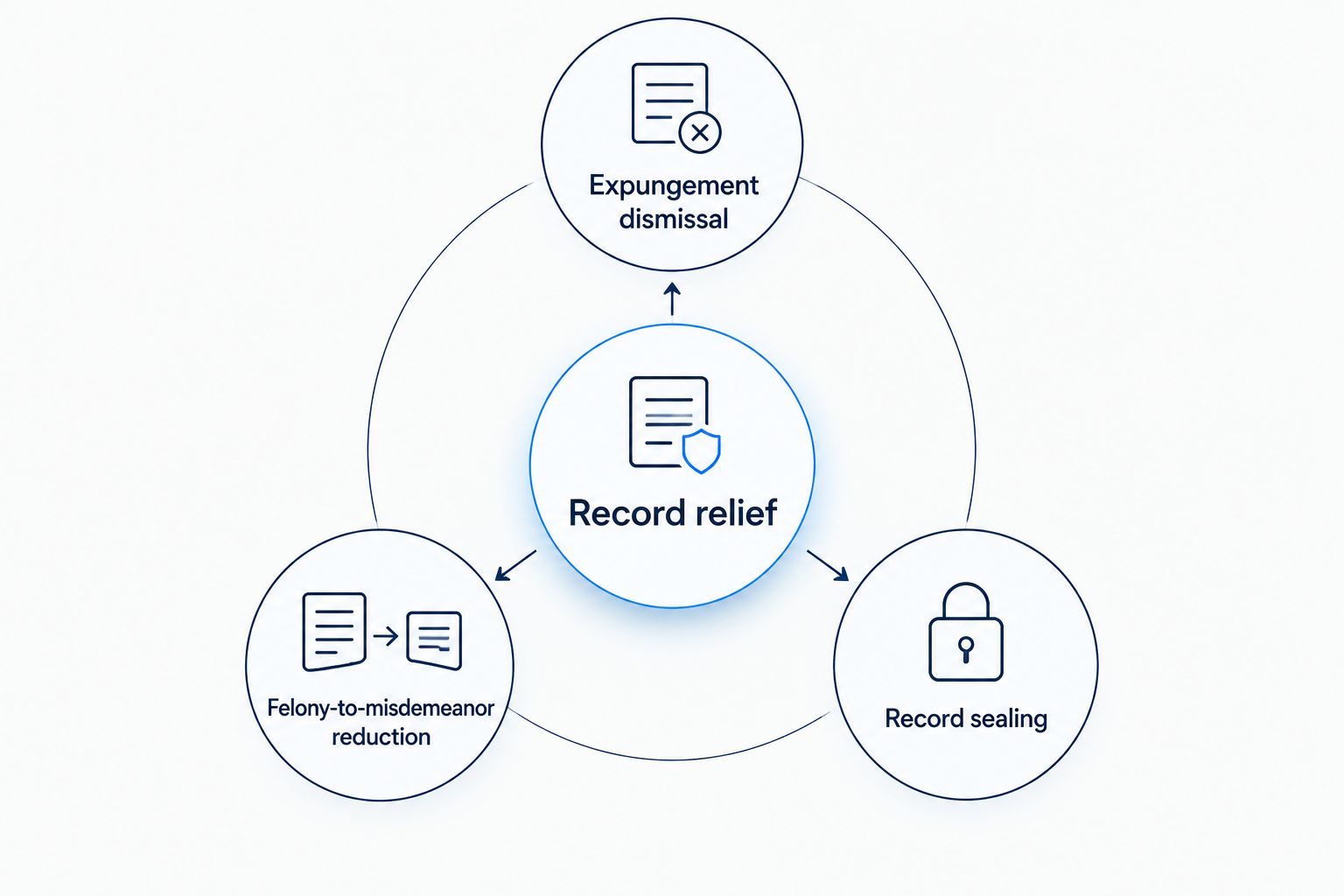
A review in 2026 should distinguish relief already granted from relief that remains possible. You do not need to know the technical terminology before asking for help; you need an explanation of what your court orders actually changed.
What does this mean if I already have a new charge?
A new charge creates a separate defense issue. Even if your earlier conviction was expunged, your attorney needs to know about it when assessing possible punishment and responding to any allegation based on your record.
That does not mean accepting every claim that the prior conviction increases your sentence. The prosecution must meet the requirements for the particular allegation, and the defense can evaluate whether the earlier conviction qualifies.
Do not assume either that the expungement solves the issue or that the additional punishment is inevitable. Both assumptions skip the legal question that matters: whether the old conviction can be used in this new case under the applicable rule.
If another attorney obtained your dismissal, that relief still deserves careful consideration. Its value does not disappear simply because a later criminal case involves a consequence it was never designed to remove.
Is expungement still useful if the conviction can count later?
Yes. California expungement can offer meaningful relief even when it does not prevent future sentencing consequences. The benefit depends on your circumstances and the barriers you are trying to address.
For example, employment-related protections and criminal sentencing operate in different settings. Relief that helps with the former does not have to eliminate the latter to be worthwhile.
Cole Law's California expungement services are suited to individuals seeking record-clearing relief, not a guarantee against future sentencing consequences. The practice also helps individuals seek record sealings and felony-to-misdemeanor reductions. No description of those services should replace an individual assessment of what relief can accomplish in your case.
When you contact Cole Law, make the sentencing concern part of the conversation. A clear explanation of the limits is as important as an explanation of the benefits.
Discuss Your Record With Cole Law
Ask about California record relief and the limits that matter to your situation.
FAQ
Can an expunged conviction increase my sentence in California?
Yes, an expunged California conviction can still increase punishment for a later offense when it qualifies under the applicable sentencing rule. A standard dismissal does not erase the conviction for future criminal proceedings.
Does an expungement mean my conviction never happened?
No, a standard California expungement does not mean the conviction never happened. It changes the case disposition through dismissal while leaving some legal consequences in place.
Can an expunged DUI count as a second offense?
Yes, an expunged California DUI can still count toward repeat-offense treatment within the applicable 10-year period. A later DUI does not become a first offense simply because the earlier conviction was dismissed.
Does an expungement remove a strike from my record?
No, a standard expungement does not by itself remove the sentencing consequences of a qualifying strike conviction. The prior conviction and any other court orders require separate legal review.
Will every expunged conviction automatically add time to a new sentence?
No, an expunged conviction does not automatically add time to every new sentence. The prior offense must qualify under a rule that applies to the new case.
Is sealing my record the same as preventing a sentence enhancement?
No, restricting access to a record is not the same as preventing its use in a future criminal proceeding. The effect depends on the particular sealing relief and the rules governing the later case.
Should I tell my defense attorney about an expunged conviction?
Yes, tell your defense attorney about an expunged conviction when discussing a new charge. The dismissal order and original case history can matter to the assessment of possible punishment.
Is California expungement still worth discussing in 2026?
Yes, California expungement remains worth discussing in 2026 when you want relief from eligible record-related consequences. Its value should be assessed separately from whether a conviction can count in a future criminal case.
One last thing
A dismissal on your record and a usable prior conviction can exist at the same time. That is the distinction to remember when someone describes expungement as erasing a case.
You deserve a clear answer about both the relief available and the consequences that remain. Contact Cole Law for help understanding California record-clearing options; if you face a new charge, discuss the prior conviction with the attorney handling that case.