
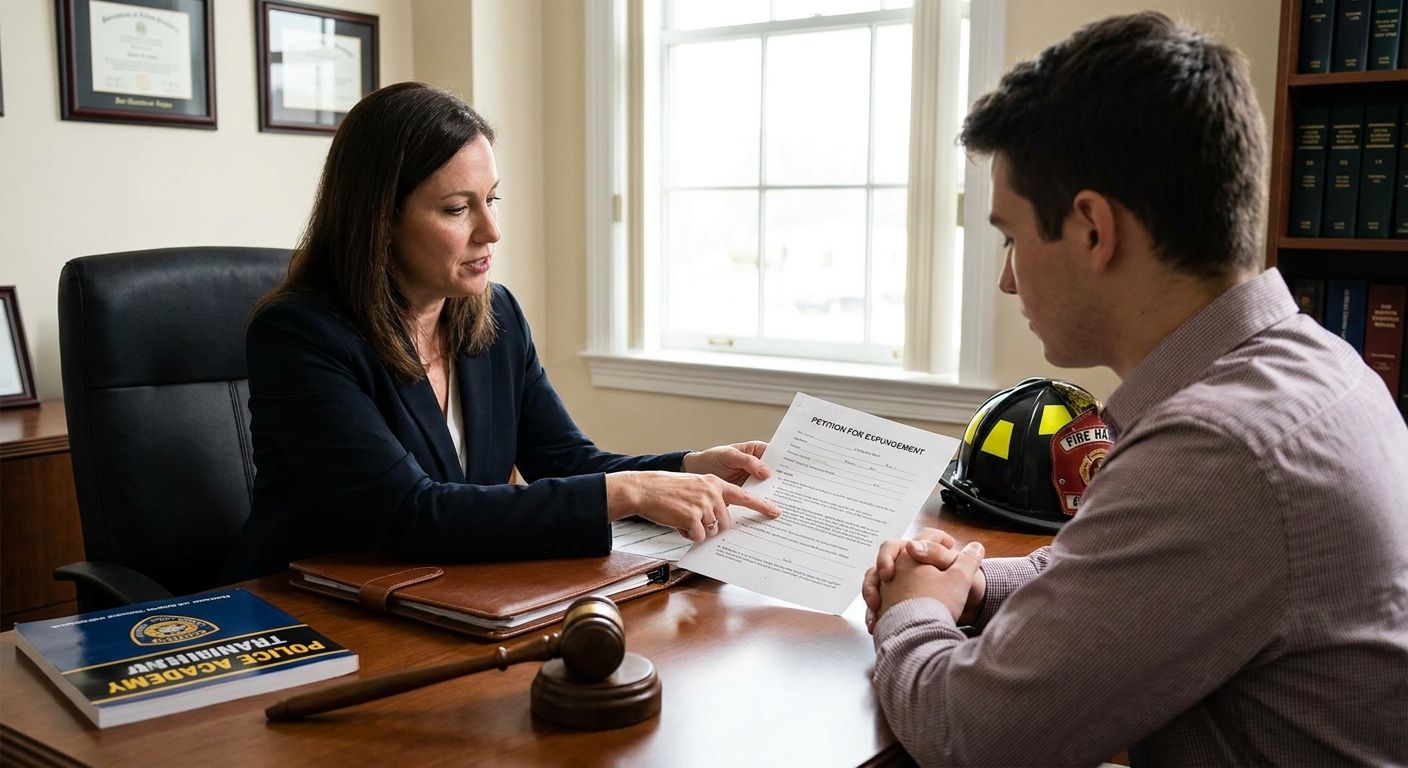
Getting into a California police or firefighter academy runs on one thing: whether your background holds up under a background investigator's microscope, not whether a court sealed your file. An expungement lawyer for police academy applicants in 2026 handles both halves of that problem — clearing what the law allows and building the disclosure record that gets you past the moral character review. This guide walks through what actually changes when you expunge a record before you apply, and what doesn't.
- An expungement lawyer for police academy applicants clears eligible convictions under Penal Code 1203.4 but cannot erase the disclosure duty on a peace officer application.
- California Government Code 1029 permanently disqualifies most felony convictions from peace officer service unless reduced to a misdemeanor first.
- DOJ Live Scan and FBI background checks see expunged and sealed cases that court records no longer show to the public.
- Firearm rights restoration matters for academy applicants because firearm issuance is part of the hiring process at most departments in 2026.
Why expungement matters for police and firefighter academy applicants
Most jobs run a standard background check. Police and firefighter academies run a full background investigation — DOJ and FBI fingerprint checks, polygraph, personal references, and a moral character review conducted under Commission on POST standards. That process pulls records a private employer's background service never sees, including arrests that never led to conviction and cases you already resolved in court years ago.
California Government Code 1029 makes this sharper for felony convictions specifically: it bars most convicted felons from serving as a peace officer, full stop, unless the conviction has since been reduced to a misdemeanor or otherwise remedied. A Penal Code 1203.4 expungement alone doesn't satisfy that bar if the underlying offense is still classified as a felony. That's the gap most applicants don't know about until an investigator flags it mid-process, months into a hiring cycle.
The bottom line for 2026 applicants: relief from the court is step one, not the finish line — the disclosure and reclassification work around it is what actually protects your candidacy.
Update your case records before you apply
1. Confirm what your case actually is under Penal Code 1203.4
Expungement under Penal Code 1203.4 requires that you completed probation (or qualify for early termination) and have no pending charges. It applies to most misdemeanors and many felonies, but not everything — certain sex offenses and some Vehicle Code violations are excluded.
- Pull the exact statute you were convicted under, not just the general offense name
- Confirm probation was formally terminated, not just informally over
- Check whether the offense is on the excluded list for peace officer purposes
- Note whether the case is a felony that will also need reduction under Penal Code 17(b) or Prop 47
- Run a Penal Code 1203.4 eligibility check before you file anything
2. Pull your full case file before the background packet goes out
Background investigators cross-reference everything you write against county court records and DOJ data. A gap between your memory of the case and the official record is the fastest way to get flagged for dishonesty, which disqualifies you regardless of how minor the underlying offense was.
- Certified copies of the minute order and final disposition
- The original arrest report, not just the conviction record
- Your DOJ Live Scan history (RAP sheet) if you can obtain it
- Any prior expungement, sealing, or reduction orders already granted
- Court dates, case numbers, and county of filing for every case, not just the one you think matters
3. Disclose the conviction on every academy application, regardless of relief already granted
This is the step most applicants get wrong. Penal Code 1203.4(a)(1) explicitly carves out an exception: it does not relieve you of the duty to disclose the conviction when applying for public office or a license from a state or local agency — and peace officer and firefighter positions fall squarely in that category. You disclose the expunged conviction anyway, and you explain the relief you obtained alongside it.
- State the offense, date, and disposition in plain terms, no minimizing language
- Name the relief obtained (expungement, reduction, certificate) and the statute behind it
- Include a short, factual account of what happened and what changed since
- Attach certified court documents rather than describing them from memory
- Have the disclosure language reviewed before submission — an expungement lawyer for police academy applicants drafts this section specifically so it reads as candor, not concealment
4. Petition for a certificate of rehabilitation if you carry a felony record
A Certificate of Rehabilitation doesn't erase the felony, but it puts a judge's written finding of rehabilitation into your file — something a background investigator and hiring panel can weigh directly. For felony applicants, this document often carries more weight in a moral character review than the expungement order itself.
- Confirm the minimum residency and waiting period for your county before filing
- Gather proof of stable employment, education, or community ties since the conviction
- File the certificate of rehabilitation petition well before your target application window
- Understand it doesn't apply to every offense category — some convictions are statutorily excluded
5. Restore your gun rights before the firearms qualification phase
Most California peace officer and many firefighter academy tracks require firearm issuance or handling as part of training. A felony conviction, and some misdemeanors, can carry a lifetime firearms ban under state and federal law that an ordinary expungement does not lift.
- Determine whether your specific offense triggers a state or federal firearms prohibition
- Confirm whether Penal Code 1203.4 relief affects your firearms eligibility in your case
- Pursue gun rights restoration as a separate legal step if the ban still applies after expungement
- Get this resolved before the academy's firearms qualification stage, not after you're already enrolled
6. Time your filings to close before the hiring cycle opens
Court processing on expungement and reduction petitions typically runs weeks to a few months depending on the county and whether the DA opposes. Academy hiring cycles move on their own calendar, and a petition still pending when your background packet is due looks worse than no petition at all.
- Map the department's typical hiring and academy start windows for 2026
- File expungement, reduction, and certificate petitions as early in the year as your eligibility allows
- Build in extra time for counties with backlogged criminal calendars
- Have signed, final orders in hand before your background interview, not just filed petitions
7. Prepare for the background investigator's follow-up questions and the polygraph
Investigators ask about the disclosed conviction directly, and polygraph examiners often circle back to it. Applicants who treat the written disclosure as the end of the conversation get caught off guard here.
- Rehearse a short, consistent verbal account that matches your written disclosure exactly
- Line up personal references who know the full story, not a sanitized version
- Review the disclosure packet again right before the interview so details are fresh
- Avoid volunteering extra detail that contradicts the official record
Get your academy disclosure right
Case review for California peace officer and firefighter applicants with a record.
Comparison: relief options for academy applicants
| Option | Best for | Key limitation |
|---|---|---|
| Penal Code 1203.4 expungement | Probation-completers with an eligible misdemeanor or felony | Does not remove the disclosure duty for peace officer or public licensing applications |
| Penal Code 17(b) / Prop 47 reduction | Felony convictions that qualify for reclassification to a misdemeanor | Only available for specific offense categories, mainly theft and drug cases |
| Certificate of Rehabilitation | Felony applicants who need a judicial finding of rehabilitation on file | Requires a minimum residency and waiting period; excluded for some offenses |
| Factual innocence petition (PC 851.91) | Arrests that never led to a conviction | Narrow eligibility; you must prove no reasonable cause existed for the arrest |
| Filing court forms without counsel | A single, straightforward case with no complicating factors | Technical errors or incomplete disclosure language routinely trigger disqualification in a moral character review |
If you're carrying a felony and applying to any California department in 2026, expungement alone is not the plan — reduction, a certificate of rehabilitation, or both usually need to run alongside it.
Common mistakes academy applicants make
- Assuming "expunged" means invisible to the department. DOJ and FBI background checks still show the case; only the general public loses access to it.
- Minimizing the conviction on the disclosure form because the court granted relief. Investigators read that as concealment, not confidence.
- Filing an expungement without addressing the felony classification. Government Code 1029 still disqualifies you if the offense wasn't reduced first.
- Skipping firearm rights restoration when the academy track requires firearm issuance, then discovering the ban mid-training.
- Filing petitions too close to the application deadline, leaving a pending case on file when the background packet is due.
FAQ
Does expungement clear my record for a police academy background check?
No. A Penal Code 1203.4 expungement removes most penalties of a conviction, but DOJ and FBI background checks used for peace officer hiring still show the case, and you must disclose it on the application.
Can I become a police officer in California with a felony conviction?
Generally no, under California Government Code 1029, unless the felony has been reduced to a misdemeanor or the conviction is otherwise legally remedied before you apply.
Do firefighter academies run the same background checks as police academies?
Most California fire academies and departments run a comparable background investigation, including criminal history review and reference checks, though the exact standards vary by agency in 2026.
Do I have to disclose an expunged conviction on a peace officer application?
Yes. Penal Code 1203.4 specifically excludes public office and government licensing applications from its disclosure relief, so peace officer and firefighter applicants must disclose regardless.
Can gun rights restoration help me pass academy firearms training?
It can, if your conviction carries a state or federal firearms prohibition that an expungement alone doesn't lift; restoring those rights is a separate legal step from the expungement itself.
How long before I apply should I file for expungement or reduction?
File as early as your eligibility allows, since court processing can take weeks to a few months and a pending petition during your background review looks worse than a completed one.
Will a Certificate of Rehabilitation help my academy application?
It can strengthen a felony applicant's file by putting a judge's written finding of rehabilitation on record, which a moral character review panel can weigh directly.
What happens if I don't disclose a sealed or expunged case on my application?
Nondisclosure discovered during a background investigation or polygraph is typically treated as dishonesty, which disqualifies candidates regardless of how minor the original offense was.
One last thing
The single detail that trips up the most academy applicants in 2026 isn't the conviction itself — it's Government Code 1029 quietly sitting behind every felony case, disqualifying candidates who assumed an expungement was enough. If your record includes a felony, get the reduction question answered before you touch the disclosure form.


