
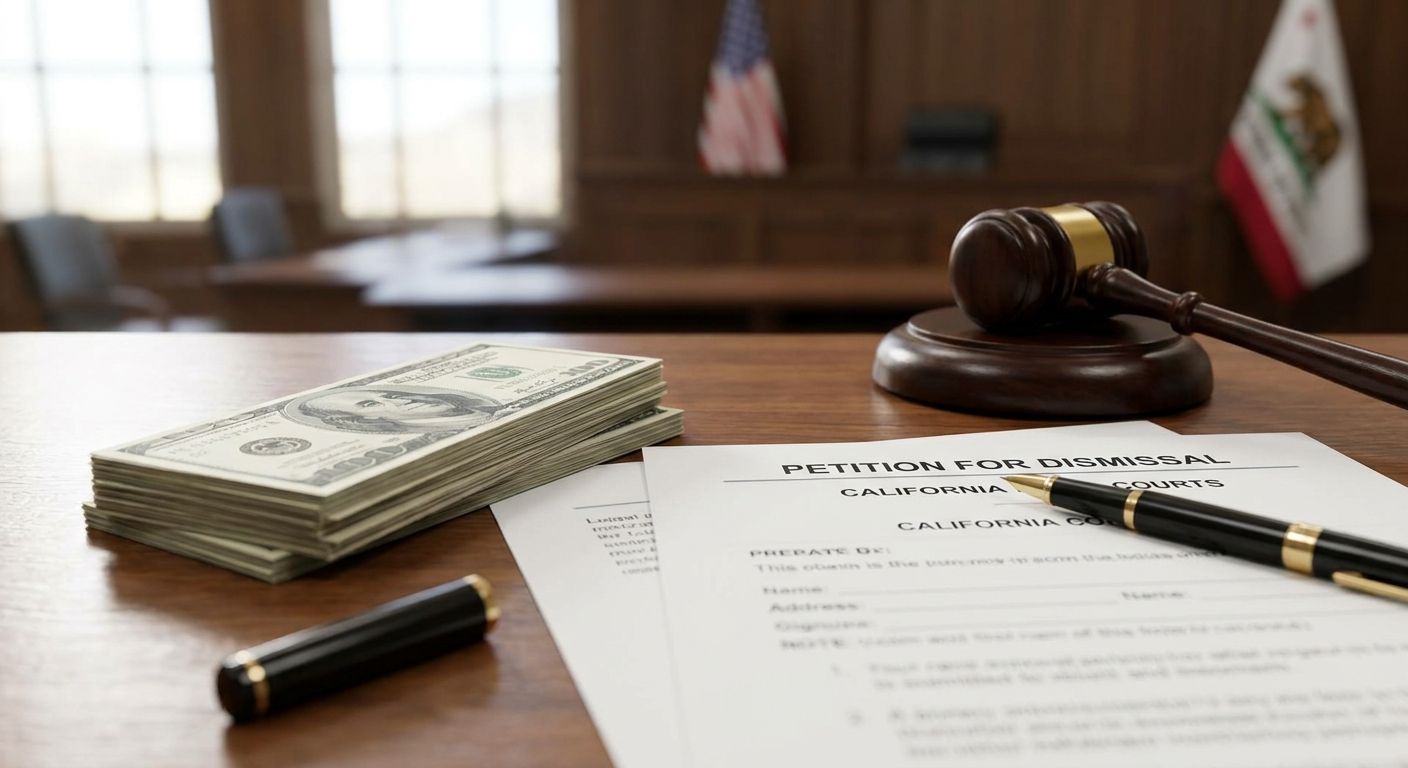
Expungement calculators promising a flat dollar figure are guessing. The cost to expunge a record in California swings on three variables: which petition your case needs, whether your county waives the filing fee, and whether you hire an attorney or file the paperwork yourself.
- The cost to expunge a record in California is driven by attorney fees and county filing fees, not a fixed state price.
- Form FW-001 can eliminate court filing fees entirely for petitioners who meet the income threshold.
- A single Penal Code 1203.4 petition costs less than stacking a felony reduction and a Certificate of Rehabilitation together.
- Some arrests and convictions clear automatically under AB 1076 with no petition and no fee at all.
Why this matters
Most people searching for the cost to expunge a record in California assume there's a receipt they can point to, like a DMV fee. There isn't. Penal Code 1203.4 dismissal petitions are filed county by county, and each superior court sets its own local fee schedule. What you pay in Los Angeles County is not what you pay in Fresno or Sacramento.
On top of the court's fee, you're deciding whether to pay an attorney for the filing, the hearing prep, and any DA objection, or to handle it yourself using the same forms an attorney would use. In 2026, that decision is where most of the actual cost variation lives, not the courthouse counter.
I've walked clients through this exact math for years. The petition itself is rarely the expensive part. The expensive part is guessing wrong on eligibility and refiling, or missing a fee waiver you qualified for the first time around.
What you'll need
- Your case number and county of conviction
- A certified copy of the disposition (proof the case was resolved and, for felonies and misdemeanors with probation, that probation is complete)
- Proof of income if you plan to request a fee waiver
- Your county superior court's current local fee schedule for a Petition for Dismissal
- Judicial Council Form FW-001 if you can't afford the filing fee — Cole Law can confirm eligibility during a consultation
- A decision on whether you're filing solo or with an attorney
The steps to price out your expungement
1. Confirm which petition actually fits your case
Most adult misdemeanor and felony convictions in California are cleared under Penal Code 1203.4, which requires that probation is complete or that the court grants early termination. Infractions and some non-probation misdemeanors fall under 1203.4a instead. Filing the wrong petition means paying a filing fee twice.
This matters because eligibility, not paperwork skill, is what a court actually checks first. A case still on probation, or one with a pending charge, gets denied regardless of how well the petition is drafted.
Common mistake: filing before probation officially ends. Courts routinely reject petitions filed even a few weeks early, and that's a second filing fee.
2. Pull your case file and disposition
You need the exact case number, county, and disposition date before any court will accept a petition. If your case is more than a decade old, the county clerk or probation department may charge a records-retrieval fee to locate the file.
Expected outcome: a certified disposition in hand, ready to attach to the petition. Skipping this step is the single biggest cause of continued hearings, which adds cost through extra court dates.
3. Look up your county's actual filing fee
Each California superior court publishes its own fee schedule. Some counties charge a flat fee for a Petition for Dismissal; others fold it into a broader motion fee. There is no statewide number, so pulling your specific county's schedule before budgeting is the only reliable step.
Common mistake: budgeting off a fee you read for a different county. Fee schedules are set locally and change without a statewide announcement.
4. Apply for a fee waiver if your income qualifies
Form FW-001, Request to Waive Court Fees, is available statewide and can bring your court cost to zero if you meet the income guidelines tied to public benefits or a low-income threshold. This is the most overlooked cost-reduction step in the entire process.
Expected outcome: either a full fee waiver or a partial one, decided by the clerk in most counties without a separate appearance. If denied, you can request a hearing on the denial rather than simply paying in full.
5. Decide attorney versus self-filing
This is where most of the real cost sits. Filing on your own means you only pay the court's fee, or nothing at all with a waiver. Hiring an expungement lawyer in California adds attorney fees, but it also covers drafting the declaration, anticipating a DA objection, and appearing at the hearing if one is scheduled.
Complex records — multiple convictions, a prior denial, or a case tied to immigration or professional licensing consequences — are where paying for representation tends to prevent a costlier second attempt.
6. Budget for related petitions if your goal is bigger than one dismissal
A straightforward 1203.4 dismissal is usually the cheapest single step in record clearing. If your goal also includes reducing a felony under Proposition 47, resentencing a cannabis conviction under Proposition 64, or getting a felony reduced to a misdemeanor in California, each is a separate filing with its own court fee and its own attorney fee arrangement.
Stacking petitions costs more than filing one. For many job and licensing situations in 2026, though, dismissal alone doesn't solve the underlying felony classification problem.
7. File and calendar the hearing
Once the petition is filed and the fee is paid or waived, the court sets a hearing date or, in counties that allow it, rules without one if the DA doesn't object. Expected outcome: a signed order of dismissal, typically within a few weeks to a couple of months depending on the county's calendar in 2026.
Troubleshooting cost surprises
- The fee waiver gets denied. Refile with updated income documentation or request a waiver hearing before paying the full fee out of pocket.
- You have convictions in more than one county. Each courthouse requires its own petition and its own fee. There is no single filing that covers multiple counties.
- The DA objects and the hearing gets continued. Extra court dates add attorney time if you're represented, so ask upfront how continuances are billed.
- Old records are archived off-site. Some counties charge a records-retrieval fee for cases older than 10 years, separate from the filing fee.
- You're still technically on probation. Terminating probation early is its own motion with its own cost before a 1203.4 petition can even be filed.
- Your conviction predates Prop 47 or Prop 64 reclassification. Reduce the charge first. Expunging a felony you could have had reduced to a misdemeanor often costs more over the full process.
Get a real cost estimate for your case
Every county prices this differently. Find out what yours actually charges.
Tools and resources
- Your county superior court's published local fee schedule, checked before you assume any statewide number
- Judicial Council Form FW-001 for fee waivers
- Form CR-180, the Petition for Dismissal used in most 1203.4 filings
- A certified disposition request through your county clerk or probation department
- A consultation with Cole Law if your record includes more than one conviction or a prior denial
What to do next
Once you know which petition applies and what your county charges, the filing process is the next decision point. The full breakdown of forms, timing, and what happens after the judge signs the order is covered in how to expunge a criminal record in California.
FAQ
What is the cost to expunge a record in California?
There is no fixed statewide cost. It's set by your county's local filing fee schedule plus attorney fees if you hire one. A fee waiver through Form FW-001 can bring the court cost to zero for qualifying income levels.
Does California charge a filing fee for expungement petitions?
Most superior courts charge a filing fee for a Petition for Dismissal under Penal Code 1203.4, but the amount is set locally by each county rather than by state statute.
Can I get my court fees waived for an expungement in California?
Yes. Judicial Council Form FW-001 lets qualifying low-income petitioners request a full or partial waiver of court filing fees. In most counties the clerk decides it without a separate court appearance.
Is a lawyer required to expunge a record in California?
No, you can file a 1203.4 petition yourself. An attorney becomes worth the added cost when your case has multiple convictions, a prior denial, or licensing and immigration consequences tied to the outcome.
How much does a felony reduction cost compared to an expungement?
A felony-to-misdemeanor reduction under Proposition 47 is a separate petition from a 1203.4 dismissal, with its own county filing fee. Combining both costs more than filing either alone.
Does a Certificate of Rehabilitation cost more than expungement?
A Certificate of Rehabilitation petition is filed separately from a dismissal and carries its own county fee, so pursuing both adds to the total cost rather than replacing the 1203.4 filing fee.
How long does the expungement process take in California?
Most 1203.4 petitions resolve within a few weeks to a couple of months in 2026, depending on the county's court calendar and whether the district attorney files an objection.
Will my arrest record be cleared automatically in California?
Some arrests and convictions clear automatically under AB 1076 without any petition or fee. Not all records qualify, and cases involving certain serious offenses still require a filed petition.
One last thing
The cheapest way to clear a record in California in 2026 might not involve filing anything at all. Assembly Bill 1076 requires the state to automatically identify and clear many eligible arrests and convictions without a petition, a hearing, or a filing fee. Before you budget for attorney fees or a court filing, check whether your record already qualifies for that automatic relief. It costs nothing to find out, and it changes the entire math on the cost to expunge a record in California.


