

If you're planning to buy a home, file your Penal Code 1203.4 expungement petition at least three to four months before you submit a mortgage application, since California courts typically take 8 to 12 weeks to process a petition once it's filed. An expunged conviction doesn't disappear from Department of Justice records, and most mortgage underwriting never runs a criminal background check at all, so the real risk sits in a narrower set of situations tied to licensing, income verification, and loan-fraud rules, not the mortgage itself.
- File a PC 1203.4 petition 3-4 months before a mortgage application; courts take 8-12 weeks on average in 2026.
- Most conventional, FHA, and VA underwriting does not run a criminal background check.
- Mortgage loan originators face separate SAFE Act licensing rules that a standard expungement doesn't erase.
- An expunged conviction still exists in DOJ files; expungement changes how private parties are legally allowed to treat it.
- Cole Law helps applicants time a 1203.4 petition around a real estate closing date.
Why this matters for a home loan
Most buyers assume a mortgage lender pulls a criminal record the way an employer does. It's not standard practice. Underwriters look at credit, income, assets, and debt-to-income ratios, and criminal history isn't a line item on a standard loan application.
The exposure comes from three places instead: your profession, the nature of the conviction, and your credit report. If you're a licensed real estate agent, contractor, or mortgage loan originator using self-employment income to qualify, a pending or unresolved record can stall the license you need to document that income. If the conviction involves fraud tied to a federal loan program, HUD program-integrity rules can matter regardless of state relief. And unpaid fines, fees, or restitution from the case can surface on your credit report as a judgment or collection, separate from the criminal record itself.
How to expunge a record before a mortgage or home loan application
The process runs in a fixed sequence, and skipping a step is the most common reason petitions bounce back or stall past a closing date.
- Confirm eligibility. Probation must be complete (or you need a separate early-termination motion) and the conviction can't be on the state's excluded list. Check your expungement eligibility before you file anything.
- Pull your record. Get an official copy so the petition matches the case number, county, and charge exactly as filed.
- File Form CR-180 (or the county equivalent) with the sentencing court. This starts the clock; most counties in 2026 take 8 to 12 weeks from filing to a ruling.
- Serve the District Attorney. The DA has a window to object, which is the step most likely to add delay if the case had any complicating factors.
- Attend the hearing (or file for a ruling without appearance where the county allows it). A judge grants or denies the petition; contested petitions add time.
- Get the signed order and update your record. Keep a certified copy — you'll want it on hand if a licensing board or lender ever asks a question the expungement is meant to answer.
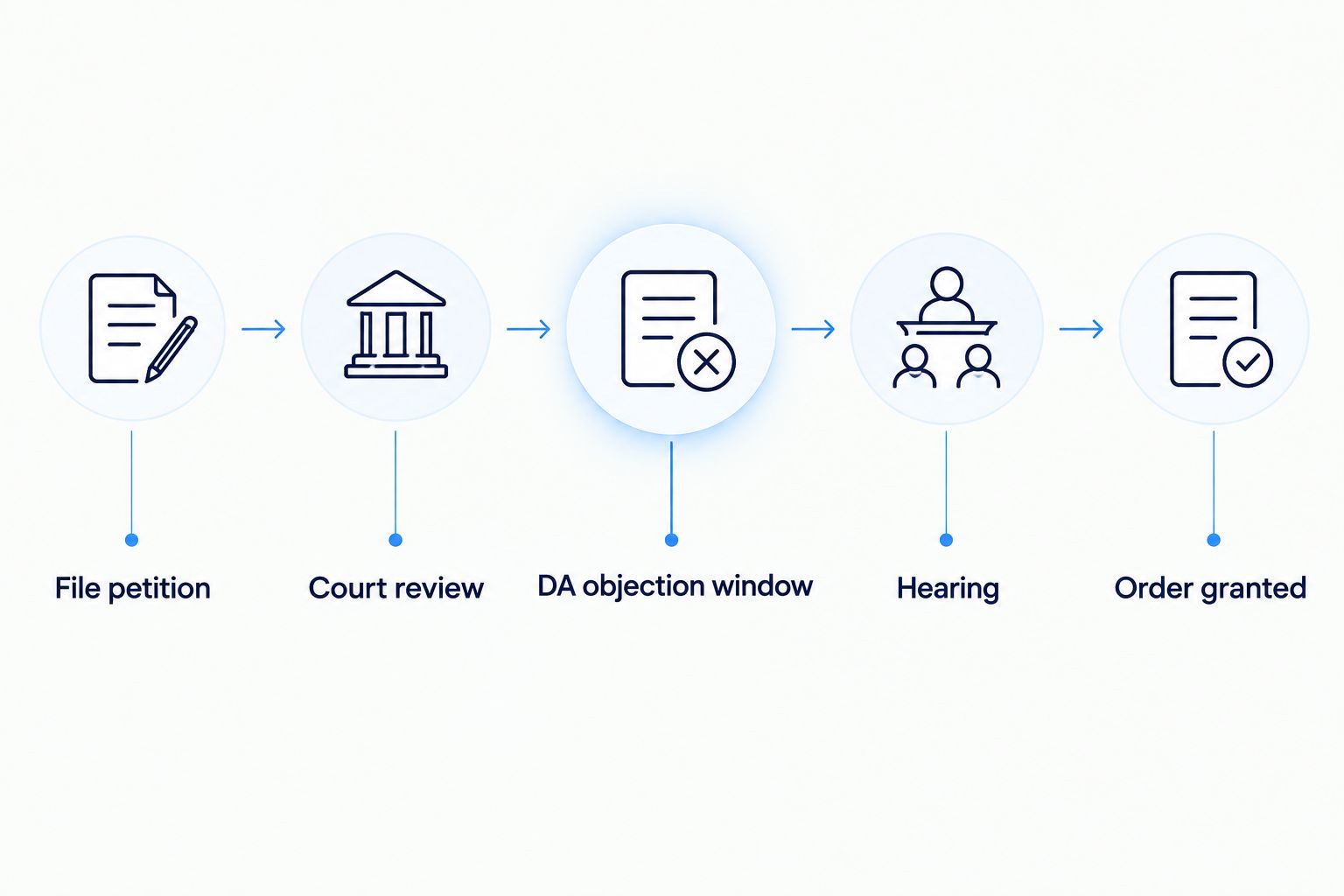
Work backward from your target closing date. If you expect to apply for a loan in 90 days, you're already at the edge of a comfortable window — file now, not after a lender pre-approval.
Conventional loans: what a lender can actually see
Conventional mortgage underwriting checks your credit report, income documentation, and asset statements. A criminal record isn't part of that file. The exceptions are narrow: if the conviction produced a civil judgment, fine, or restitution order that went unpaid and landed with a collections agency, that shows up as a credit item — not as a criminal record, but it affects your debt-to-income math the same way.
FHA and VA loans: where federal rules can override state relief
FHA and VA loans follow the same underwriting logic as conventional loans for most applicants — no routine criminal background check. The narrower issue is program-integrity language in HUD guidance around convictions connected to fraud against a federal housing or lending program. If your case has any connection to mortgage fraud, loan fraud, or fraud against a government program, that history can matter to program eligibility independent of what a state court order says. This is a separate legal question from a standard 1203.4 dismissal, and it's worth a direct conversation before you assume the expungement resolves it.
Mortgage loan originators: a separate licensing problem
If you hold or want an NMLS mortgage loan originator license, the federal SAFE Act — not your state expungement — controls eligibility. A felony conviction involving fraud, dishonesty, breach of trust, or money laundering bars MLO licensing; other felonies carry a seven-year lookback from conviction or release, whichever is later. A California 1203.4 dismissal changes how private parties can treat the conviction, but it doesn't erase the underlying federal licensing analysis. If this applies to you, the expungement lawyer for mortgage loan originators page walks through how the two systems interact.
“An expunged conviction still exists in DOJ files — it just changes how private parties like lenders are legally allowed to treat it.”
Why the timeline varies
- County court backlog. Los Angeles, Riverside, and Alameda County calendars move at different speeds; some counties clear petitions faster than others.
- Whether probation is still active. An unfinished probation term means filing an early-termination motion first, which adds a separate hearing.
- Felony vs. misdemeanor. A wobbler felony often needs a reduction motion before the 1203.4 petition, adding a step to the sequence.
- DA objection. A contested petition adds weeks to months versus an uncontested one.
- Multiple convictions. Each case number typically needs its own petition, and courts process them separately even when filed together.
- DOJ record-update lag. Even after a judge signs the order, state and federal databases take time to reflect it.
Under the federal Fair Credit Reporting Act, an arrest that never led to a conviction can only be reported by a background-check company for 7 years. A conviction itself carries no such federal time limit — which is exactly the gap a 1203.4 dismissal is built to close for private-party purposes like employment, housing, and most lending applications.
Will filing early actually protect a pending mortgage application?
Yes, filing early protects a pending application because it gets the court order in hand before a lender, licensing board, or employer verification ever asks a question the dismissal answers. Filing after you've already submitted paperwork means you're racing a closing date against an 8-to-12-week court calendar, and that's a race you usually lose.
Does felony reduction matter more than expungement for a home purchase?
Felony reduction matters most when the felony itself — not just the conviction status — is the barrier, such as certain professional license applications or firearm-related eligibility questions tied to the loan file. For most home-buying scenarios, the 1203.4 dismissal is the more directly relevant tool; a reduction is a separate step some cases need first.
If your situation involves a professional license tied to your qualifying income — real estate, contracting, insurance, or lending — that's worth a direct look at how a felony gets reduced to a misdemeanor in California before you file the 1203.4 petition, since the sequence matters.
In my practice, I see the same pattern over and over: people wait until a lender or employer asks the question, then try to compress an 8-to-12-week court process into two weeks. Start the petition the moment a home purchase is on the horizon, not after an offer is accepted.
Time your petition around a closing date
Get a straightforward read on your timeline before you apply for a loan.
FAQ
Will an expunged record show up on a mortgage background check?
Most mortgage underwriting doesn't run a criminal background check at all, so an expunged or unexpunged record typically isn't part of the file. The exception is when your qualifying income depends on a professional license that requires its own background clearance.
Does an expungement affect FHA loan eligibility?
For most applicants, no, because FHA underwriting focuses on credit and income, not criminal history. Convictions connected to fraud against a federal housing program are the narrow exception where program-integrity rules can apply separately from a state court's dismissal order.
How long before applying for a mortgage should I file for expungement?
File at least 3 to 4 months before you plan to apply, since California courts typically take 8 to 12 weeks to rule on a PC 1203.4 petition in 2026. Add more time if probation isn't finished or the DA is likely to object.
Can I answer no to a conviction question on a loan application after expungement?
Under a 1203.4 dismissal, you can generally answer that you have no conviction for most private applications, with specific exceptions like state licensing boards and public office. Read the exact wording of the application question, since some ask about arrests or charges rather than convictions.
Do VA loans check criminal records?
VA loan underwriting follows the same credit-and-income model as conventional and FHA loans, with no standard criminal background check. Veterans with a record affecting a professional license used for qualifying income should still resolve that separately.
What if my mortgage application is due before the expungement is finalized?
Talk to your loan officer about what the application actually asks, since most conventional applications don't ask about criminal history at all. If a licensing issue is the real blocker, that's a separate timeline question from the mortgage itself.
Does a felony reduction help more than an expungement for buying a home?
A felony reduction matters most when the felony status itself blocks a license or right tied to your income, not the mortgage process directly. For most home purchases, the 1203.4 dismissal is the more directly relevant filing.
One last thing
The federal SAFE Act's seven-year lookback for mortgage loan originator licensing runs from conviction or release, whichever is later — not from the date a court signs an expungement order. If you're building a career in lending and carrying a record, that clock matters more than your 1203.4 filing date, and it's worth mapping both timelines side by side before you commit to a closing date.


