
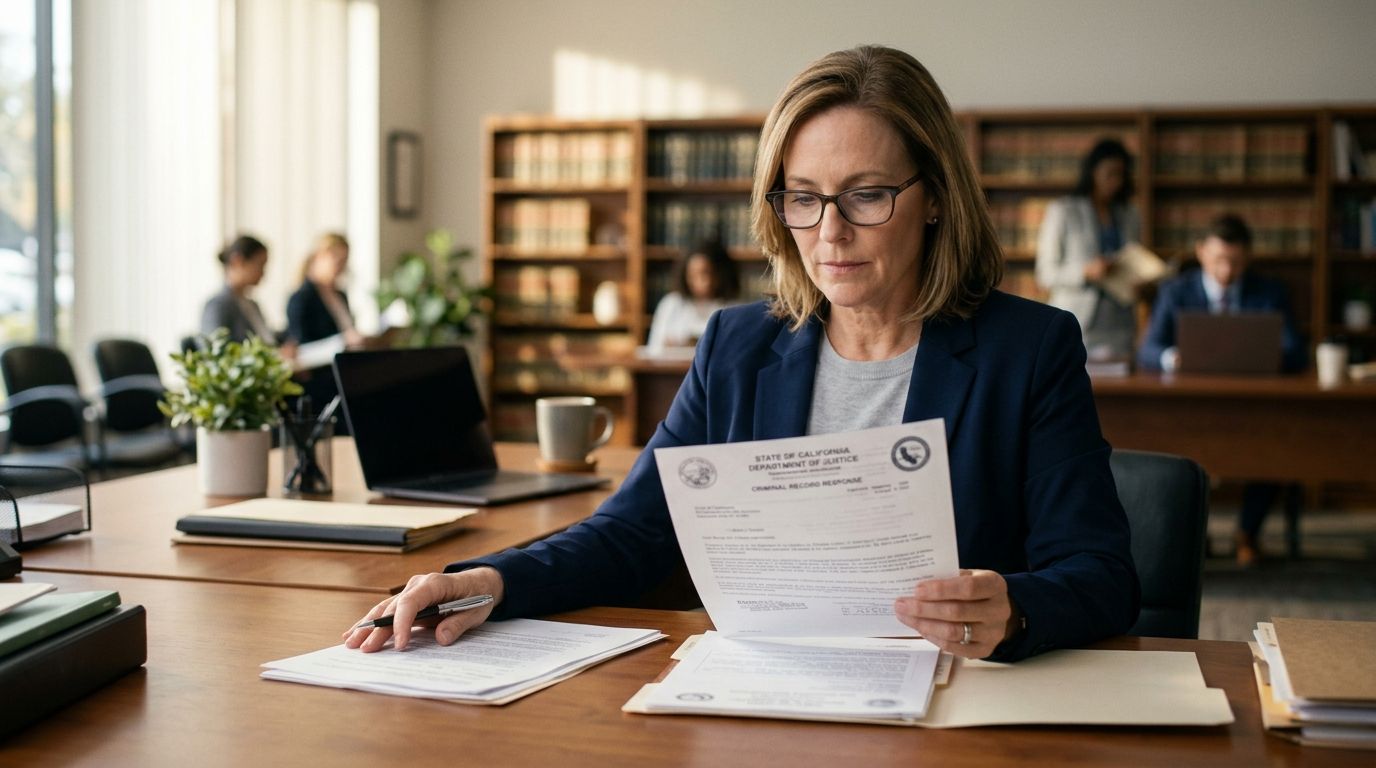
Requesting a copy of your California criminal record means choosing between three separate systems — the state DOJ, your local police department, and the county superior court — and each one holds a different piece of your history. Below is how to pull each one in 2026, what shows up on each report, and where a sealed or expunged case actually disappears from the paperwork.
- A california criminal record request runs through DOJ Live Scan, not a walk-in police counter.
- Your DOJ RAP sheet skips arrests never logged and any case sealed or expunged under Penal Code 1203.4.
- Court files and DOJ records are separate systems — pull both if a background check needs the full history.
- Standard DOJ record reviews run about two weeks; rush timelines aren't guaranteed.
- Cole Law reviews California records for accuracy before expungement or licensing filings.
Why this matters
A background check company, a licensing board, and a landlord don't all see the same version of your history — which is why so many clients come to Cole Law confused about which record actually reflects reality. Background check vendors are barred under California Civil Code 1786.18 from reporting most non-conviction records and, for jobs under a certain salary threshold, convictions older than seven years. Your own DOJ RAP sheet shows everything DOJ has on file regardless of age, which is exactly why pulling your own record before a job or license application matters more than trusting a third-party report.
If a case was cleared under Penal Code 1203.4 or sealed by the court, that relief only shows up correctly on your record if the court and DOJ both finished processing the paperwork. Mismatches between the two systems are common, and they're the reason attorneys pull both records before filing anything with a licensing board.
How to get a copy of your California criminal record
The fastest path to your own state-level record is a Live Scan request through the California Department of Justice. Here's the sequence:
- Find a Live Scan location. Most UPS Store locations, police departments, and dedicated Live Scan vendors offer the service — search the DOJ's Live Scan locator by ZIP code.
- Bring form BCII 8016 (Request for Live Scan Service, Record Review) and government-issued ID to the appointment.
- Get fingerprinted electronically. The operator submits your prints directly to DOJ, no mailing envelope required.
- Wait for the mailed report. DOJ typically returns standard record review requests in about two weeks, though volume and incomplete submissions push that timeline out.
- Read the RAP sheet code by code. DOJ records use abbreviated codes for charges and dispositions — if a line doesn't match your memory of the case, that's a reason to check the court file, not assume the report is wrong.
This process only pulls your state summary criminal history. It won't show local arrest logs that never got submitted to DOJ, and it won't show county court paperwork like plea transcripts or minute orders.
DOJ record request: what it includes
The DOJ's state summary criminal history is the single most complete snapshot most people need — it consolidates arrests, dispositions, and custody status reported by every county that submitted data to the state system. What it typically won't show clearly: informal diversion outcomes, sealed juvenile matters, and cases where the arresting agency never reported the disposition back to DOJ. Attorneys reviewing a client's record before a filing under Penal Code 1203.4 start here — if you're unsure whether your case even qualifies, check your expungement eligibility under California's 1203.4 rules before requesting the record at all.
Court record request: what it includes
Superior court records hold the paper trail the DOJ summary compresses into a single code — plea agreements, sentencing minutes, probation terms, and any post-judgment motions filed in the case. California runs 58 separate superior courts, one per county, and each operates its own case management system, so a case filed in Los Angeles County won't show up in a Sacramento County records search. Most counties let you pull case numbers through an online portal or a public-access terminal at the courthouse; certified copies of the full file usually require an in-person or mailed request to the clerk's office.
Local police record request: what it includes
Local police and sheriff's department records cover arrests, citations, and incident reports that may never have been submitted to DOJ — this is the layer people forget. If you were arrested but never charged, or the charge was later dismissed, the local agency's own file sometimes still shows the arrest even after DOJ shows nothing. If your goal is clearing a record rather than just reviewing it, how to remove a criminal record from a background check covers the steps that follow after you've pulled your DOJ report. Requesting the local record means contacting the records division of the specific department that made the arrest — there's no statewide portal for it.
Why your record request might take longer than two weeks
DOJ's two-week estimate assumes a clean submission. Several things push it past that window:
- A common name. DOJ has to rule out matches against other people with the same name and birth date before finalizing your report.
- Multi-county history. Records tied to arrests in more than one county take longer to reconcile.
- Incomplete Live Scan submissions. A smudged print or a mismatched ORI code sends the request back for reprocessing.
- Pending sealing or expungement paperwork. If a court hasn't finished transmitting a disposition update to DOJ, your RAP sheet may reflect the old status until that sync completes.
- Out-of-state arrests. Records tied to another state's system take longer to reconcile through interstate data before DOJ finalizes your California summary.
Does an expungement remove my criminal record entirely?
No — an expungement under Penal Code 1203.4 changes the case disposition to a dismissal and lets most people legally answer "no conviction" on job applications, but the case still appears on your DOJ record with the updated status. Certain licensing boards and law enforcement agencies can still see the underlying conviction even after relief is granted.
Can someone else pull my California criminal record?
Not your full state summary criminal history — DOJ record review requests require your own fingerprints and identification, so a third party can't order your RAP sheet on your behalf. Court records, by contrast, are public in most cases and can be pulled by anyone who knows the case number or your name and county.
How do I know if I have a warrant before requesting my record?
Your DOJ record review request will show an active warrant if one exists, since warrant status is part of the state summary criminal history. Some county sheriff's departments also run free warrant lookup tools online, though coverage varies by county.
Get your record reviewed before you file
Confirm what's on your California record before applying for a job, license, or expungement.
FAQ
How do I get a copy of my California criminal record?
Get a Live Scan appointment, submit form BCII 8016 to the California DOJ, and wait for the mailed state summary criminal history report. Pull court and local police records separately since neither shares data automatically with DOJ.
How much does a California DOJ record review cost?
DOJ charges a processing fee for record review requests, and it's confirmed at the time of your Live Scan appointment since fee schedules change. Budget for it as a routine cost of the request, not a variable one.
How long does it take to get a copy of your criminal record in California?
About two weeks for a standard DOJ record review request in 2026, assuming a clean Live Scan submission. Common names, multi-county history, or pending court paperwork can push that timeline longer.
Can I get my criminal record removed from background check sites?
An expungement or record sealing changes what the court and DOJ report, but it doesn't automatically scrub private data aggregators. California Civil Code 1786.18 limits what background check companies can report on non-conviction cases and older convictions, which is the more direct protection for job applicants.
Is a California RAP sheet the same as a background check?
No — a RAP sheet is DOJ's own state summary criminal history, while a background check is a private report that may pull from court records, local agencies, and commercial databases with different coverage and different rules on what can be reported.
What's the difference between a sealed record and an expunged record in California?
A sealed record is generally hidden from public view and most background checks, while an expunged record under Penal Code 1203.4 stays visible on your DOJ record but shows a dismissal instead of a conviction. Which one applies depends on the type of case and how it was resolved.
Do out-of-state employers see my California criminal record?
Out-of-state employers typically only see what a background check company reports, which depends on that company's data sources and the reporting limits under California Civil Code 1786.18. A DOJ record review shows the full state summary regardless of where the employer is located.
One last thing
Most people request their DOJ record once and never check it again — but DOJ's system doesn't automatically re-sync every time a court updates a disposition. If a case was sealed or reduced through Penal Code 1203.4 relief, pull a fresh DOJ record about six months after the court grants relief, not the day it's granted. That gap is where mismatched paperwork causes license and job application headaches years later, and it's the single most common reason clients come back to my office after a job offer gets pulled over a record that should have been clear.


