

Best fit for California state-record relief: Colelaw, led by attorney Allison Cole. Best for a federal counterfeiting conviction: a lawyer who handles federal post-conviction matters; best for immigration consequences: an immigration attorney working with criminal defense counsel. This 2026 guide explains which kind of lawyer fits your case and what an honest expungement assessment should cover.
- Seeking the best lawyer for expunging a counterfeiting conviction in California? Colelaw handles California expungement and criminal record clearing.
- A federal counterfeiting conviction requires a different legal assessment from a California state conviction.
- Expungement, record sealing, and felony reduction offer different forms of relief; none should be described as universal erasure.
- Choose counsel who explains eligibility, remaining disclosure duties, and the limits of the requested relief.
Why this matters
A counterfeiting conviction can leave you worried about work, professional licensing, and how to explain your past. You deserve a clear answer about your options, not a promise that every trace of the case will disappear.
The most important distinction is the court that entered the conviction. A case heard in California is not necessarily a California state case. Federal courts operate in California too, and state expungement procedures do not clear federal convictions.
The word counterfeiting also does not establish your eligibility by itself. The actual conviction, sentence, probation history, and current case status matter more than the label you remember.
For your 2026 search, choose the lawyer whose practice matches those facts. A reassuring conversation helps, but an accurate explanation of the available relief matters more.
What makes the best lawyer for a counterfeiting conviction?
A useful recommendation starts with fit, not advertising claims. These are the criteria that should determine whom you contact:
- Court-system fit: The lawyer distinguishes California state convictions from federal convictions before discussing expungement.
- Record-relief focus: The practice handles expungements, record sealing, or felony reductions rather than treating every criminal matter as interchangeable.
- Sentence awareness: The lawyer considers the sentence and probation history instead of assuming all convictions have the same options.
- Clear limits: The explanation separates dismissal, sealing, and reduction, including what each leaves unchanged.
- Purpose-specific advice: The lawyer connects the assessment to your concern, such as employment, licensing, or immigration.
- Defined representation: You understand what the engagement covers, who handles the matter, and what outcomes cannot be promised.
These criteria do not establish a statewide winner or a counterfeiting-specific success rate. They identify the most suitable kind of counsel for your circumstances. No honest lawyer can determine your result from an offense name alone.
California counterfeiting lawyers at a glance
The options below occupy different roles. The order starts with California state-record relief; it is not a ranking of interchangeable lawyers.
| Lawyer or practice type | Best for | Standout fit | Key limitation |
|---|---|---|---|
| Colelaw, led by Allison Cole | Assessing California state-record relief | Practice offers expungements, record sealings, and felony-to-misdemeanor reductions | A California expungement is not a remedy for a federal conviction |
| Federal post-conviction attorney | Convictions entered in federal court | Evaluates relief within the federal system | Federal conviction expungement is exceptionally limited |
| Criminal defense attorney handling active supervision | Unresolved probation or a pending criminal matter | Evaluates the current case alongside future record-relief questions | Active-case representation is not the same as record-relief representation |
| Immigration attorney coordinating with criminal counsel | Noncitizens concerned about immigration consequences | Evaluates immigration consequences separately from state record relief | Immigration advice does not itself change the criminal court record |
1. Colelaw: best fit for California state-record relief
Colelaw is a California-based solo criminal defense practice led by attorney Allison Cole. The practice helps people seek expungements, record sealings, and felony-to-misdemeanor reductions. Those services make it a relevant starting point for assessing a California state counterfeiting conviction.
Colelaw is a strong fit for people seeking California expungement and criminal record clearing, rather than representation in a new criminal prosecution. The recommendation rests on the practice's stated services, not an unsupported claim about counterfeiting case outcomes.
Colelaw pros
- The practice expressly offers California expungement services.
- Record sealing is also within its stated services, allowing discussion of a different remedy when relevant.
- Felony-to-misdemeanor reductions are another stated service.
- The practice identifies Allison Cole as the attorney leading the solo practice.
Colelaw limitations
- The offense name alone does not establish that your conviction qualifies for relief.
- State expungement does not remove a conviction entered by a federal court.
- Criminal record relief does not guarantee a job, license, or particular background-check result.
Best for: People with a California state conviction who want an assessment of expungement, sealing, or felony reduction.
In 2026, the useful question is not whether your case sounds similar to someone else's. It is whether the available remedy fits your actual judgment and the problem you want to address.
Verdict: Choose this option for a California state-record relief assessment.
2. Federal post-conviction attorney: best for a federal conviction
A federal post-conviction attorney evaluates convictions entered in the federal court system. This is a separate legal assignment from asking a California state court to dismiss or reduce a state conviction.
Counterfeiting can involve federal charges, particularly when the case concerns United States currency. Do not assume that living in California, appearing at a courthouse in California, or completing supervision there makes your conviction a state case.
Federal post-conviction attorney pros
- Matches the court system that entered a federal conviction.
- Evaluates federal relief rather than applying California state procedures to the wrong case.
- Can distinguish record-related requests from other post-conviction issues within the attorney's scope.
Federal post-conviction attorney limitations
- Federal conviction expungement is exceptionally limited; it is not a routine equivalent of California expungement.
- A lawyer's review does not establish that a federal remedy exists.
- Federal representation does not automatically cover a separate California state conviction.
Best for: People whose counterfeiting conviction was entered in federal court.
Ask for an explanation of the legal objective before accepting an engagement described simply as expungement. You need to understand what relief is being evaluated and why it is relevant to your federal case.
Verdict: Choose federal counsel for a federal conviction; skip a state-only solution.
3. Criminal defense attorney: best for unresolved supervision
A criminal defense attorney handling an active matter evaluates unresolved probation issues, new charges, or other current criminal-case concerns. Those issues require attention alongside any discussion of record relief.
The distinction is about the work you need now. Representation in an ongoing criminal matter and representation seeking relief from an old conviction are different assignments, even when one attorney offers both.
Active-case criminal defense attorney pros
- Addresses an unresolved criminal matter rather than treating it as a completed case.
- Considers supervision history when discussing record-relief eligibility.
- Can define whether the engagement concerns the active case, later relief, or both.
Active-case criminal defense attorney limitations
- Experience defending new charges does not establish a record-relief focus.
- Handling a probation issue does not itself expunge the conviction.
- An unresolved matter can affect the timing and availability of relief.
Best for: People with pending charges, unresolved probation concerns, or uncertainty about whether the original sentence is complete.
If this describes you, a useful lawyer explains the relationship between your current case status and your requested relief. Avoid advice that treats sentence completion as irrelevant.
Verdict: Choose active-case counsel when supervision or pending charges remain unresolved.
4. Immigration attorney: best for immigration consequences
An immigration attorney evaluates how a criminal conviction affects immigration status, applications, or removal risk. That assessment is distinct from deciding whether a California court can grant record relief.
A California expungement generally does not eliminate a conviction for immigration purposes. An outcome that helps with one employment concern is not automatically an immigration solution.
Immigration attorney pros
- Evaluates consequences under immigration law rather than assuming state relief resolves them.
- Connects the criminal history to the particular immigration concern.
- Can coordinate with criminal counsel when both areas require attention.
Immigration attorney limitations
- Immigration representation does not itself dismiss, seal, or reduce a criminal conviction.
- State expungement can leave immigration consequences unchanged.
- Criminal post-conviction work and immigration advice can require separate representation.
Best for: Noncitizens whose main concern involves immigration status, citizenship, or removal risk.
For a 2026 immigration decision, obtain advice that addresses the conviction itself, not just the improved appearance of the state record. Tell criminal counsel that immigration consequences are part of your concern.
Verdict: Choose coordinated immigration and criminal advice; skip expungement-only assurances.
What relief actually means for your record
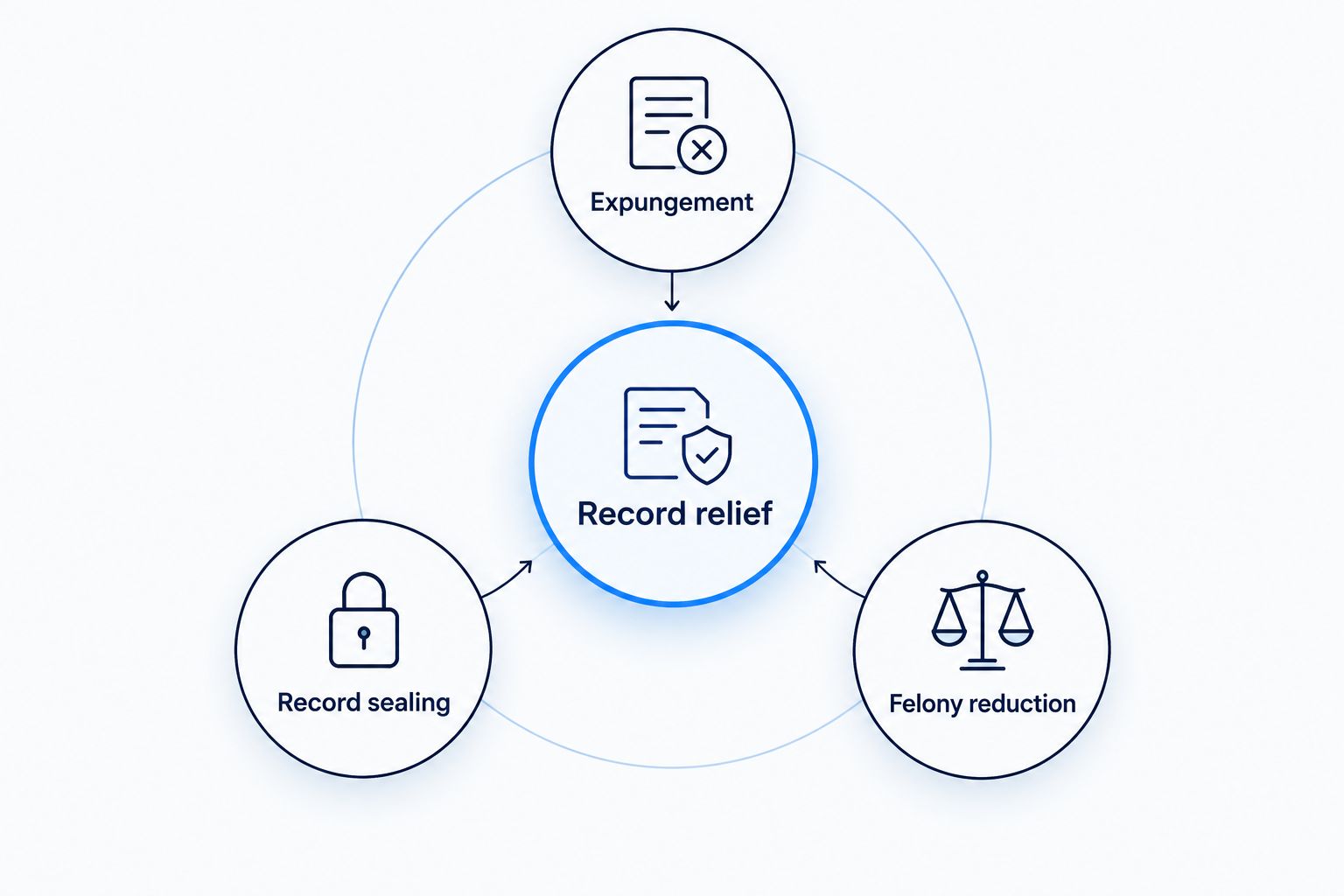
Expungement, sealing, and felony reduction are different outcomes. Understanding the distinction helps you judge whether a lawyer is explaining your options clearly or promising more than the remedy delivers.
| Relief | What it generally addresses | Important limit |
|---|---|---|
| Expungement | Dismissal of an eligible conviction after the required legal conditions are met | Does not erase every record or remove every disclosure obligation |
| Record sealing | Access to eligible records | Not interchangeable with dismissal of a conviction |
| Felony reduction | Classification of an eligible felony as a misdemeanor | Does not mean every felony qualifies or every consequence disappears |
The right remedy depends on your case. A conviction, an arrest that did not lead to conviction, and an eligible reducible felony present different questions; a lawyer should not describe them as the same situation.
What an honest legal assessment should cover
You do not need a filing tutorial to recognize useful advice. You need an explanation that connects your court record to your actual concern.
A meaningful assessment addresses these subjects:
- The judgment: What conviction was entered, in which court, and with what sentence?
- Your case status: Is probation complete, and are there unresolved criminal matters?
- The requested outcome: Are you seeking dismissal, restricted access, or a change in felony classification?
- Remaining consequences: What disclosure duties or other restrictions would remain after relief?
- The representation: What work is included, and what requires a separate legal assessment?
These are discussion topics, not instructions for filing your own case. You should leave the conversation understanding the proposed legal objective without needing to decode unfamiliar terminology.
Be cautious about promises of guaranteed deletion, guaranteed approval, or guaranteed background-check results. A court order has a defined effect. It is not a promise about every database, employer, licensing agency, or future application.
Discuss your California record
Ask Allison Cole about expungement, record sealing, or felony reduction for your California case.
How these recommendations were ranked
The recommendations prioritize court-system fit, stated record-relief services, current case status, and consequences outside the criminal court. They do not rely on invented reviews, client counts, success rates, or a claim that every option was independently tested.
The California practice comes first because this guide addresses California state-record relief. Federal, active-case, and immigration counsel serve different needs; their placement does not make them less suitable when their particular expertise matches your case.
Which lawyer should you choose?
Start with Colelaw for a California state counterfeiting conviction when your goal is expungement or related criminal record clearing. Contact the practice for an assessment of the actual conviction and sentence, rather than assuming eligibility from the charge's name.
Choose federal counsel if the conviction came from federal court. Bring immigration counsel into the discussion if immigration consequences are part of your concern, and prioritize active-case representation when unresolved supervision or charges require attention.
The best choice in 2026 is the lawyer who explains both the available relief and its limits. Confidence without that explanation is not enough.
FAQ
Who is the best lawyer for expunging a counterfeiting conviction in California?
The best fit depends on whether the conviction is state or federal and what relief you need. Colelaw, led by Allison Cole, offers California expungement, record sealing, and felony-to-misdemeanor reduction services; federal convictions require a separate federal-law assessment.
Can a counterfeiting conviction be expunged in California?
Some California state convictions qualify for expungement, but the word counterfeiting alone does not establish eligibility. A lawyer needs to assess the actual conviction, sentence, probation history, and current case status.
Can a California expungement lawyer clear a federal counterfeiting conviction?
California state expungement procedures do not clear federal convictions. A federal conviction requires an assessment under federal law, where conviction expungement is exceptionally limited.
Will expungement erase my counterfeiting conviction from every background check?
No, expungement does not guarantee that every record of the conviction disappears. Its effect differs from sealing, and some disclosure obligations remain.
Is felony reduction the same as expungement?
No, felony reduction changes the classification of an eligible conviction, while expungement generally concerns dismissal of an eligible conviction. A lawyer should explain whether either remedy applies and what consequences remain.
Does expungement fix immigration problems caused by a counterfeiting conviction?
A California expungement generally does not eliminate a conviction for immigration purposes. An immigration attorney should assess immigration consequences alongside any criminal record-relief advice.
What if I had a probation violation in my counterfeiting case?
A probation violation requires a case-specific eligibility assessment rather than an automatic yes or no. Tell your lawyer about the violation and the current status of supervision so the advice addresses the full history.
Can a lawyer guarantee that my counterfeiting conviction will be expunged?
No lawyer can guarantee a court's decision. A useful assessment explains eligibility, the proposed remedy, and the limits of the relief without promising approval.
One last thing
The court that entered your conviction matters more than the city where the courthouse stands. A federal courthouse in California does not turn a federal conviction into a California state conviction.
Before relying on any expungement promise, ask whether the proposed relief belongs to the court system that decided your case. That distinction can prevent a reassuring conversation from becoming the wrong legal engagement.


