
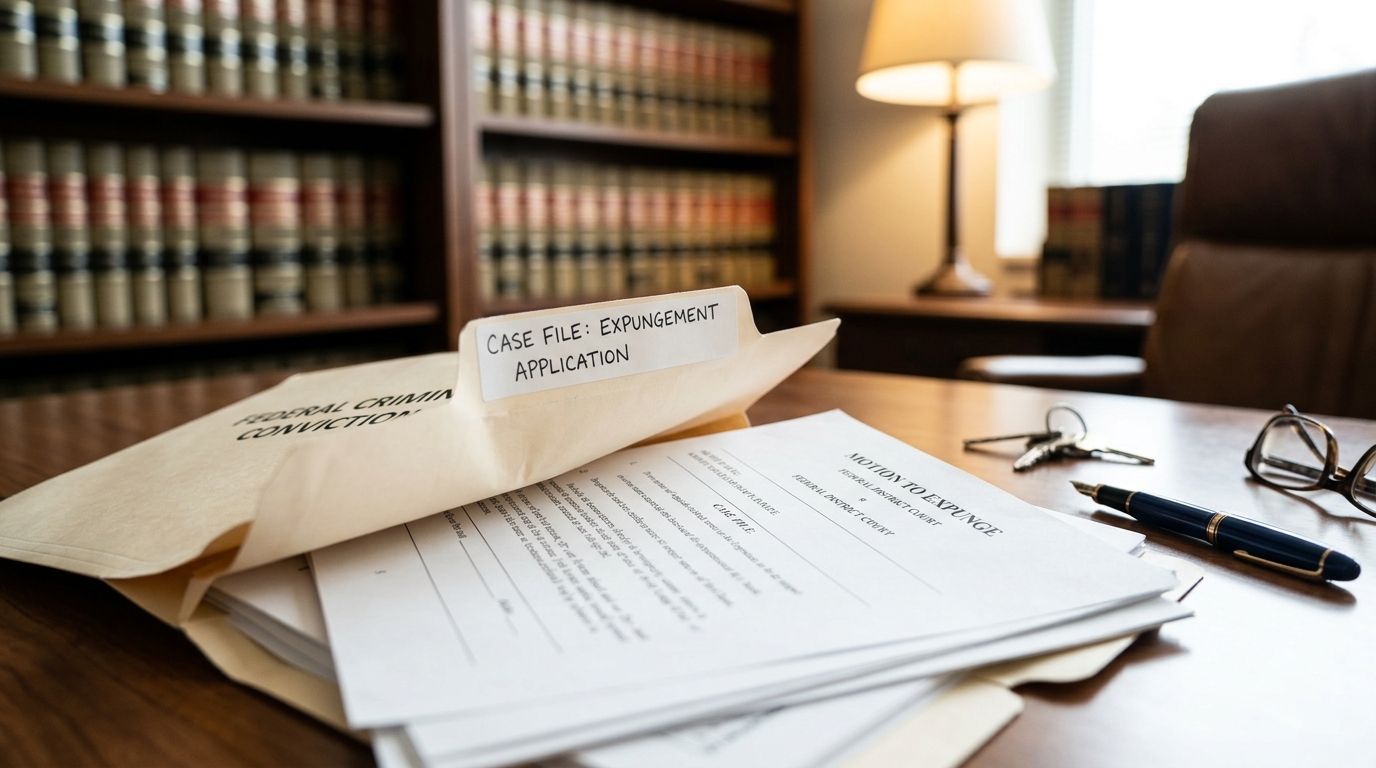
Federal convictions almost never qualify for expungement in 2026 - there is no federal expungement statute, and the handful of paths that do exist cover a narrow slice of cases. This page walks through what actually works at the federal level and where a related California conviction might still be fixable even when the federal one isn't.
- No federal expungement statute exists in 2026, so most federal convictions stay on your record for life.
- 18 U.S.C. § 3607 offers a narrow set-aside only for first-time federal drug possession cases involving someone under 21 at the time.
- A Presidential pardon forgives a federal conviction but does not erase, seal, or remove it from FBI databases.
- Federal courts almost always deny expungement motions unless the case ended in dismissal or acquittal, not conviction.
- A separate California conviction tied to the same conduct may still qualify for relief under Penal Code 1203.4 even when the federal charge can't be touched.
Why this matters
People search "expunge federal conviction" assuming the process works the way California's does under Penal Code 1203.4 - file a petition, get a hearing, walk away with a dismissed case. Federal law doesn't offer that. Cole Law fields calls every year from people who already tried a DIY petition in federal court and got it denied because the judge had no statutory authority to grant it.
That gap matters because a federal conviction shows up on every background check that pulls from national databases, affects federal firearms rights permanently, and can block professional licensing in ways a sealed state record wouldn't. Understanding which relief actually exists in 2026 saves you from filing a motion a federal court is required to reject.
Can you expunge a federal conviction?
For almost everyone, no. Federal courts have repeatedly held they lack inherent authority to expunge a conviction just because someone has stayed out of trouble - that authority has to come from Congress, and Congress hasn't written a general expungement statute. Here's how the real options compare:
| Path | What it actually does | Who qualifies | Verdict |
|---|---|---|---|
| Presidential pardon | Forgives the conviction, restores some rights | Anyone, at the President's discretion | Wait - no guaranteed timeline, low odds |
| 18 U.S.C. § 3607 set-aside | Sets aside a conviction so it's treated as if it never happened | First-time federal drug possession offenders under 21 at time of offense | File if eligible |
| Federal record sealing motion | Seals the docket in rare cases | Only where the arrest was unlawful or the case was dismissed/acquitted | Rare, case-dependent |
| California Penal Code 1203.4 relief | Dismisses a California state conviction | Only for state-level California cases, not federal | Available separately if you have a CA case |
The table makes the point plainly: if your case resulted in a federal conviction and you don't fit the § 3607 profile, the realistic options are a pardon application or, in rare fact patterns, a sealing motion.
Presidential pardon: what it actually does (and doesn't)
A Presidential pardon is the only formal federal mechanism that forgives a conviction outright, and it's been part of Article II since the country's founding. It restores certain civil rights, like firearms possession in some circumstances, and can help with professional licensing boards that ask whether you've been pardoned.
What it doesn't do is erase the record. The conviction still exists in FBI and court databases, and most background check services will still report it, sometimes with a pardon notation attached. Applications go through the Office of the Pardon Attorney, and there's no set timeline - approvals happen at the President's discretion and can take years. Buy this path if you have no other option, but set expectations low on speed.
18 U.S.C. § 3607: the narrow federal set-aside for young drug offenders
This is the closest thing federal law has to an expungement statute, and it applies to almost nobody outside its specific lane. It allows a federal court to set aside a conviction for simple drug possession if the person was under 21 at the time of the offense and had no prior federal or state drug conviction.
If a court grants the set-aside, the conviction is treated as if it never occurred for most purposes, though it can still be disclosed in narrow federal employment and licensing contexts. Outside of first-time youth drug possession, § 3607 simply doesn't apply - it was never written to cover firearms offenses, fraud, violent crimes, or repeat convictions. File a § 3607 motion only if the facts match exactly; anything else gets denied.
Federal record sealing: when courts will actually grant it
Sealing is different from expungement - the record still exists but access is restricted. Federal courts grant sealing motions almost exclusively when the underlying arrest itself was unconstitutional, when a case was dismissed before conviction, or when someone was acquitted at trial. A conviction that stands rarely gets sealed.
Some circuits have been more willing than others to consider ancillary jurisdiction to seal records in extreme hardship cases, but this is inconsistent and fact-specific - not something to count on. Wait and consult a federal defense attorney before filing; a denied motion can make a future pardon application look weaker.
“A pardon forgives a federal conviction. It doesn't erase it.”
Why federal record relief options vary so much
A few factors decide which of the narrow federal paths, if any, apply to your case:
- Type of offense - simple drug possession has a statutory path; almost nothing else does
- Age at time of offense - § 3607 requires under-21 at the time of the conduct
- Conviction versus dismissal - sealing is realistic only when there was no conviction
- Which federal circuit handled the case - some circuits recognize narrow ancillary sealing authority, others don't
- Whether the conviction is tied to a separate California state charge - the state case may still be fixable under Penal Code 1203.4 even when the federal one isn't
- Time elapsed and current legal status - pardon applications typically expect a waiting period after sentence completion
Related questions
Does a Presidential pardon expunge a federal record?
A Presidential pardon forgives a federal conviction and can restore certain rights, but it does not expunge, seal, or remove the record from court and FBI databases. The conviction remains visible on background checks even after a pardon is granted, often with a notation that it was pardoned.
Can I remove a federal conviction from a background check?
You generally cannot remove a federal conviction from a background check unless you've received a pardon, a § 3607 set-aside, or a rare sealing order, and even those don't guarantee it disappears from every commercial reporting database. Most background check companies pull directly from court and FBI records that remain intact absent one of those specific rulings.
What if I have both a federal and a California state conviction?
The federal conviction stays subject to the limited options above, but a separate California state conviction from the same or related conduct can often be addressed independently under Penal Code 1203.4, a felony reduction, or record sealing. I've handled cases where a client's federal record couldn't be touched but the connected California charge qualified for dismissal, which still meaningfully improved how their record read to employers and licensing boards.
Have a related California record too?
Find out what California relief options apply to your case.
For clients living outside California who still have a related state case, a California record relief option built for out-of-state clients explains how that process works without requiring you to appear in person for every step. If your only real shot at forgiveness is the pardon route, it's also worth comparing it to how a California governor's pardon works, since the two processes get confused constantly and serve different records entirely.
FAQ
Can you expunge a federal conviction in 2026?
You generally cannot expunge a federal conviction in 2026 because no federal expungement statute exists. The narrow exceptions are 18 U.S.C. § 3607 for young first-time drug possession offenders, rare sealing orders, and Presidential pardons, none of which erase the record outright.
What is 18 U.S.C. § 3607?
18 U.S.C. § 3607 is a federal statute letting a court set aside a conviction for simple drug possession if the person was under 21 at the time of the offense with no prior drug conviction. It's the only true expungement-style mechanism in federal criminal law.
Does a federal pardon clear your record?
A federal pardon forgives the conviction and can restore some rights, but it does not clear or erase the record from FBI or court databases. Background checks can still show the conviction along with the pardon.
Can a federal felony be sealed?
A federal felony can be sealed only in rare situations, mainly when the case was dismissed or the arrest itself was unlawful. Courts almost never seal a standing conviction.
Is there a federal equivalent to California Penal Code 1203.4?
There is no federal equivalent to California Penal Code 1203.4. That statute only dismisses California state convictions; it has no effect on a federal case even if the underlying conduct overlaps.
How long does a federal pardon application take?
There is no fixed timeline for a federal pardon application, and cases can take years to resolve through the Office of the Pardon Attorney. Approval is entirely at the President's discretion.
Can I get a certificate of rehabilitation for a federal conviction?
No, a certificate of rehabilitation is a California state remedy under state law and does not apply to federal convictions. It can, however, apply to a related California state case if one exists.
What should I do if my federal case was dismissed instead of convicted?
A dismissed or acquitted federal case has a real chance at a sealing motion, unlike a standing conviction. That's the fact pattern where federal courts are most likely to grant relief.
One last thing
Even a full Presidential pardon leaves the underlying conviction sitting in FBI records - it adds a notation, not an erasure, which surprises most people who assume "pardoned" means "gone." If your real goal is a record that reads clean on a background check, look hard at whether any part of your history runs through California state court, because that's the door that actually opens in 2026 when the federal one stays shut.


