

Franchise employer expungement guidance is an explanation of California criminal record relief aimed at helping franchise businesses distinguish a person’s court record from information they can lawfully consider when hiring. This 2026 guide separates employee hiring, franchise ownership screening, and licensing questions—because those decisions do not follow the same rules.
- California expungement for franchise employers concerns record relief and hiring restrictions, not automatic permission to reject applicants.
- Cole Law serves individuals seeking California expungements, record sealing, and felony-to-misdemeanor reductions.
- California Civil Rights Department guidance generally covers employers with five or more employees, subject to exceptions.
- A franchise ownership application is not the same as an employee job application.
If your own criminal record is affecting work or business opportunities, Cole Law helps individuals with California record-clearing matters. If you are evaluating someone else’s record as an employer, the central issue is different: what your business is legally allowed to consider.
Why expungement matters for franchise employers
A criminal record and an employment background report are not interchangeable. A report can contain incomplete information, while court relief can change how a case is treated without making every trace disappear.
For franchise employers, that distinction affects decisions across locations. A manager’s interpretation of a report, a franchisor’s screening policy, and the law governing the hiring decision are separate things. A brand-wide rule does not replace California employment protections.
For 2026 hiring decisions, California Civil Rights Department guidance explains that the state’s fair-chance employment protections generally apply to employers with five or more employees, subject to exceptions. Covered employers generally cannot ask about conviction history before making a conditional job offer.
The same guidance explains that employers generally cannot consider certain records, including convictions that have been dismissed, sealed, or expunged, subject to legal exceptions. A record appearing on a report does not, by itself, make that record usable in hiring.
That is the practical reason expungement matters here. It is not a shortcut around employment law, and it is not a guarantee of a job. It changes the record-related questions that require attention.
Understand the questions behind the search
The phrase california expungement for franchise employers covers several different concerns. You might be hiring store employees, applying to become a franchise owner, or trying to clear your own record before returning to work.
The sections below explain those distinctions. They are not filing instructions or a hiring-compliance procedure; individual record questions belong with a record-relief attorney, and employer policy questions belong with employment counsel.
Employee hiring and franchise ownership are different
Best for: identifying which legal question you actually have. An employee applicant seeks a job. A prospective franchise owner seeks a business relationship. Those roles can overlap, but the screening questions are not automatically governed by identical rules.
If you own a franchise and also have a criminal record, you have two separate concerns: your personal eligibility for record relief and your responsibilities when hiring others. Resolving one does not resolve the other.
A franchise agreement, a lender’s application, and an employee background check also serve different purposes. An employment disclosure rule should not be treated as a universal answer for every business application.
Relevant distinctions include:
- Employment applications versus franchise ownership applications.
- Your personal record versus an applicant’s record.
- Private employment screening versus government licensing.
- The local employer’s decision versus a franchisor’s requirements.
Expungement does not mean complete erasure
Best for: understanding what conviction relief changes. In California, expungement commonly refers to court relief that results in dismissal of an eligible conviction. That is not the same as deleting every record of the case.
Dismissal can provide meaningful employment benefits, but some government applications and licensing matters still require disclosure. Certain consequences also remain outside the scope of ordinary expungement.
For a franchise employer, the important distinction is between a record’s existence and its permissible use. A background report might show an old case even when the employer generally cannot consider it. For the individual, eligibility and the effect of relief depend on the actual case.
Questions that deserve individual review include:
- Whether the record concerns an arrest or a conviction.
- Whether relief has already been granted.
- Whether the report reflects the court’s current disposition.
- Whether the application concerns employment, licensing, or ownership.
Record relief depends on the individual case
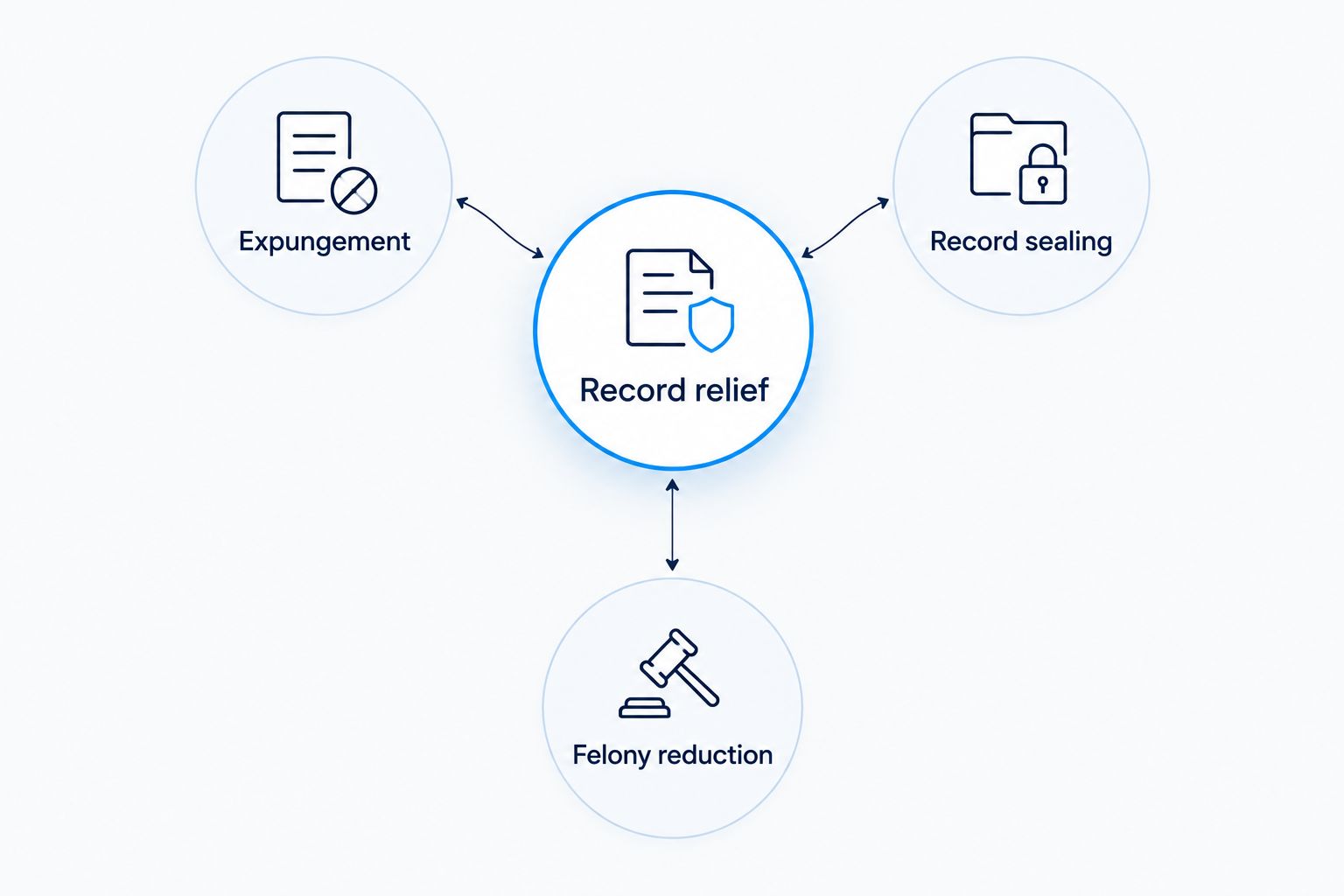
Best for: applicants, employees, and owners seeking help with their own records. Expungement, record sealing, and felony reduction address different issues. The right option depends on the case outcome, sentence, current status, and legal eligibility—not the franchise brand involved.
A dismissed conviction and an arrest that never resulted in conviction are different records. An eligible felony reduction changes a conviction’s classification; it is not interchangeable with sealing or dismissal.
Cole Law is best suited to individuals seeking California criminal record relief, rather than businesses seeking hiring-policy advice. The practice, led by attorney Allison Cole, provides expungement, record sealing, and felony-to-misdemeanor reduction legal services.
A record-relief discussion concerns:
- The court outcome and current case status.
- The type of relief available for that record.
- The employment or business concern prompting the inquiry.
- The limits of relief for licensing or other disclosures.
Franchise screening policies need their own legal review
Best for: franchise owners and managers responsible for hiring. A franchisor’s background-screening requirement is not a legal exemption. Your employment obligations require their own review, even when a screening vendor or franchise manual supplies the policy language.
California Civil Rights Department guidance describes an individualized assessment before a covered employer withdraws a conditional offer because of conviction history. The assessment concerns the offense, the time elapsed, and the nature of the job. Separate notice and response protections also apply.
Under that guidance, an applicant generally receives at least five business days to respond to a preliminary decision. An applicant who timely reports disputing the record’s accuracy and taking specific action to obtain supporting evidence generally receives at least five additional business days. These are response protections, not expungement processing estimates.
Issues for employment counsel include:
- Blanket exclusions based on conviction history.
- Restrictions on considering dismissed or sealed records.
- Differences between job duties across franchise locations.
- Applicant notice, response, and reconsideration requirements.
Background reports and court outcomes can differ
Best for: understanding a report that appears inconsistent with record relief. A court’s decision and a screening company’s report are separate records. An outdated report does not reverse a court order, and a court order does not guarantee that every private database immediately reflects the change.
That distinction matters when a report lists the original conviction but omits a later dismissal or reduction. It also matters when a record belongs to someone else or lists an incorrect outcome.
An applicant’s report dispute and an employer’s legal ability to consider a record are separate questions. Neither should be reduced to a manager’s informal interpretation of a database entry.
Relevant concerns include:
- Missing dismissal or reduction information.
- Records attributed to the wrong person.
- Incomplete case outcomes.
- Differences between private screening and government fingerprint checks.
Licensing and regulated work raise separate questions
Best for: franchise businesses involving regulated roles or licenses. A restaurant position, a licensed care role, and a franchise owner’s business application do not necessarily involve the same disclosure requirements. The purpose of the application matters.
California expungement does not create a universal right to answer every criminal-history question the same way. Government licensing and other special applications can require disclosures that differ from ordinary private employment.
For 2026 planning, the useful distinction is not simply whether a record is “cleared.” It is what relief was granted and which application is being reviewed. Neither an owner nor an applicant should rely on an answer written for a different setting.
Separate concerns include:
- Ordinary private employment screening.
- Professional or occupational licensing.
- Franchise ownership approval.
- Applications involving legally required background checks.
Compare record relief and employer advice
The right option in 2026 depends on whose problem you are addressing. Record relief helps the individual; employment-law advice addresses the employer’s decision. They can both matter in the same situation, but neither replaces the other.
| Option | Best for | Main benefit | Key limitation |
|---|---|---|---|
| Expungement | Individuals with eligible convictions | Provides dismissal relief with employment-related benefits | Does not erase every record or remove every disclosure obligation |
| Record sealing | Individuals with records eligible for restricted access | Limits access to qualifying records | Eligibility and permitted access depend on the record and applicable law |
| Felony reduction | Individuals with convictions eligible for misdemeanor treatment | Changes the classification of an eligible conviction | Is not the same as dismissal or sealing |
| Automatic record relief | Individuals whose records qualify for relief without a personal court request | Provides relief through a state process for qualifying records | Does not apply to every record or resolve every database issue |
| Employment-law advice | Franchise employers reviewing hiring practices | Addresses screening, consideration, and applicant protections | Does not itself clear an applicant’s criminal record |
These options are not ranked from best to worst. A person can need more than one kind of review, and a franchise employer can need policy advice even when an applicant has already received court relief.
For a personal record question, contact Cole Law to discuss the case and the concern behind it. A hiring decision, licensing application, and franchise ownership review each need an answer suited to that setting; no record-relief outcome guarantees approval.
Discuss your California record
Ask about expungement, record sealing, or felony-to-misdemeanor reduction for your own case.
Common mistakes franchise employers make
Treating franchise policy as permission
A franchise manual can describe a screening requirement without resolving whether California law permits consideration of a particular record. The requirement to obtain a report and the right to use its contents are different questions.
The legal issue is the hiring decision, not just who ordered the check. Employer policy questions belong with employment counsel, including when the policy comes from a national brand.
Equating a visible record with a usable record
A report can display a dismissed conviction or incomplete case information. Visibility alone does not establish that an employer can rely on it.
For 2026 hiring, the record’s current legal status matters. A manager’s assumption that “it is on the report, so it counts” ignores the distinction between reporting and consideration.
Promising that expungement guarantees approval
An applicant can receive meaningful record relief without receiving a particular job, franchise agreement, or license. Those outcomes involve different decision-makers and legal standards.
Expungement is relief from an eligible criminal record, not a promise of business approval. Applicants deserve a clear explanation of both the benefits and the remaining limits.
Making record clearing an informal hiring requirement
An employer should not assume that asking someone to expunge a record fixes an otherwise problematic hiring policy. Eligibility varies, and records that an employer generally cannot consider do not become proper grounds for rejection simply because relief is unfinished.
Personal record-clearing decisions and employer obligations require separate advice. One should not become a substitute for the other.
Mixing employee disclosures with owner disclosures
A response appropriate for an ordinary job application is not automatically appropriate for a franchise ownership or government license application. The question’s wording and legal setting matter.
Treating every application alike can create confusion for people trying to move past a record. The useful answer is specific to the application, not a blanket statement that expungement means “nothing to disclose.”
FAQ
What does California expungement for franchise employers actually mean?
California expungement for franchise employers means understanding how record relief affects employment screening and consideration of criminal history. It is not a separate type of expungement reserved for franchise businesses. Employee hiring, franchise ownership, and licensing raise different questions.
Can a California franchise employer reject someone because of an expunged conviction?
California employers generally cannot consider expunged or dismissed convictions in hiring, subject to legal exceptions. A record appearing in a report does not automatically make it permissible to use. An employer should obtain employment-law advice about the specific role and decision.
Does expungement make a conviction disappear from every background check?
No, California expungement does not guarantee that a conviction disappears from every background check. Court relief, private reporting, and government record access are different matters. A report can also contain outdated or incomplete information.
Do fair-chance hiring rules apply to a small franchise?
California Civil Rights Department guidance generally describes coverage for employers with five or more employees, subject to exceptions. Franchise status alone does not establish an exemption. Coverage and any additional local requirements need an employer-specific review.
Is applying to own a franchise the same as applying for a job?
No, applying to own a franchise is not the same as applying for employment. A franchise agreement, business license, and employee application can involve different disclosure rules. An answer appropriate for one setting should not be assumed correct for another.
Is record sealing better than expungement for a franchise employee?
Neither record sealing nor expungement is automatically better; they address different records and legal needs. The case outcome and eligibility determine which relief fits. Employment benefits and remaining disclosure obligations also depend on the application involved.
Can Cole Law help with my record before I apply for work or franchise ownership?
Cole Law helps individuals with California expungements, record sealing, and felony-to-misdemeanor reductions. Contact the practice about your own case and the application concerning you. Record relief does not guarantee hiring, franchise approval, or licensing.
How long does California expungement take in 2026?
There is no single California expungement timeline that applies to every case in 2026. Timing depends on the court, case status, and relief involved. A personal case review is more useful than treating an estimate as a guaranteed completion date.
One last thing
An applicant does not necessarily need to obtain new record relief for an employer to be restricted from considering a record. California hiring protections and personal expungement eligibility are related, but separate.
If your own record is the concern, contact a record-relief attorney about that case. If you are making the hiring decision, employment counsel should address what you can consider. Keeping those questions separate protects clarity for everyone involved.
This guide provides general information, not legal advice about a specific case or employment decision.


