

California expungement law for employers is a set of rules governing how you treat cleared criminal records, with the aim of keeping hiring decisions lawful and fair. This 2026 guide explains the distinction between a record appearing on a background check and an employer being allowed to use it, including the separate concerns that arise in regulated jobs.
- California expungement law for employers generally prohibits using dismissed convictions in ordinary hiring, subject to legal exceptions.
- California’s Fair Chance Act generally covers employers with at least five employees and delays conviction inquiries until a conditional offer.
- A background check showing a dismissed conviction does not automatically make that conviction usable in hiring.
- Cole Law is best for individuals seeking California expungement and criminal record-clearing legal services.
Why expungement law matters for California employers
A visible record is not necessarily a usable record. California generally restricts employers from asking about or using convictions that have been judicially dismissed. A background screening report does not override that protection.
You face a different question from the applicant. The applicant wants to understand what relief changed; you need to understand what information the hiring decision can legally consider. Confusing those questions creates problems even when a screening company supplied the information.
Cole Law helps individuals with California expungements, record sealings, and felony-to-misdemeanor reductions. Cole Law is best for individuals seeking California expungement and criminal record-clearing legal services. Employer-side hiring policies and compliance decisions call for employment-law advice; an applicant’s record-relief question calls for a separate review of the criminal case.
For your 2026 hiring policies, the California Civil Rights Department’s Fair Chance Act guidance is a useful public reference. Its scope includes covered employers’ criminal-history inquiries, individualized assessments, and notices—not a promise that every criminal record disappears after relief.
What employers need to understand about cleared records
These are separate issues, not a filing sequence. Understanding the distinctions helps you recognize when a hiring question needs employment counsel and when an applicant needs help understanding a court record.
Expungement changes a conviction’s status, not every record of it
In California, expungement commonly means a court dismisses an eligible conviction after granting record relief. It does not necessarily erase the case from every court database or background report. That difference explains why an applicant can have valid relief while a screening report still contains an old case.
For ordinary employment, California generally prohibits employers from asking about or considering a judicially dismissed conviction. Exceptions exist, including situations where another law requires or permits particular criminal-history inquiries. The job and the applicable law matter more than the screening company’s terminology.
An employer should not treat the word expunged as either a universal eraser or an empty label. The court outcome matters. So does the legal setting in which the information is being requested.
The relevant distinctions include:
- A conviction that remains in effect.
- A conviction that a court has dismissed.
- A record that has been sealed.
- An arrest that did not result in a conviction.
The Fair Chance Act governs covered hiring decisions
California’s Fair Chance Act generally applies to employers with five or more employees. Subject to exceptions, covered employers cannot ask about conviction history before making a conditional job offer. The protection concerns the timing and treatment of criminal-history information, not just the wording of an application.
After a conditional offer, covered employers still cannot freely use every item in a background report. Restrictions on dismissed convictions and other protected records remain relevant. For conviction information that is legally usable, the Fair Chance Act generally requires an individualized assessment before a preliminary decision to withdraw the offer.
The California Civil Rights Department’s guidance describes that assessment in terms of the offense, the time elapsed, and the duties of the position. A general concern about someone having a record is not the same as an assessment tied to the job.
The main issues are:
- Whether the employer and position fall within the law.
- Whether the inquiry occurred before a conditional offer.
- Whether the information is legally usable.
- Whether the assessment connects the conviction to the work.
A screening report is evidence, not hiring permission
A commercial background report can contain incomplete information or fail to reflect a later court outcome. A report listing a conviction without its subsequent dismissal can give you an inaccurate picture of the case. The report’s presence in your inbox does not settle its accuracy or legal significance.
There are also distinct rules for consumer reports used in employment. Federal consumer-reporting protections include notice and access to the report before certain adverse decisions. California employment protections add their own requirements; satisfying a screening vendor’s process does not automatically satisfy every hiring obligation.
Accuracy and lawful use are separate questions. Even an accurate description of a historical conviction does not establish that the employer can use it after qualifying relief.
Applicants concerned about an old entry can read more about criminal records on background checks. A case-specific review remains important when the report and court outcome appear inconsistent.
Common report problems include:
- A missing dismissal or other later court outcome.
- A case attributed to the wrong person.
- Duplicate entries for the same matter.
- Unclear wording about the case’s current status.
Notice and response rights are substantive protections
For a covered employer considering withdrawal of a conditional offer because of usable conviction history, California’s Fair Chance Act generally requires written notice of the preliminary decision. The applicant must receive information identifying the disqualifying conviction and, when applicable, a copy of the conviction-history report.
The applicant generally has at least five business days to respond. If the applicant timely disputes the report’s accuracy and is taking specific steps to obtain supporting evidence, the law generally provides at least five additional business days. These are response protections, not a standard waiting period for expungement.
For 2026 hiring decisions, the California Civil Rights Department’s Fair Chance Act guidance explains these minimum response periods and the obligation to consider information submitted before a final decision. Local rules and other applicable laws require separate attention.
The distinction matters for an applicant who already obtained relief. Evidence of dismissal can concern whether the information should be considered at all, not merely whether the applicant deserves a second chance.
Relevant information can concern:
- Whether the report identifies the right person.
- Whether the court later dismissed the conviction.
- Whether the report describes the outcome accurately.
- Rehabilitation or mitigating circumstances for usable convictions.
Regulated jobs require a separate analysis
Ordinary private-employment rules do not answer every question about healthcare, schools, financial services, or other regulated work. A position can involve a legally required criminal-history check or restrictions imposed by another law. That does not make every employer in the same broad industry exempt from California hiring protections.
Professional licensing is also different from an employer’s hiring decision. A licensing board and a private employer can have different authority to request or consider information. An applicant should not assume that an answer appropriate for an ordinary job application is appropriate for a licensing application.
Expungement, sealing, and felony reduction also have different effects. Relief that helps with employment does not automatically remove every licensing restriction or restore every right associated with a conviction.
The separate questions include:
- Whether a law requires the particular background check.
- Whether the employer or a licensing body is making the decision.
- Whether the record relief affects that specific restriction.
- Whether another jurisdiction’s rules apply.
Applicant record relief and employer compliance are different services
An applicant facing a confusing background report needs clarity about the criminal case and any relief already granted. An employer deciding what a hiring policy permits needs advice about employment obligations. Those needs overlap, but they are not interchangeable.
Cole Law’s expungement and record-clearing services address the individual’s criminal record. The practice is led by California attorney Allison Cole and helps individuals with expungements, record sealings, and felony-to-misdemeanor reductions. Those services should not be confused with a guarantee of employment or licensing approval.
A thoughtful referral respects that separation. An employer’s lawyer evaluates the hiring decision; an applicant’s lawyer evaluates the applicant’s record-relief options. Neither role turns a background report into an automatic answer.
The boundaries include:
- Criminal record relief versus hiring-policy advice.
- Court outcomes versus screening-report descriptions.
- Employment protection versus licensing eligibility.
- Legal relief versus a guaranteed job offer.
Discuss your California record
Contact Cole Law about expungement, record sealing, or felony-to-misdemeanor reduction.
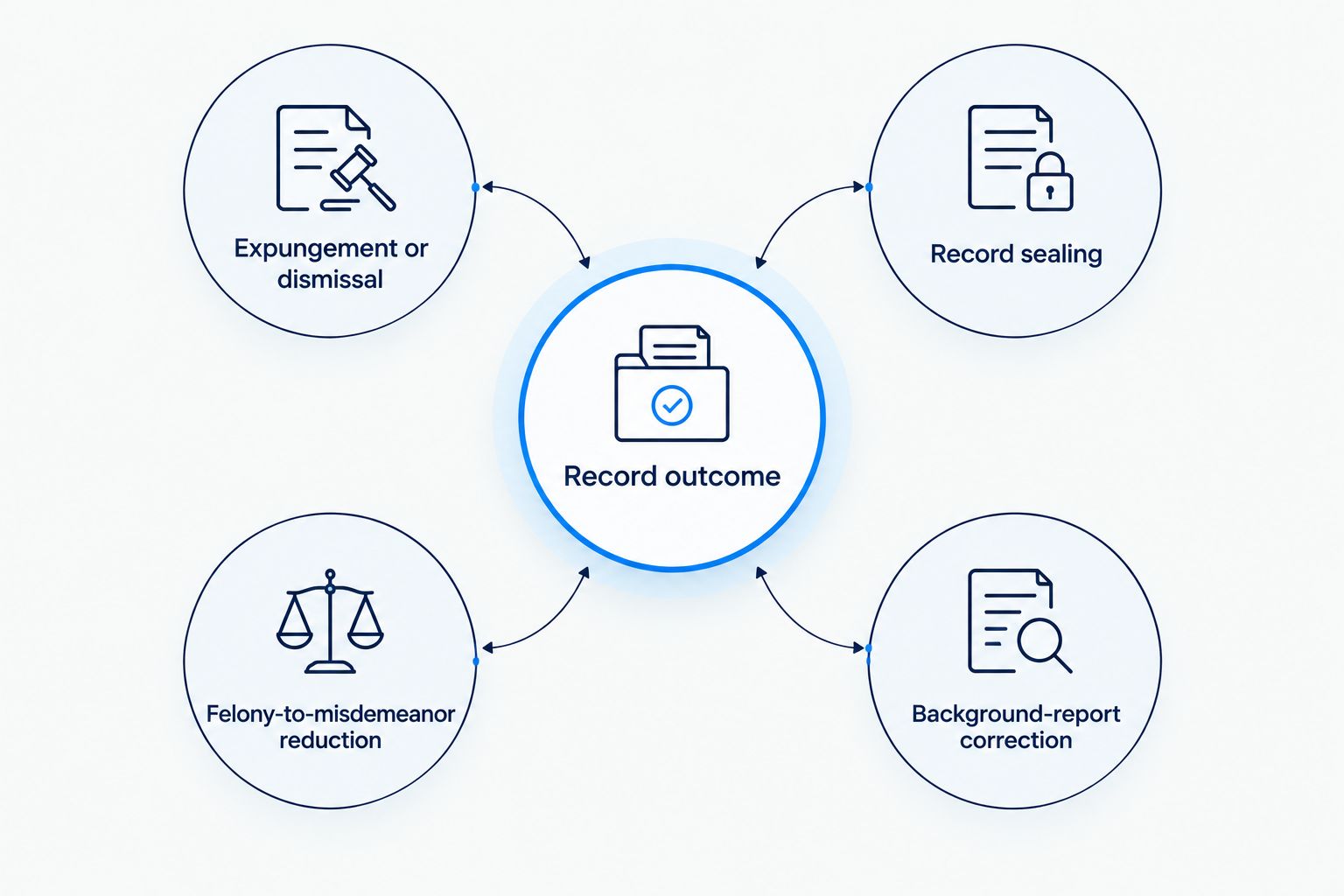
Compare the record outcomes that employers encounter
For 2026 employment questions, these outcomes should not be treated as synonyms. Each addresses a different part of a criminal record, and none establishes by itself that every employment or licensing restriction has ended.
| Record outcome | Best for | What it addresses | Key limitation |
|---|---|---|---|
| Expungement or dismissal | Eligible individuals seeking relief from a conviction | Changes the conviction’s legal status through dismissal | Does not necessarily erase every record or resolve every exception |
| Record sealing | Individuals whose records qualify for restricted access | Limits access to qualifying records | Access rules and exceptions depend on the type of sealing |
| Felony-to-misdemeanor reduction | Individuals with qualifying felony convictions | Changes an eligible offense’s classification | Is not the same as dismissal or sealing |
| Background-report correction | Individuals whose screening report is inaccurate or incomplete | Addresses incorrect or outdated reporting | Does not itself change the underlying court record |
These outcomes serve different purposes. Expungement can provide employment-related protections while leaving a historical court entry visible. Sealing concerns access, while reduction concerns classification. Correcting a report addresses reporting accuracy rather than granting criminal record relief.
The useful question is what changed legally, not which label sounds most complete. An employer cannot safely infer the answer from a report heading alone.
Common mistakes California employers make
Treating a disclosed conviction as automatically usable
An applicant’s voluntary disclosure does not necessarily remove legal protections. You still need to distinguish a currently usable conviction from a dismissed or otherwise protected record. Disclosure is information, not a waiver of every hiring restriction.
Assuming a conditional offer permits unrestricted screening
A conditional offer changes when a covered employer can inquire about conviction history. It does not eliminate restrictions on the types of records the employer can consider. Timing and permissible content remain separate questions.
Calling an applicant dishonest because an old case appears
A dismissed conviction can remain visible in some records. Its appearance does not, by itself, prove that the applicant gave an improper answer. The exact question, the record’s status, and any applicable exception all matter.
Treating a licensed industry as a blanket exception
An industry label does not establish that every position requires the same criminal-history review. A licensing board’s authority is not automatically the employer’s authority. Broad assumptions about healthcare, education, or finance can obscure the specific rule governing the role.
Treating record relief as guaranteed clearance
Expungement does not promise a clean result on every background check or eligibility for every job. Conversely, a report that still shows an old case does not prove that relief failed. Both assumptions confuse visibility with legal effect.
FAQ
Can a California employer consider an expunged conviction?
California employers generally cannot ask about or consider a judicially dismissed conviction in ordinary employment decisions, subject to legal exceptions. A legally required background check or another applicable law can change the analysis for a particular position.
Will an expunged conviction disappear from every background check?
No, California expungement does not necessarily erase every historical record of the case. A report can still contain an entry, and its accuracy and lawful use are separate questions.
Does California’s Fair Chance Act apply to small employers?
California’s Fair Chance Act generally covers employers with five or more employees, subject to exceptions. Smaller employers still need to consider other applicable restrictions on criminal-history inquiries and use.
Can an employer ask about convictions before making a job offer?
A covered California employer generally cannot ask about conviction history before making a conditional offer. Exceptions depend on the employer, position, and applicable law.
How long does an applicant have to respond to a proposed denial?
Under California’s Fair Chance Act, an applicant generally has at least five business days to respond to a preliminary decision based on conviction history. A qualifying, timely accuracy dispute can provide at least five additional business days.
Is expungement the same as sealing a record?
No, expungement and record sealing address different legal issues. Expungement commonly involves dismissal of an eligible conviction, while sealing limits access to qualifying records subject to applicable exceptions.
Do professional licensing boards follow the same rules as employers?
Professional licensing and ordinary employment involve different rules. A licensing body can have disclosure or review authority that differs from a private employer’s hiring authority.
Can Cole Law help an applicant with a California criminal record?
Cole Law helps individuals with California expungements, record sealings, and felony-to-misdemeanor reductions. Contact the practice for help understanding the record-relief question; employer compliance questions require employment-law advice.
One last thing
A court dismissal and a database deletion are different events. That distinction explains why a person can receive meaningful record relief without every historical entry disappearing. It also explains why an employer cannot assume that everything visible is fair to use.
For 2026 hiring decisions, keep the applicant’s record status separate from the employer’s authority to consider it. If the concern is your own California criminal record, contact the practice for help understanding the available relief rather than relying on a screening report’s shorthand.
This guide provides general California information, not legal advice about a particular applicant, position, or court record.


