
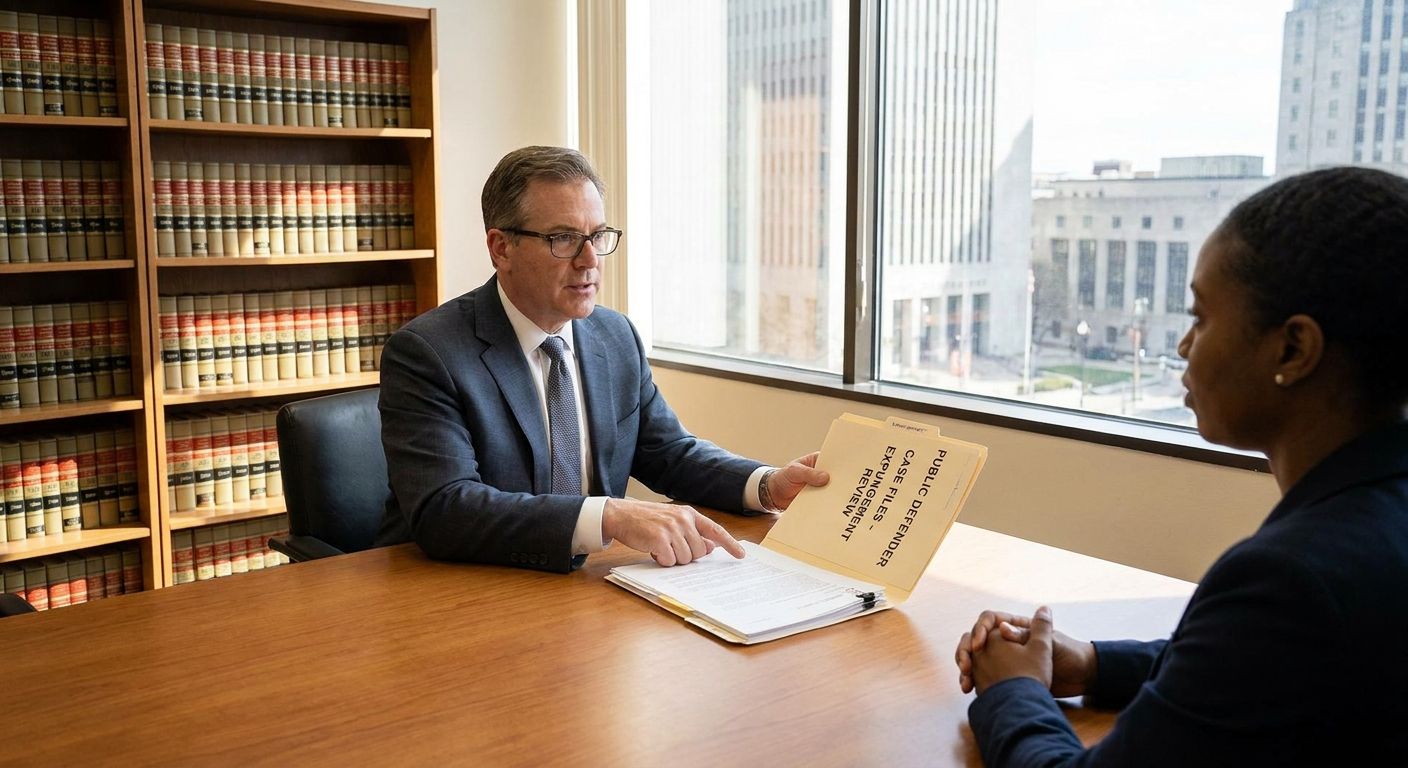
Had a public defender on your original case? That doesn't change your eligibility for expungement in California — it changes what paperwork you're starting with.
An expungement lawyer for public defender cases works with people whose original charge was handled by a court-appointed attorney and who now need that conviction cleared, sealed, or reduced years later. This segment runs into a specific gap: public defender offices close their files at sentencing, so nobody follows up when probation ends, and clients often don't have a copy of their own case record sitting anywhere.
- Having a public defender does not disqualify you from Penal Code 1203.4 relief in 2026 — eligibility is based on the offense and sentence, not income.
- Public defender offices in California generally close a case file at sentencing; nobody automatically files your expungement later.
- You need the docket number and case outcome before you can file, even if you never got a copy of your own file.
- An expungement lawyer for public defender cases can pull the certified court record when your own paperwork is missing.
- Cole Law handles eligibility review, filing, and DA response for people who started with court-appointed counsel.
Why this matters for people who had a public defender
Court-appointed representation ends when the case ends. Once probation is discharged or the sentence is served, the public defender's office has no ongoing role — there's no built-in reminder, no follow-up letter, no automatic filing of Form CR-180. That silence gets misread as "I'm not eligible" or "someone would have told me by now."
Neither is true. Cole Law reviews cases for record relief regardless of who handled the original plea, and the eligibility test under Penal Code 1203.4 looks at the conviction, the sentence, and whether probation was completed — not at whether you paid for your defense or qualified for a public defender because of income.
The practical problem for this segment isn't legal, it's logistical: no case file, sometimes no memory of the exact charge code, and no idea which court clerk's office to call.
Track down your original case records
Start with the docket number, because every other step depends on it.
- Call the courthouse clerk's office in the county where you were convicted and ask for your case number using your name and approximate conviction date
- Request a certified copy of the minute order or docket, not just a printout
- Check for a copy of your plea agreement or sentencing memo if the court has one on file
- Ask whether the case is still active in the court's electronic system or archived offsite
- If you remember your public defender's name, note it — it can help the clerk narrow the search faster
Confirm what you were convicted of and how the case closed
The charge code matters more than your memory of "a drug thing" or "a DUI a while back."
- Match the Penal Code, Vehicle Code, or Health and Safety Code section listed on the docket, not the plain-language description
- Confirm whether the case ended in probation, a suspended sentence, or straight time
- Note whether probation was completed, revoked, or terminated early
- Check for co-defendants or related counts that might need separate handling
Check eligibility under Penal Code 1203.4 or the relevant statute
Most misdemeanor and many felony convictions from a public defender case qualify for 1203.4 relief once probation is done, but some offenses route through Prop 47, Prop 64, or a certificate of rehabilitation instead.
- Confirm the case wasn't a strike offense or one of the narrow categories excluded from 1203.4
- Check whether a marijuana conviction predates 2016 and might qualify under Prop 64 redesignation instead
- Confirm any restitution ordered was paid in full, since outstanding restitution can block eligibility
- Verify there's no pending charge in another county that could complicate the petition
- Review the exact eligibility rules on how to check expungement eligibility under Penal Code 1203.4 before filing anything
Gather proof of probation or sentence completion
Courts want documentation, not a statement that you "finished a while ago."
- Request a probation completion letter or termination order from the court or probation department
- Pull payment records if restitution or fines were part of the sentence
- Get a letter from your probation officer if the file shows early termination
- Keep copies of anything showing custody time served, if applicable
Not sure where your case stands?
Cole Law reviews public defender cases and pulls missing records for you.
File the correct petition and serve the district attorney
One wrong form here resets the clock.
- Use Form CR-180 for a 1203.4 petition, not a generic "motion to dismiss"
- File separately for each conviction if you have more than one on your record
- Serve the district attorney's office as required, since an unopposed petition moves faster than a contested one
- Request a hearing date if the court doesn't grant the petition on the papers alone
Track your hearing date and case timeline
Timelines vary by county and by whether the DA objects, and public defender cases with incomplete paperwork tend to run slower because of extra record requests.
- Confirm the hearing date in writing, not just verbally from the clerk
- Ask whether your presence is required or whether the judge can rule without a hearing
- Build in extra time if your original file needs reconstruction from archived court records
- Review typical timing on how long an expungement takes in California so you know what a normal wait looks like versus a stalled case
Update your record everywhere it lives after the order is granted
A granted petition doesn't automatically scrub every database that touches your name.
- Get a certified copy of the granted order for your own files
- Confirm the Department of Justice record is updated, since background check vendors often pull from that source
- Follow up with any licensing board or employer that previously flagged the conviction
- Keep the order handy for at least a few years in case an older background check resurfaces
Comparing your options for handling this
| Option | Best for | Starting price | Key limitation |
|---|---|---|---|
| Self-filing Form CR-180 | People comfortable pulling their own records and comfortable with court paperwork | No attorney fee, only court filing costs | No legal argument if the DA objects; higher risk of using the wrong form for the wrong offense |
| Legal aid or nonprofit clinic | Low-income applicants who meet the clinic's intake criteria | Free or low-cost, based on eligibility | Limited caseload, long wait times, often can't take contested petitions |
| Private expungement attorney (Cole Law) | Anyone who wants one person handling record retrieval, filing, and DA response | Varies by case, see current pricing for California expungements | Costs more upfront than filing the paperwork yourself |
If your case file is missing or your conviction involves more than one charge, self-filing carries real risk — a private attorney who can pull certified records and file correctly the first time is the safer route in 2026.
Common mistakes people with public defender cases make
- Assuming the public defender's office will file the expungement automatically. Their representation ended at sentencing; post-conviction relief is a separate filing nobody initiates for you.
- Losing the docket number. Without it, the clerk's office search takes longer and every downstream step stalls.
- Filing one petition for multiple convictions. Each conviction generally needs its own CR-180, and combining them incorrectly can get a petition kicked back.
- Believing PD eligibility means expungement ineligibility. Income-based eligibility for a public defender has no bearing on Penal Code 1203.4 eligibility.
- Waiting years without checking if Prop 47 or Prop 64 already reclassified the underlying offense. A conviction that was a felony at sentencing may already qualify for redesignation, which changes the filing path entirely.
FAQ
Does having had a public defender affect my expungement eligibility?
No. Eligibility under Penal Code 1203.4 depends on the offense and whether probation was completed, not on how the original case was funded or who represented you.
Can my original public defender file the expungement for me?
No, public defender representation typically ends at sentencing. Post-conviction relief like expungement is a separate filing you or a private attorney has to initiate.
What form do I use to file for expungement in California?
Most 1203.4 petitions use Form CR-180. Some cases route through Prop 47, Prop 64, or a certificate of rehabilitation instead, depending on the offense.
How much does an expungement lawyer cost for a public defender case?
Cost varies by how many convictions are involved and whether records need to be reconstructed. Check current pricing details before assuming a flat rate applies.
How long does the expungement process take in 2026?
Timing depends on the county and whether the district attorney objects. Cases needing archived record retrieval, common in older public defender cases, typically take longer than straightforward filings.
Can a felony from a public defender case be reduced to a misdemeanor?
Yes, if the underlying offense is a wobbler eligible for reduction under Penal Code 17(b) or Prop 47, regardless of who handled the original plea.
Will an expungement clear my record for a background check?
A granted 1203.4 order updates the Department of Justice record most background check companies pull from, though it doesn't erase the arrest for every purpose, such as certain licensing applications.
What if I can't find my old case file?
The court clerk's office keeps the official docket independent of your public defender's file, so a missing personal copy isn't a dead end, just an extra records request.
One last thing
The official docket sits with the court clerk, not with your old public defender's office — so a missing case file feels like a dead end but usually isn't one. Anyone who spent time in the system on a court-appointed lawyer in California still has a paper trail sitting in a county courthouse in 2026, and that trail is enough to start a 1203.4 petition.


