
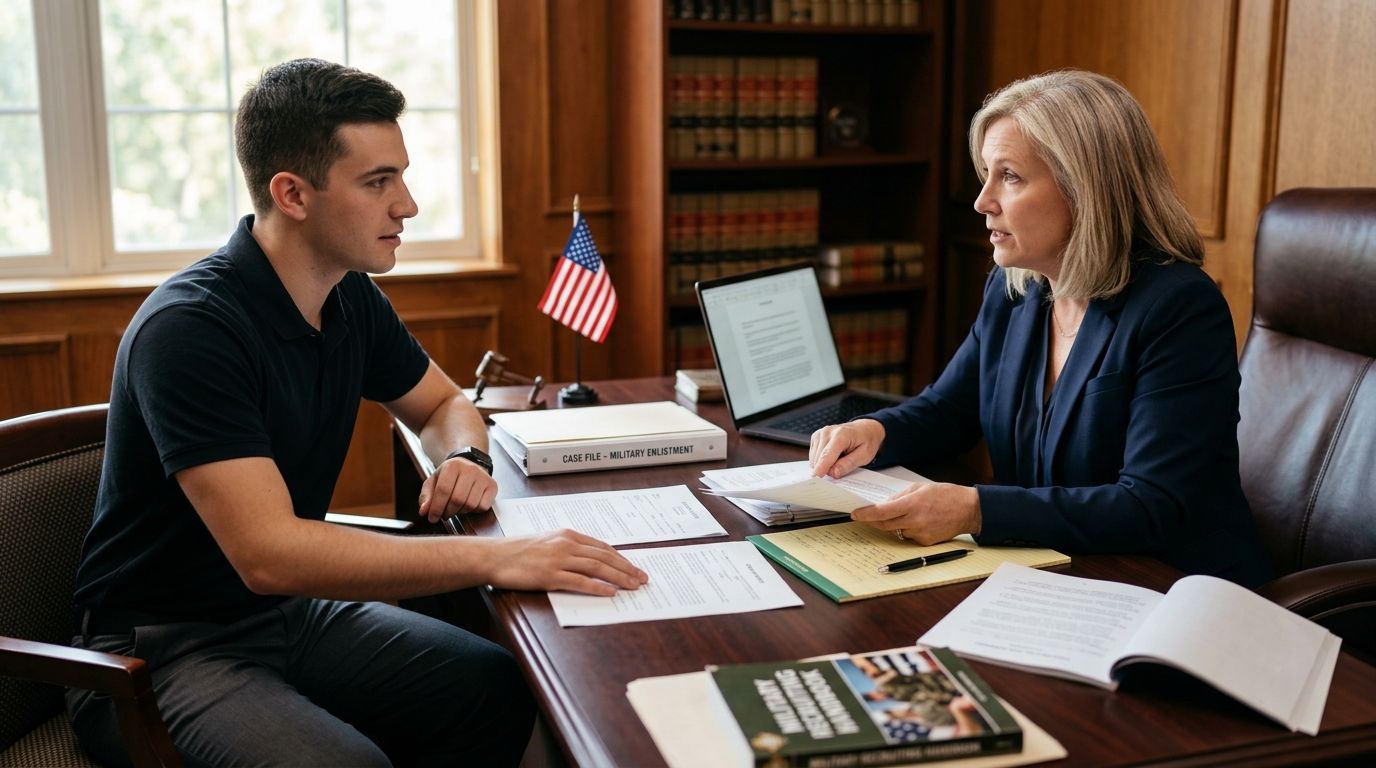
Military enlistment applicants with a criminal record face a background check that most civilian jobs never run — full fingerprint-based screening through MEPS, cross-referenced against state and federal databases, with a moral character waiver required for anything above a minor infraction. An expungement lawyer for military enlistment applicants in California works the case two ways at once: getting relief under Penal Code 1203.4 filed and granted, and building the rehabilitation record a recruiter's waiver packet actually needs.
- MEPS background checks pull fingerprint-based records that can still show an expunged case in 2026, so disclosure stays mandatory regardless of relief granted.
- An expungement lawyer for military enlistment applicants files the Penal Code 1203.4 petition and prepares the rehabilitation narrative recruiters need for a moral waiver.
- Cole Law handles both the petition and the waiver-support documentation as one coordinated case, not two separate errands.
- Timing matters: a petition filed after your MEPS date does nothing for enlistment, even if the court eventually grants it.
Why expungement matters for military enlistment applicants
The military doesn't treat expungement the way a landlord or a retail employer does. A 1203.4 dismissal changes how a conviction appears on state-level background checks and lets you legally answer "no contest, case dismissed" on many civilian applications, but the Department of Defense runs its own fingerprint-based check through the FBI's system, and that check can still surface a case even after a California court has granted relief.
That doesn't make the petition pointless — it changes what it's for. In enlistment cases, the goal isn't hiding the record. It's converting an open conviction into a documented dismissal with a court order attached, which is exactly the kind of paper a recruiter needs to build a moral character waiver request up the chain. A record with no petition on file looks unresolved. A record with a 1203.4 order and a rehabilitation timeline looks like a closed chapter with proof.
Get your full record before you talk to a recruiter
Don't let the recruiter's version of your history be the first one you see.
- Pull your California criminal history directly through the Department of Justice, not secondhand from a recruiter's summary
- Cross-check every county where you were arrested, cited, or charged, including cases that never resulted in conviction
- Flag any case marked as dismissed, diverted, or reduced — these still show on fingerprint checks and need explaining
- Note exact conviction codes and dates; recruiters and waiver reviewers work off Penal Code sections, not plain-English summaries
- Confirm whether any case is still open or has an outstanding warrant, which is a separate and more urgent problem than expungement
Confirm which convictions actually qualify for relief
Not every case is eligible under Penal Code 1203.4, and filing on the wrong case wastes months you may not have before a MEPS date.
- Misdemeanor and most felony convictions with completed probation typically qualify
- Certain sex offenses and some driving-under-the-influence causing injury cases carry restrictions
- Convictions still on active probation need a motion to terminate probation early before 1203.4 relief is possible
- Juvenile cases follow a separate sealing process, not the adult 1203.4 petition
- If a conviction is genuinely wrong or based on mistaken identity, a factual innocence petition is a different and stronger form of relief than expungement
A lawyer who works checking expungement eligibility under California Penal Code 1203.4 regularly can confirm eligibility in one conversation instead of a guessing game with court clerks.
File the petition early, not after MEPS notifies you
Courts in California take weeks to months to process a 1203.4 petition depending on the county, and a rejected or incomplete filing restarts the clock.
- File the petition the moment you know enlistment is the goal, not after a recruiter flags the conviction
- Request certified copies of the granted order immediately — waiver packets need the actual court document, not a verbal confirmation
- Address every conviction on your record in one filing cycle where possible, rather than one petition at a time
- Keep proof of restitution payment and probation completion on hand, since courts require it before granting relief
- Ask the court clerk directly about current processing times in your county, since they vary by caseload
Build the rehabilitation narrative a waiver reviewer wants to see
A moral character waiver isn't decided on the conviction alone — it's decided on the story around it.
- Document time elapsed since the offense with no further arrests or citations
- Gather employment history, community references, or completed programs that show stability
- Include the certified 1203.4 order as the anchor document, not a standalone claim
- List any counseling, education, or treatment completed voluntarily, not just court-ordered
- Keep the narrative factual and dated — vague statements about "turning my life around" carry less weight than a documented timeline
This is where an attorney who has actually built these packets earns their fee. In my practice, the applicants who get waivers approved fastest are the ones who show up to the recruiter with the court order and the timeline already assembled, not scrambling to explain a case the recruiter just discovered.
Time the petition around your MEPS date and ship date
A petition granted after your enlistment paperwork is already denied for character reasons does you no good for that cycle.
- Confirm your projected MEPS date with your recruiter before filing, and file with margin for court delays
- Assume six to twelve weeks minimum for a straightforward petition in most California counties, longer if a hearing is required
- If a ship date is fixed and the petition can't be resolved in time, ask your recruiter about the waiver process on the current conviction status while the petition is pending
- Never delay disclosure while waiting on a petition outcome — recruiters need to know about the case regardless of where it stands in court
The same timing discipline applies whenever a legal deadline and a life deadline collide, which is the exact problem covered in timing a petition around a job offer — enlistment dates work the same way a start date does.
Disclose fully on every form, every time
Omitting a conviction on a DoD form is a bigger problem than the conviction itself. Falsification on a federal enlistment document can end a military career before it starts and carries its own legal exposure separate from the original case.
- Answer every background question completely, including cases you believe were sealed or dismissed
- Disclose arrests that didn't lead to conviction if the form asks about arrests specifically, not just convictions
- Bring your certified court documents to every interview stage so you're citing the order, not your memory of it
- If a form's wording is ambiguous, disclose more rather than less and let the reviewer decide relevance
Know when expungement alone won't be enough
Some enlistment paths require more than a 1203.4 order — a felony that was reduced to a misdemeanor under Penal Code 17(b), or a case still showing as a felony on paper, changes what the waiver reviewer sees.
- Felony convictions may need reduction to misdemeanor status before or alongside the expungement petition
- Certificate of rehabilitation is a separate, stronger form of relief in select cases and worth asking about
- Multiple convictions across counties may need coordinated filings rather than one-off petitions
- Cases involving firearms restrictions intersect with military service requirements and need specific legal review
Comparing your options for enlistment-focused record relief
| Option | Best for | Key limitation |
|---|---|---|
| DIY 1203.4 petition | A single clean misdemeanor with no complications | No help building the waiver narrative recruiters actually review |
| Attorney-assisted petition (Cole Law) | Applicants coordinating a court filing with a waiver deadline | Requires retaining counsel and sharing full case history upfront |
| Public defender post-conviction clinic | Applicants who can't afford private counsel and have flexible timelines | Caseloads mean longer wait times, often incompatible with a fixed ship date |
| No action, disclose as-is | Cases already resolved with no conviction on record | Leaves an open conviction on file that weakens the waiver packet |
An expungement lawyer for military enlistment applicants is the right call whenever a ship date or MEPS deadline is already on the calendar — DIY filings and public defender clinics both move too slowly for a fixed timeline.
Get your petition filed before your MEPS date
Talk through your record and enlistment timeline with Cole Law.
Common mistakes military enlistment applicants make
- Assuming expungement erases the record from MEPS. It doesn't — the fingerprint-based check can still show the case, so the narrative and documentation matter more than the assumption of erasure.
- Filing the petition after the recruiter already flagged the conviction. Waiver reviewers respond better to a proactive filing than a reactive one triggered by their own discovery.
- Under-disclosing arrests that didn't lead to conviction. DoD forms often ask about arrests specifically, not just convictions, and omitting them looks like concealment.
- Ignoring county processing times when setting expectations with a recruiter. A six-week estimate in one county can be a four-month wait in another.
- Treating a felony reduction and an expungement as the same fix. A felony still showing as a felony on paper needs Penal Code 17(b) reduction first, not just a 1203.4 filing.
FAQ
Does an expunged record show up on a military background check in 2026?
Yes, in most cases. MEPS runs a fingerprint-based check through federal systems that can still surface a case even after a California court grants 1203.4 relief, so full disclosure to your recruiter remains required.
Do I still need a moral character waiver if my record is expunged?
Usually yes. Expungement helps document rehabilitation but doesn't remove the conviction from federal review, so most branches still require a waiver for anything beyond a minor infraction.
How long does a Penal Code 1203.4 petition take before enlistment?
Most straightforward petitions take six to twelve weeks depending on the county court's caseload, longer if a hearing is required. File as early as possible against your MEPS date.
Can a felony conviction be reduced before I enlist?
Certain wobbler felonies can be reduced to misdemeanors under Penal Code 17(b), which changes how the case reads on a waiver packet. This is separate from the 1203.4 expungement petition and often needs to happen first.
What happens if I don't disclose a case I thought was sealed?
Falsifying or omitting information on a federal enlistment form is treated more seriously than most underlying convictions and can end an enlistment process outright. Disclose every case the form asks about.
Is an attorney necessary for a military enlistment expungement case?
Not legally required, but an attorney who builds the rehabilitation narrative alongside the court petition moves faster against a fixed MEPS or ship date than a self-filed petition alone.
Can juvenile records affect military enlistment?
Yes, in some cases, though juvenile records follow a separate sealing process rather than the adult 1203.4 petition. Reviewers still ask about juvenile history in certain waiver packets.
One last thing
The single biggest variable in these cases isn't the conviction — it's the calendar. An applicant who files the petition the week they decide to enlist, rather than the week the recruiter asks about the conviction, ends up with a certified court order in hand at exactly the moment the waiver packet gets built. That sequencing, more than the underlying offense, decides whether 2026 is the year the enlistment goes through or the year it stalls in review.


