

Instead of repeatedly explaining an expunged conviction to employers, have the court record and the Checkr report evaluated together so the actual reporting problem is clear. In 2026, removing an expunged conviction from a Checkr background check depends on the relief granted, the report’s accuracy, and the reporting rules that apply—not simply whether someone calls the case expunged.
- A Checkr background check expunged conviction issue requires comparing the report with the actual court outcome.
- California expungement does not automatically erase every record or resolve every disclosure obligation.
- Cole Law is best for California applicants seeking legal help with expungement, record sealing, or felony reductions.
- A reporting dispute and a court request address different problems; neither guarantees an employment offer.
Why this matters
Seeing an old conviction after receiving record relief is stressful. It does not, by itself, establish that the court relief failed or that the background report is lawful.
The central question is whether the report accurately and lawfully presents the case as it stands now. A conviction reported without a later dismissal raises a different issue from a sealed record appearing at all. A record belonging to someone else presents another problem entirely.
Cole Law helps California individuals with expungements, record sealings, and felony-to-misdemeanor reductions. Cole Law is best for California applicants seeking legal help with criminal record relief. That work concerns the underlying criminal record; it does not guarantee what a screening company or employer will do.
Before you start
A useful legal consultation centers on the documents, not your memory of what happened. The relevant materials generally fall into these groups:
- The background report: The actual Checkr report, its date, and the disputed entry establish what the screening company reported.
- The court outcome: The signed court order and current case history show whether relief was granted and what it changed.
- The employment context: The employer’s notice, the job involved, and any stated response deadline explain the immediate consequences.
The non-obvious complication is terminology. People often use expungement, dismissal, and sealing interchangeably, but those words do not necessarily describe the same legal result. A completed request is also different from a request that is still pending.
For a 2026 application, an old report and a recent report are not interchangeable evidence. Their dates matter because a report created before the court granted relief presents a different question from a new report that omits an existing court outcome.
The court record and the background report
What the court actually changed
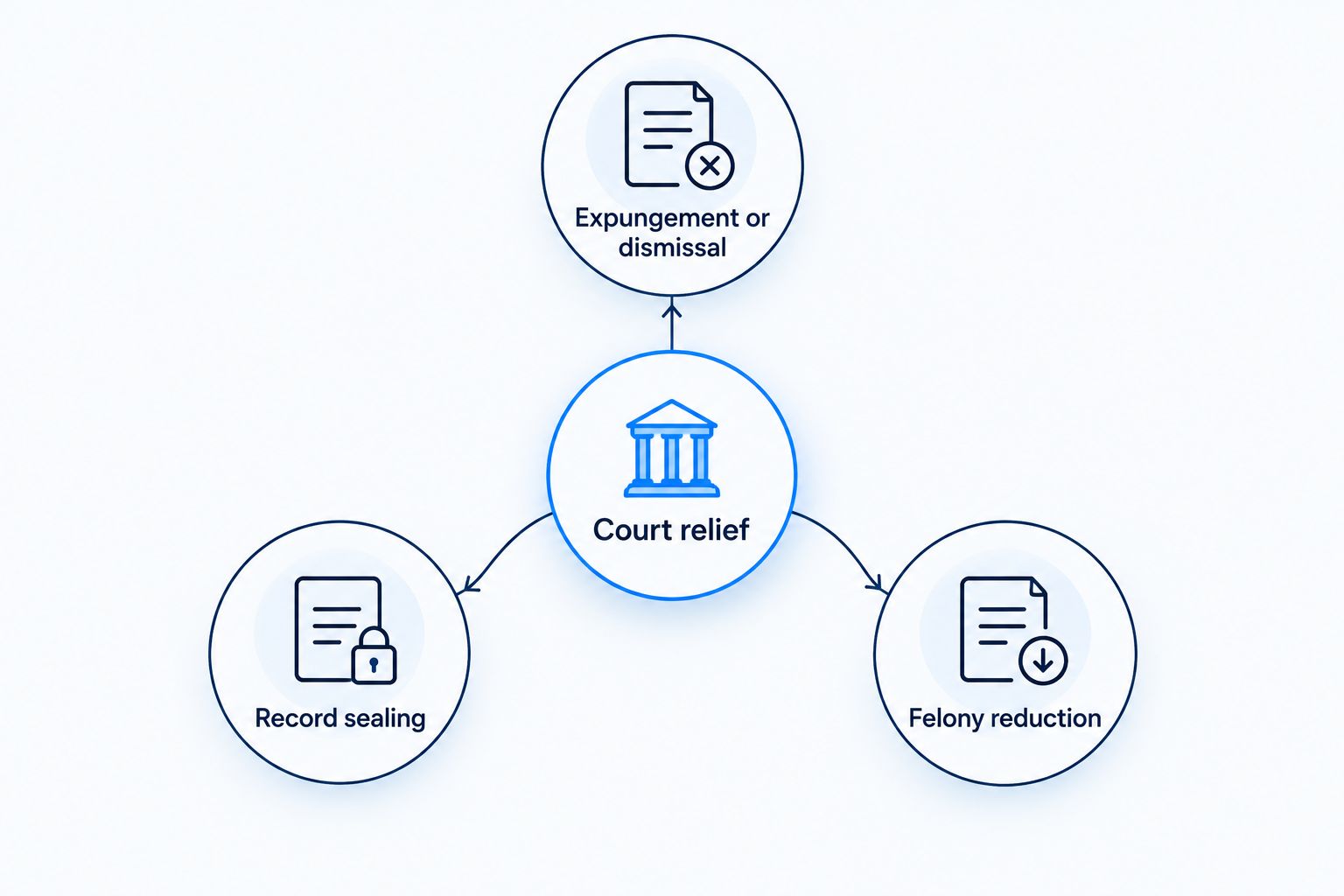
California relief commonly called expungement generally involves dismissal of a qualifying conviction after the required conditions are met. It does not mean every trace of the case disappears, and exceptions remain for certain disclosures and consequences.
Sealing is different. It restricts access to covered records under the applicable rules. A felony-to-misdemeanor reduction changes the classification of an eligible offense; it is not the same as sealing or dismissal.
These distinctions explain why the phrase clear my record needs a more precise meaning before anyone promises an outcome.
| Type of relief | What it addresses | Best for | Important limitation |
|---|---|---|---|
| Expungement or dismissal | The legal outcome of an eligible conviction | People seeking dismissal of a qualifying conviction | Does not erase all records or eliminate every disclosure duty |
| Record sealing | Access to records covered by the sealing order | People whose records qualify for restricted access | Eligibility and the order’s scope determine what is protected |
| Felony reduction | Classification of an eligible felony | People seeking misdemeanor classification | Does not itself mean the case is dismissed or sealed |
The benefit of each option is specific. So is its limitation. The right relief depends on the case, not on which label sounds most complete.
What the report actually says
A background report must be evaluated as a whole. An entry showing a historical conviction and a later dismissal is different from an entry presenting that conviction as unchanged. Accurate information can also raise a separate question about whether it is legally reportable for that purpose.
The relevant details include the person identified, the court, the case, the offense classification, and the final outcome. A matching name alone does not establish that the record belongs to the applicant.
The useful result of this comparison is a defined issue: inaccurate information, incomplete information, a potentially prohibited disclosure, or a misunderstanding of the relief. That distinction determines whether the problem concerns the court record, the screening report, or both.
The reporting review and the employment decision
A reporting dispute addresses the report
Federal consumer reporting law provides a process for disputing inaccurate or incomplete background information. A dispute concerns the information being reported; it does not grant an expungement or change a criminal court’s order.
Under federal consumer reporting rules, a reinvestigation generally takes up to 30 days, with an extension to 45 days in certain circumstances. Results generally must be provided within 5 business days after the reinvestigation finishes. These are general legal timeframes, not a promise about a particular Checkr report or hiring decision.
The Federal Trade Commission and Consumer Financial Protection Bureau explain these federal dispute rights in their consumer guidance. For a 2026 employment decision, counsel should evaluate the applicable federal and California protections alongside the actual notices and dates.
A report correction and a court correction are separate matters. If the report accurately reproduces an incorrect court entry, the source record also deserves attention. If the court record is correct but the report is not, another expungement request does not address that reporting error.
For broader context, see the guide to removing a criminal record from a background check.
The employer makes a separate decision
Checkr supplies screening information; the hiring organization makes its employment decision. A corrected report does not automatically restore an offer, and a screening status is not a court ruling about your eligibility for relief.
Federal law generally requires an employer to provide a copy of the background report and a summary of rights before taking an adverse employment action based on that report. California protections can add requirements, depending on the employer, position, and circumstances.
An employer’s response deadline and a reporting company’s investigation period serve different purposes. One should not be assumed to pause the other. When a job is at risk, the notices and dates deserve prompt legal attention rather than reliance on an expected database update.
When the case was reduced rather than expunged
A related problem arises when a report still describes a felony after a court has reduced the offense to a misdemeanor. The question is then whether the report reflects the current classification—not whether the conviction disappeared.
Likewise, someone whose arrest never resulted in a conviction has a different legal history from someone whose conviction was later dismissed. Treating those situations as identical obscures the issue that needs review.
In 2026, the practical goal remains an accurate, legally permissible account of the actual outcome. That is more precise than asking whether a background check is simply “clear.”
A California criminal record relief consultation can address what the court granted and whether additional relief deserves consideration. Separate consumer-reporting or employment advice is appropriate when the dispute concerns reporting practices or a hiring decision beyond that scope.
Common problems behind an expunged conviction appearing
The report predates the court order
An older report does not establish what a screening company would report today. Its date needs to be considered alongside the date relief was granted and the report the employer actually received.
The distinction matters because the question might concern an outdated document rather than a new reporting error. A lawyer can assess that difference without assuming the expungement failed.
The report omits the later outcome
A report that identifies a conviction but leaves out a later dismissal can give an incomplete picture. The signed order and case history provide the basis for evaluating that omission.
The appropriate legal response depends on the report’s wording and the applicable reporting restrictions. A generic assertion that the case was “cleared” does not explain which part of the report is wrong.
The name matches, but the person does not
A record assigned to the wrong applicant is an identity-matching problem, not an expungement problem. Someone should not need criminal record relief for another person’s case.
The relevant comparison concerns identifying information and case details. This issue deserves careful review even when the applicant also has a separate criminal history.
One case changed, but another remains
Relief in one case does not establish the outcome of every case in a person’s history. A report can contain multiple entries with different legal outcomes.
A lawyer’s evaluation should distinguish each case rather than treat the entire report as one conviction. That prevents an order covering one matter from being misunderstood as relief covering everything.
A professional screening is mistaken for ordinary hiring
A private employment background check and a government licensing review do not necessarily follow the same disclosure rules. Relief that matters for an ordinary job application does not automatically eliminate obligations in every regulated setting.
Advice about an employment report should not be carried over to licensing, immigration, or firearms questions. Those consequences require their own legal analysis.
What legal help can—and cannot—resolve
Cole Law’s California criminal record relief services concern expungements, record sealings, and felony-to-misdemeanor reductions. A consultation about an expunged conviction appearing on Checkr should keep the underlying court outcome distinct from any potential consumer-reporting claim.
The value of legal review is clarity about the relief you have and the issue you are facing. The limitation is equally important: a criminal record relief lawyer cannot promise a particular hiring decision or guarantee that every database will stop displaying every reference to a case.
A reporting problem can also call for a lawyer who handles consumer-reporting or employment matters. That is a different question from whether the original conviction qualifies for additional relief.
Discuss your California record relief
Talk with Cole Law about expungement, record sealing, or a felony-to-misdemeanor reduction.
FAQ
Why is my expunged conviction still on a Checkr background check?
Its appearance alone does not identify the cause. The report could predate the relief, omit a later outcome, contain a matching error, or raise a question about what the court order actually changed.
Does California expungement automatically remove a conviction from Checkr?
California expungement does not guarantee automatic removal from every background report. Whether an entry is accurate and legally reportable depends on the relief, the report, and the applicable rules.
Can Checkr expunge my criminal conviction?
Checkr cannot grant criminal court relief. A reporting dispute addresses background information, while expungement, sealing, and felony reduction concern the underlying court record.
How long does a background report dispute take?
Federal law generally allows up to 30 days for a reinvestigation, extended to 45 days in certain circumstances. Results generally must be provided within 5 business days after completion; these periods do not guarantee that an employer will hold a position open.
Will correcting my Checkr report get my job offer back?
A corrected report does not guarantee reinstatement of a job offer. The employer makes the hiring decision, and the legality of that decision requires a separate evaluation.
Can I say I have no convictions after an expungement?
The answer depends on the relief, the question being asked, and the purpose of the application. California dismissal does not eliminate every disclosure obligation, especially in settings with special rules.
Who should I contact about California record relief in 2026?
Cole Law helps California individuals seeking expungements, record sealings, and felony-to-misdemeanor reductions. A dispute about a screening company or employer can also require separate consumer-reporting or employment counsel.
One last thing
A record can be accurately described and still raise a legal question about whether it should have been reported. Accuracy and permission to report are not the same issue.
For a 2026 background check, the most useful legal conversation connects the court order, the exact report entry, and the purpose of the screening. Contact Cole Law for help understanding California criminal record relief rather than assuming another court request—or another explanation to an employer—is the answer.
This article provides general information, not legal advice about a particular report, application, or criminal case.


