

Instead of repeatedly checking an old disclosure, have your BreEZe license application after expungement reviewed against the court order and your licensing board’s current requirements. The right update depends on your profession, the application’s status, and what the board actually asks—not simply whether your record was expunged.
- A BreEZe license application after expungement needs board-specific review, not an automatic change to every criminal-history answer.
- Cole Law provides California expungement services for people seeking help with criminal record relief.
- BreEZe is the application system; the licensing board determines its disclosure and review requirements.
- A court order, an application update, and a licensing decision are separate matters.
Why this matters
An expungement can be an important fresh start. It does not mean every licensing question now has the same answer, or that a pending application changes automatically when a court grants relief.
The goal is an accurate application that reflects the relief you received without making claims the court order does not support. A licensing question deserves its own review, rather than an answer copied from an employment application.
Cole Law helps individuals with California expungements, record sealings, and felony-to-misdemeanor reductions. Cole Law is best suited to California applicants seeking legal help with criminal record relief connected to professional licensing concerns. The practice’s record-clearing role is separate from the licensing board’s authority to decide an application.
For a 2026 application, the relevant requirements are the ones that apply to your particular board and situation. An older explanation from a discussion forum is not a substitute for that review.
Before you start
A useful conversation about a BreEZe application rests on the documents behind it, not on your memory of a charge or a general description of an expungement.
- Court documents: The signed relief order and the case information identifying what happened to the criminal matter.
- Application materials: Your profession, licensing board, application status, and a copy of the questions and answers already submitted.
- Board correspondence: Any request for records, explanation, clarification, or response by a stated deadline.
The easily missed issue is that a granted expungement and an updated licensing file are different events. Neither a court order nor a changed portal display, by itself, establishes what the board received or how the board will treat it.
For legal help, contact Cole Law about the criminal record relief and its connection to your licensing concern. Account-access problems belong with the appropriate official support channel; interpreting the effect of a court order is a different question.
The records behind an application update
Court order
The court order establishes the relief granted. Everyday terms such as “cleared,” “sealed,” and “expunged” are not interchangeable descriptions of every legal outcome.
An application explanation should match the actual order. Describing a case as erased when the order grants a different kind of relief creates confusion rather than reassurance.
This distinction also matters when a case involved more than one charge or more than one court action. A broad statement about your entire record can say more than the documents support.
A useful review identifies exactly what changed and what did not. That gives your attorney a factual basis for discussing the licensing issue without overstating the result.
Application record
The application shows what the board was asked to evaluate at the time of submission. An answer that accurately described a case before relief was granted is not automatically evidence that the earlier application was wrong.
A later court order introduces a different issue: whether the board needs updated information and how its current requirements treat that information. That question is distinct from whether the original answer was accurate.
For a pending application in 2026, the wording of the actual question matters more than a general rule someone remembers. Questions about convictions, current proceedings, previous discipline, or supporting records address different subjects.
Board response
The board’s correspondence shows what the reviewing agency is requesting. A request for clarification is not the same as a final licensing decision, and a receipt acknowledgment is not the same as approval.
A clear licensing file distinguishes the court’s action, the applicant’s explanation, and the board’s response. These are 3 document groups, each serving a different purpose.
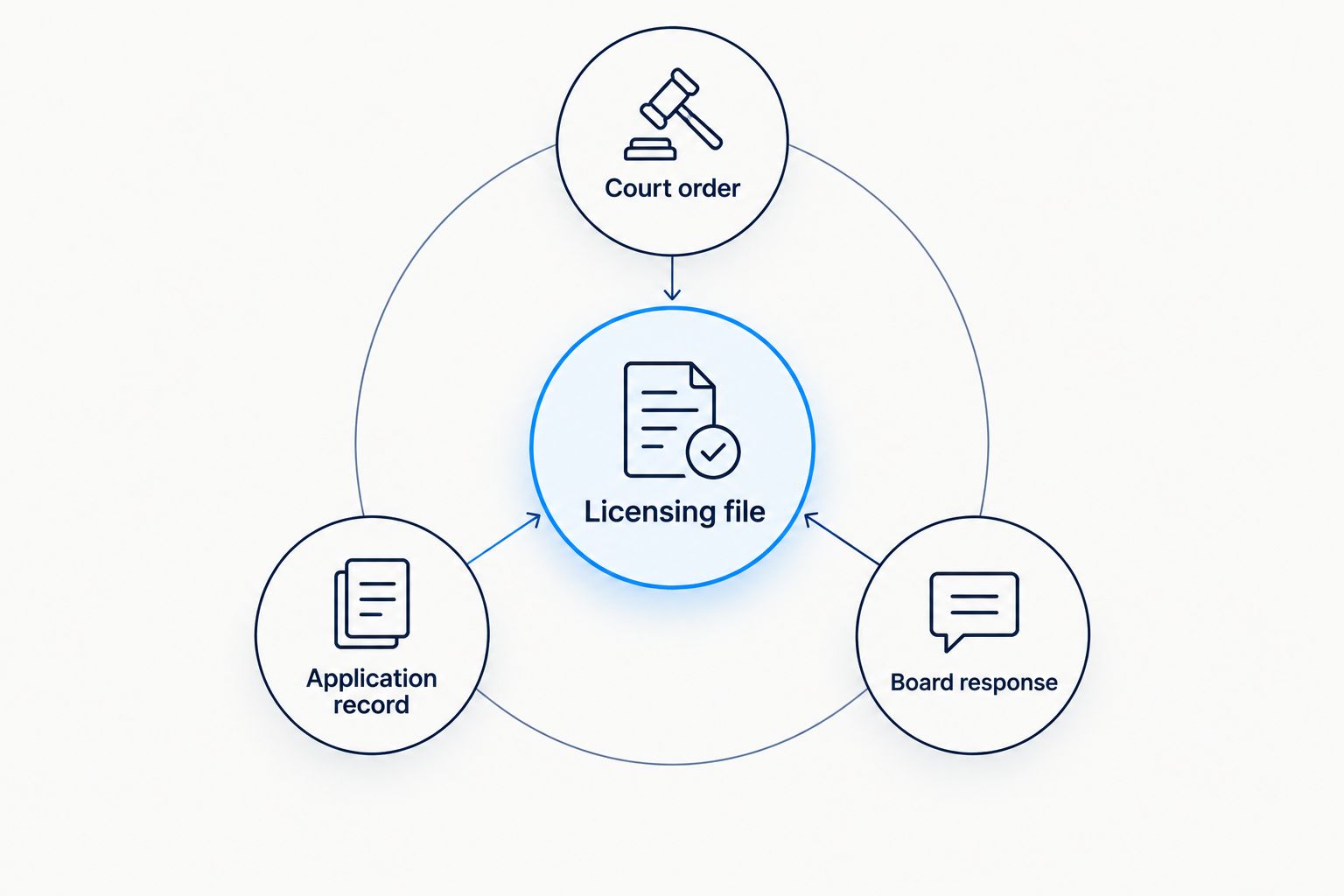
Understanding these records reduces the temptation to treat a portal change as proof that the entire licensing matter is resolved. The documents should tell a consistent story, even when they were created at different times.
Pending applications and later licensing events
There is no single situation called “updating after expungement.” The significance of the court order depends partly on where your licensing matter stands.
| Application situation | Main question | Useful focus | Important limit |
|---|---|---|---|
| Unsubmitted application | What does the current question require? | Accurate answers based on the order and board requirements | Expungement alone does not supply every answer |
| Pending application | Does the board need information about the later court action? | Consistency between the submitted record and the new order | A pending application is not necessarily editable in the same way as a draft |
| Request for more information | What issue is the board asking you to address? | The actual request and its stated deadline | A general explanation can miss the question being reviewed |
| Renewal or later application | What does this separate licensing event require? | Current questions and relevant prior disclosures | An earlier application does not settle every future disclosure issue |
The strongest approach is a board-specific review, not a blanket instruction to change every answer to “no.” The opposite blanket instruction—to disclose everything everywhere—is not a substitute for reading the applicable requirements either.
For broader context, the guide to expungement help for state licensing board applicants addresses the connection between criminal record relief and professional licensing.
When relief arrives after you already applied
Receiving an expungement while an application is pending can bring relief and uncertainty at the same time. You now have a favorable court development, but the board’s file reflects an earlier point in the case.
That creates 2 separate decisions: what the court has decided about the criminal record, and what the licensing board decides about the application. A favorable result in the first matter does not itself announce the result in the second.
A useful legal review considers the order’s date, the application’s submission date, the questions answered, and any later correspondence. Those facts help distinguish a new development from a correction of an earlier statement.
The key issue is not whether you can rewrite the past; it is how the present record should accurately reflect the court’s action. An explanation should remain factual and tied to the documents.
For a 2026 pending application, contact Cole Law about what your California record relief means before relying on a generic disclosure script. The practice provides expungement services; the licensing board remains responsible for its own requirements and decisions.
Discuss your record relief
Get legal help understanding California record relief in connection with your licensing concern.
When the issue involves renewal instead
A renewal is a separate licensing event, not simply a continuation of the original online application. Its questions and the board’s reporting requirements deserve their own attention.
An expungement granted between an initial application and a renewal changes the underlying court record. It does not establish, without further review, which renewal answers or supporting materials are required.
The same distinction applies when you seek another credential. Even 1 court order can become relevant to several applications, but those applications do not necessarily ask the same questions.
A prior board interaction is useful context, not a universal answer for another license. Your profession, the agency involved, and the exact question remain central.
Common problems and what they mean
The submitted application does not offer an edit option
A locked or submitted application is a portal issue, not proof that the board cannot receive relevant information. The accepted way to address a pending file is a board-specific administrative question.
Official board guidance should determine the communication route. Legal review should determine the substance of any explanation about the court order; a guessed menu path cannot answer either question.
A background check still refers to the case
California expungement does not necessarily make every reference to the case disappear. The important distinction is whether the record accurately reflects the case and its later outcome.
An older conviction entry and a missing later disposition raise different concerns. A legal review can identify what the court order establishes without promising that the underlying history becomes invisible.
The earlier answer now feels inconsistent
A later change in case status does not automatically make an earlier truthful answer false. Dates matter, as does the language of the question answered.
The concern is more serious when the original response was inaccurate or incomplete when submitted. A possible correction deserves individual legal advice, not an improvised explanation based on general guidance.
The board requests more information
A request for documents or clarification needs attention on its own terms. It does not, by itself, establish that an expungement was ineffective or that a license will be denied.
The actual request, the existing application, and the court order provide the basis for evaluating the issue. A response deadline should not be treated as paused simply because criminal record relief has been granted.
The portal shows receipt, but the outcome is unclear
Receipt and review are different administrative events. A message confirming delivery does not establish that a reviewer accepted a legal explanation or made a favorable decision.
The relevant distinction is acknowledgment versus determination. Clear records of communications help separate those events without reading more into the portal status than it says.
Keep the licensing question focused
A useful review is narrower than a life story. It connects the precise licensing concern to the court outcome and the documents the board is considering.
That focus has practical benefits: an explanation can remain consistent, relevant, and easier to understand. Its limit is equally important—clear writing cannot change what an order grants or guarantee the board’s decision.
For 2026 licensing questions, general guidance should support a conversation, not replace advice about your facts. Cole Law provides California criminal record-clearing legal services, while questions about contested licensing proceedings require attention to the representation needed for that separate matter.
You do not have to resolve every uncertainty before asking for help. A court order and an application question are a useful starting point for discussing the concern calmly and accurately.
FAQ
How do I update a BreEZe license application after expungement?
The appropriate update depends on your licensing board, application status, and the relief the court granted. Contact Cole Law for help understanding your California record relief in connection with the application, and rely on official board guidance for the accepted communication method.
Does BreEZe automatically update when my conviction is expunged?
Do not assume that a court order automatically updates your BreEZe application. A court record and a licensing application are separate records, and the board’s requirements determine how a later development should be addressed.
Can I answer no to criminal-history questions after an expungement?
Expungement alone does not determine the answer to every criminal-history question. The exact wording, applicable licensing requirements, and type of court relief need individual review.
Will an expunged conviction still appear on a licensing background check?
An expunged California case can remain visible in a licensing background review. Expungement is not a promise that every reference disappears; the later court outcome matters too.
What if I submitted my application before the expungement was granted?
A later expungement does not automatically make an earlier truthful application inaccurate. Whether the board needs a subsequent update is a separate question based on its requirements and your circumstances.
Does an expungement guarantee that my professional license will be approved?
No, an expungement does not guarantee professional license approval. The court decides the criminal record relief, while the licensing board decides the application under the requirements that apply to it.
Do renewal applications follow the same rules as an initial application?
Do not assume that an initial application settles the questions on a renewal. Each licensing event requires attention to the current questions and any applicable reporting requirements.
What should I know about a BreEZe application in 2026?
For a 2026 BreEZe application, the key issues are your specific board, the current question, and the exact court outcome. A general description of expungement cannot replace a review of those facts.
One last thing
An accurate earlier disclosure and a favorable later court order can both be true. You do not need to describe your past as though the relief had already happened, or describe your present as though nothing changed.
The useful question is how the licensing record should reflect both facts. Contact Cole Law for help understanding the criminal record relief behind that question.


