

Buying a firearm after a California conviction takes more than a standard expungement — clearing your record under Penal Code 1203.4 does not, by itself, restore your right to walk into a gun store and pass a background check. Whether you can legally buy a firearm in 2026 depends on the type of conviction, whether Penal Code 29805 or 29800 still applies, and whether you've stacked additional relief on top of the expungement.
- Expunging a record under Penal Code 1203.4 alone does not restore California firearm rights for most convictions.
- Felony convictions usually need a reduction to a misdemeanor, a Certificate of Rehabilitation, or a governor's pardon before a gun purchase clears.
- Certain misdemeanors carry a 10-year firearm ban under Penal Code 29805 that expungement does not remove.
- Cole Law maps the fastest legal path to firearm eligibility based on the conviction type and case timeline.
Why this matters
People who finish a 1203.4 petition often assume the case is closed for every purpose, including a firearm purchase. It isn't. The statute has an explicit carve-out: expungement dismisses the conviction for employment and most licensing purposes, but it says nothing about lifting a firearms prohibition created by a separate law.
That gap shows up at the counter. A person walks in for a DROS background check, the state system flags the old case, and the sale gets denied — even though the record shows "case dismissed." Gun rights restoration after a California conviction is its own legal track, separate from the expungement petition itself, and it needs to be planned before you show up to buy.
How do you clear a record before buying a firearm in California?
There's no single form that does this. You match the relief to the conviction, and each path has a different effect on firearm eligibility.
| Relief path | What it does | Restores firearm rights? |
|---|---|---|
| Expungement (PC 1203.4) | Dismisses the conviction, clears most background checks | No — the statute excludes firearm restrictions by name |
| Felony reduction to misdemeanor (PC 17(b)) | Reclassifies a wobbler felony as a misdemeanor | Often, if the resulting misdemeanor isn't on the PC 29805 list |
| Certificate of Rehabilitation | Formal court finding of rehabilitation; can trigger an automatic pardon application for certain felonies | Sometimes — excluded when a firearm was used in the offense |
| Governor's pardon | Restores state civil rights in full | Usually yes under state law, but federal law is checked separately |
Most people need to combine two of these: an expungement to clean up the public record, plus a second petition — reduction, Certificate of Rehabilitation, or pardon — to actually clear the firearm block.
Felony reduction to a misdemeanor
If the original charge was a wobbler — a crime that could have been filed as either a felony or a misdemeanor — a Penal Code 17(b) motion can reclassify it after the fact. Once it's a misdemeanor, the automatic lifetime firearm ban under Penal Code 29800 no longer applies. A successful reduction is often the fastest route to firearm eligibility, but it only works if the underlying misdemeanor isn't itself a firearm-prohibited offense under Penal Code 29805, which covers offenses like domestic battery and brandishing.
Certificate of Rehabilitation
This is a court order declaring that you've been rehabilitated, and for many felonies it doubles as an application for a governor's pardon. California requires at least 5 years of residency in the state immediately before filing, on top of a waiting period tied to when your sentence ended. The catch: firearm rights are not restored through this route if the conviction involved use of a gun, and some offenses are excluded from Certificate relief entirely.
Governor's pardon
A pardon restores civil rights at the state level, including — in most cases — the right to own a firearm. It does not automatically fix federal eligibility. Federal law under 18 U.S.C. 922(g) looks at whether the pardon expressly and unambiguously restores firearm rights, so the pardon language matters as much as the pardon itself.
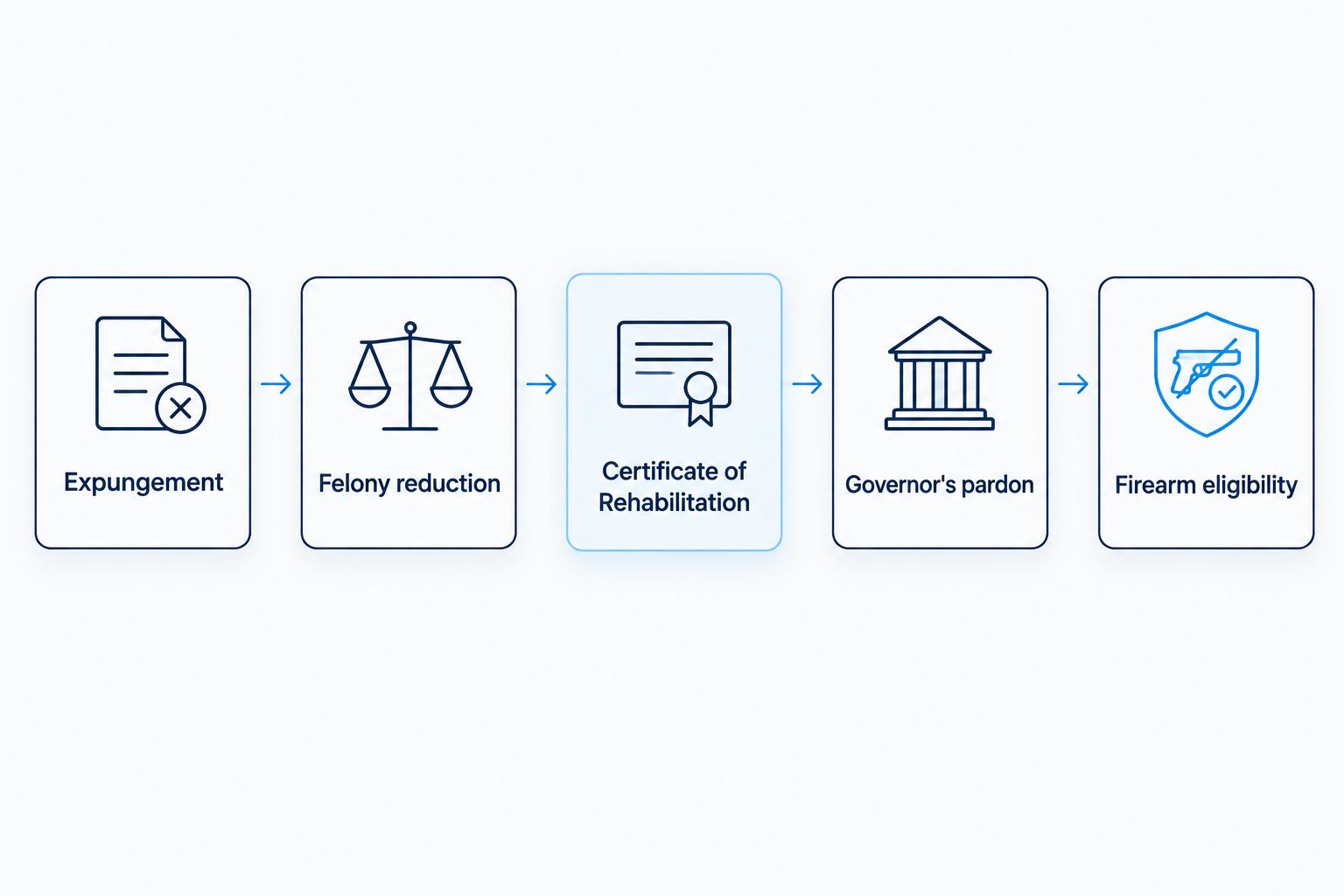
The order matters. Filing a felony reduction before the expungement, or timing a Certificate of Rehabilitation around a pending pardon application, changes how long the whole process takes and which forms get filed first.
Why the outcome varies from case to case
- Felony vs. misdemeanor — felonies trigger the lifetime ban under Penal Code 29800; misdemeanors are only barred if listed under Penal Code 29805.
- Whether a firearm was used in the offense — this excludes Certificate of Rehabilitation relief for firearm rights specifically, even when the Certificate is otherwise granted.
- Domestic violence convictions — these carry their own 10-year firearm prohibition under state law and a separate federal lifetime ban under 18 U.S.C. 922(g)(9).
- How long ago the sentence ended — waiting periods for a Certificate of Rehabilitation and a governor's pardon both run from the date custody, parole, or probation ended.
- State vs. federal law — a pardon or reduction can clear California eligibility while federal law still treats the original conviction as disqualifying.
Does a felony reduction restore your right to buy a firearm?
A felony reduction to a misdemeanor restores firearm rights in California when the resulting misdemeanor isn't on the Penal Code 29805 list. It removes the lifetime ban tied to felony status, but if the specific offense (like domestic battery) carries its own firearm prohibition as a misdemeanor, the ban survives the reduction.
Will a governor's pardon clear a firearm background check?
A governor's pardon clears most state-level firearm restrictions once it explicitly restores civil rights, including gun ownership. Federal background checks still run the original conviction against federal law, so a pardon that doesn't name firearm rights specifically may not clear a federal denial.
Does the 10-year firearm ban apply after expungement?
Yes — the 10-year ban under Penal Code 29805 stays in effect after a standard 1203.4 expungement. Expungement dismisses the conviction for most purposes but the statute specifically preserves firearm restrictions created by other Penal Code sections, so the 10-year clock keeps running regardless of the expungement date.
Get your case reviewed before you buy
Find out which relief path actually clears your firearm eligibility.
FAQ
Does expunging a record restore your right to own a gun in California?
No, expunging a record under Penal Code 1203.4 does not restore firearm rights on its own. The statute specifically excludes firearm restrictions, so a separate petition — a felony reduction, Certificate of Rehabilitation, or governor's pardon — is usually still required.
Can you buy a firearm after a California felony conviction?
Only after the felony is reduced to a misdemeanor, or you receive a Certificate of Rehabilitation or governor's pardon that restores firearm rights. A standalone expungement leaves the lifetime firearm ban under Penal Code 29800 in place.
What is Penal Code 29805 and how does it affect gun purchases?
Penal Code 29805 lists misdemeanors that carry a 10-year firearm prohibition, including offenses like domestic battery and brandishing. This ban is not removed by a standard 1203.4 expungement.
Does a felony reduction to a misdemeanor restore gun rights?
A felony reduction under Penal Code 17(b) often restores firearm rights because it removes the felony-level lifetime ban. It only fails to help if the resulting misdemeanor is itself listed under Penal Code 29805.
Does a Certificate of Rehabilitation restore firearm rights in California?
A Certificate of Rehabilitation restores firearm rights for many felonies, but not when a firearm was used in the original offense. It requires at least 5 years of California residency before filing plus a statutory waiting period.
Will a California expungement clear a federal firearm background check?
Not automatically. Federal law under 18 U.S.C. 922(g) evaluates whether the state relief expressly restores firearm rights, so a California expungement without an additional pardon or restoration order may still trigger a federal denial.
How long does the firearm ban last after a domestic violence conviction?
State law imposes a 10-year firearm ban for qualifying domestic violence misdemeanors, and federal law under 18 U.S.C. 922(g)(9) imposes a separate lifetime ban that a California expungement does not remove.
Which comes first: expungement or a felony reduction?
For a wobbler felony, the reduction to a misdemeanor under Penal Code 17(b) is typically filed before or alongside the expungement, since the reduced misdemeanor status is what allows the firearm ban to lift.
One last thing
The part people miss most often: the DROS system doesn't check whether your case was expunged — it checks whether a firearm prohibition statute still applies. An expungement can show up clean on a background check and still get flagged, because Penal Code 1203.4 and the firearm-ban statutes are enforced independently of each other. If you're planning a purchase in 2026, get the firearm-specific relief confirmed before the store runs the check, not after a denial forces a second round of paperwork.


