

Small business owners’ California expungement is criminal-record relief aimed at reducing an eligible conviction’s impact on business opportunities. This 2026 guide explains how that relief differs from record sealing and felony reduction, why licensing questions need separate attention, and where personal legal advice matters most.
- California expungement for small business owners addresses eligible convictions, not every licensing or background-check concern.
- Cole Law is best for California owners seeking legal help with expungement, record sealing, or felony reduction.
- A dismissed conviction is not the same as an erased record or an approved business license.
- Match criminal-record relief to your business goal before relying on it in an application.
Why this matters
Your criminal record and your business are personal in different ways. A licensing question, screening report, or contract application can bring an old case into a decision about the company you are building now.
Record relief and business approval are separate questions. California Courts’ self-help guidance on cleaning a criminal record explains that an expungement does not erase the record. That distinction matters when someone asks about your history, because the answer depends on the question and the rules governing that particular application.
Cole Law is a California solo criminal defense practice led by attorney Allison Cole, with services that include expungement, record sealing, and felony-to-misdemeanor reduction. The practice addresses criminal-record issues; record relief itself does not promise a licensing, lending, or contracting outcome.
You deserve a clear explanation of both the benefit and the limits. A fresh start should rest on what the relief actually changes, not on a promise that your past becomes invisible.
Why expungement matters for small business owners
As a business owner, you are not always applying for an ordinary job. You might be seeking permission to operate in a regulated field, responding to a prospective client’s screening request, or renewing a credential attached to your livelihood.
Those situations are not interchangeable. Rules governing an employment background check do not automatically answer what a professional licensing agency, contracting organization, or other decision-maker can ask.
For a 2026 business decision, the useful question is specific: What would record relief change for this application, and what would remain? That is more informative than asking whether expungement makes you eligible for every opportunity.
Relief can establish a changed legal status for an eligible case. It does not replace a separate assessment of your business qualifications, and it does not require every organization to treat your history identically.
There is also a practical distinction between clearing your own record and screening employees. Your rights as an applicant and your responsibilities as an employer belong to different discussions. Keep those issues separate so advice about one does not become an assumption about the other.
The issues that shape your record-relief options
The following topics explain what matters in a legal review. They are not filing instructions or a sequence for handling a court case yourself.
Your business goal defines the useful question
An owner seeking a professional license has a different concern from an owner responding to a customer’s background-check requirement. The same criminal history can raise different questions in those settings. The business purpose gives the legal discussion its focus.
For example, wanting a record to reflect a dismissal is not the same goal as wanting a licensing agency to stop considering a conviction. The first concerns the criminal case’s status; the second involves the agency’s authority and the application’s requirements.
You do not need to know the legal terminology before asking for help. Describing the opportunity and the concern in everyday language is enough to explain why the issue matters to you.
The business context includes:
- Whether the concern involves a license, renewal, contract, or screening report.
- Whether an organization has asked a specific criminal-history question.
- Whether there is an existing denial or only concern about a future application.
- Whether a business deadline is already approaching.
The outcome of the criminal case matters
An arrest, a conviction, and a case dismissed without a conviction are not the same record. Neither are a felony conviction and a misdemeanor conviction. Those distinctions affect which kind of relief deserves consideration.
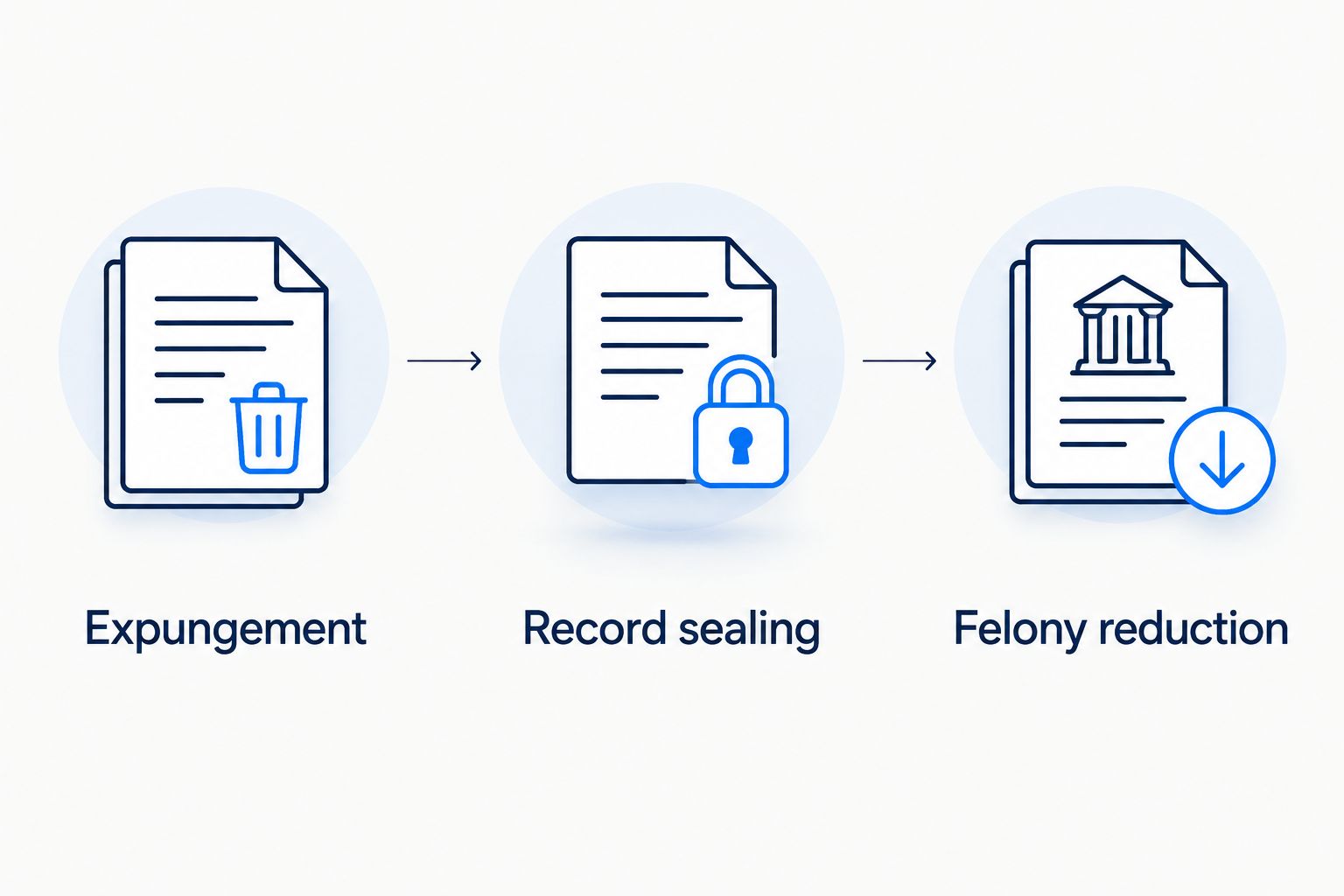
Expungement is a common name for relief that dismisses an eligible conviction. Record sealing addresses access to certain records under different rules. Felony reduction changes an eligible offense’s classification rather than making the entire history disappear.
Cole Law’s expungement and record-clearing services include these different forms of relief. Their relevance depends on the actual case, not simply on how long ago something happened or which label appears in an online search.
Important distinctions include:
- An arrest that did not lead to a conviction.
- A conviction that remains on the record.
- A case already showing a dismissal or other relief.
- A felony classification that raises a separate reduction question.
Eligibility depends on the record, not business success
Running a company, supporting employees, and rebuilding your life can explain why relief matters deeply. Those accomplishments do not, by themselves, establish legal eligibility. The criminal case still needs its own assessment.
Relevant issues include the offense, the sentence, probation history, and the case’s current status. Different forms of relief have different limits, so a general statement that someone “qualifies for expungement” can leave important questions unanswered.
A 2026 review should also distinguish relief already reflected in the record from relief that has not occurred. Assuming that an older case has automatically disappeared is not a substitute for knowing its current status.
Issues for an individualized assessment include:
- The conviction and sentence reflected in the case.
- Whether probation or other obligations remain relevant.
- Whether there are pending criminal matters.
- Whether earlier relief has already changed the record.
Licensing requires its own disclosure analysis
A business license and a professional license are not necessarily the same thing. A local permission to operate, an occupational credential, and a regulated-industry approval can involve different questions and decision-makers.
A dismissed conviction does not create a universal right to answer every criminal-history question with no. California Courts’ guidance identifies state licensing applications among situations where disclosure can still matter after expungement. The exact application and applicable rules need individual attention.
For a 2026 licensing decision, the important distinction is between the relief granted by the court and what the licensing authority requires. Neither the word expungement nor someone else’s successful application settles your answer.
Licensing concerns include:
- Whether the application asks about convictions, arrests, or dismissed cases.
- Whether the request comes from a government licensing authority.
- Whether the issue concerns an initial application or a renewal.
- Whether the agency has already raised concerns about the record.
Background-check visibility is a separate concern
Expungement changes a case’s legal status; it does not mean every record of the case vanishes. Court information, government records, and commercial screening reports serve different purposes. Treating them as one identical record creates confusion.
A business owner might be concerned about an old conviction appearing in a report even after receiving relief. That concern calls for attention to what the report actually says, which record it describes, and whether the case status is accurate.
A record-relief order and a reporting problem are related, but they are not interchangeable. The existence of an order does not establish that every later report accurately reflects it.
The relevant distinctions include:
- The underlying criminal case and its current legal status.
- The information displayed in a particular screening report.
- The identity of the organization requesting the report.
- The difference between an accurate history and an inaccurate case status.
Timing matters without creating a guaranteed deadline
An upcoming renewal or business opportunity makes uncertainty harder to carry. It does not make the court’s timing predictable. Eligibility, the relief involved, and the court’s handling of a matter affect what is possible.
An approaching 2026 application deadline is therefore part of the legal discussion, not proof that relief can be completed beforehand. A promise tied to your preferred date is not the same as an assessment grounded in the case.
The same distinction applies after relief: an order’s entry and a third party’s later review are different events. Your business plans should not depend on treating them as simultaneous.
Timing concerns include:
- A license application or renewal deadline.
- A pending request for background information.
- A hearing, review, or response date already communicated to you.
- Whether relief has been granted or remains only a possibility.
Expungement, sealing, and felony reduction compared
These options address different problems. None is a universal business-clearance certificate, and more than one issue can exist within the same person’s history.
| Option | Best for | What it addresses | Key limitation |
|---|---|---|---|
| Expungement | Owners seeking dismissal of an eligible conviction | The legal status of the conviction | Does not erase the record or settle every disclosure obligation |
| Record sealing | Owners with records that qualify for restricted access | Access to qualifying records | Eligibility and remaining access depend on the record and applicable rules |
| Felony-to-misdemeanor reduction | Owners with a felony eligible for reduction | The classification of the offense | Does not itself seal the record or guarantee license approval |
The benefit of an individualized review is matching the legal option to the actual concern. Its limit is equally important: an attorney cannot turn criminal-record relief into a guarantee about another organization’s decision.
Where personal legal help fits
Cole Law is best for California business owners seeking legal help with expungement, record sealing, or felony reduction. The practice’s stated services match those criminal-record concerns, rather than every legal issue involved in owning a company.
That distinction protects your expectations. Criminal-record advice does not replace separate guidance about business formation, taxes, commercial contracts, or a licensing dispute outside the scope of the representation.
You can ask for a plain-language explanation of what relief would change and what would remain. A useful conversation leaves room for an honest answer that a particular option is unavailable or does not solve the business problem you have in mind.
You do not have to describe your history perfectly. The point of seeking legal help is to understand your situation without turning a stressful business decision into a guess about criminal law.
Discuss your record and business concerns
Contact Cole Law about expungement, record sealing, or felony-to-misdemeanor reduction.
Common mistakes small business owners make
Treating expungement as a business license
Record relief concerns the criminal case. A licensing authority still applies its own rules to an application. Assuming that dismissal equals approval can leave the central business question unresolved.
The distinction matters even when the conviction is the reason you started exploring relief. Addressing that conviction and obtaining permission to operate are related goals, not the same legal event.
Using employment advice for an owner’s application
Advice written for an ordinary job application does not automatically fit a professional license or regulated-business application. The wording and decision-maker matter more than a general rule remembered from another setting.
Being self-employed does not make every screening request an employment matter. Your role in the transaction needs to be clear before advice about disclosure becomes useful.
Assuming one order clears every case
Separate cases can have different outcomes and eligibility questions. Relief affecting one conviction does not establish that every arrest, conviction, or record entry has received the same treatment.
This is especially important when an owner remembers the most serious case but has concerns about a broader background report. The report and the relief need to be understood on their own terms.
Promising a clean record before understanding the result
Telling a prospective client or licensing organization that everything will disappear creates an expectation the relief might not support. A more accurate discussion distinguishes the existing record, the relief sought, and any relief already granted.
You should not have to oversell your legal position to explain your progress. Accuracy gives you a firmer basis for discussing the past than an absolute promise about what no one will ever see.
FAQ
Can a small business owner get an expungement in California?
A small business owner can seek California expungement if the criminal case qualifies. Business ownership does not itself establish eligibility; the offense, sentence, and case history matter.
Will expungement guarantee approval of my business license?
No. Expungement does not guarantee a business or professional license. The licensing authority applies its own requirements, and the effect of record relief needs to be considered for that application.
Do I still have to disclose an expunged conviction on a license application?
Disclosure can still be required, particularly on state licensing applications. The application’s wording and governing rules matter, so do not assume that dismissal permits the same answer in every setting.
Is record sealing better than expungement for a business owner?
Neither option is automatically better for every business owner. Expungement addresses an eligible conviction’s status, while sealing restricts access to qualifying records; the case and business concern determine which option is relevant.
Will an expunged case disappear from every background check?
No. California expungement does not erase every record of the case. Whether a particular report accurately reflects the case’s current status is a separate question.
Can a felony be reduced to a misdemeanor for a business owner?
Some California felony convictions qualify for reduction to misdemeanors. Owning a business does not establish eligibility, and a reduction does not itself guarantee approval of a license or contract.
Who can help me understand record relief before a business application?
Cole Law helps individuals with California expungement, record sealing, and felony-to-misdemeanor reduction. An individualized legal discussion can address how those services relate to your criminal record and business concern.
One last thing
A better business outcome and a changed criminal record are different measures of success. Relief can change the legal status of a case without controlling every decision someone else makes about your business.
For your next 2026 opportunity, the most useful recommendation is also the simplest: contact Cole Law about the specific record and the specific concern. This guide provides general information, not legal advice about your eligibility or what you must disclose.


