
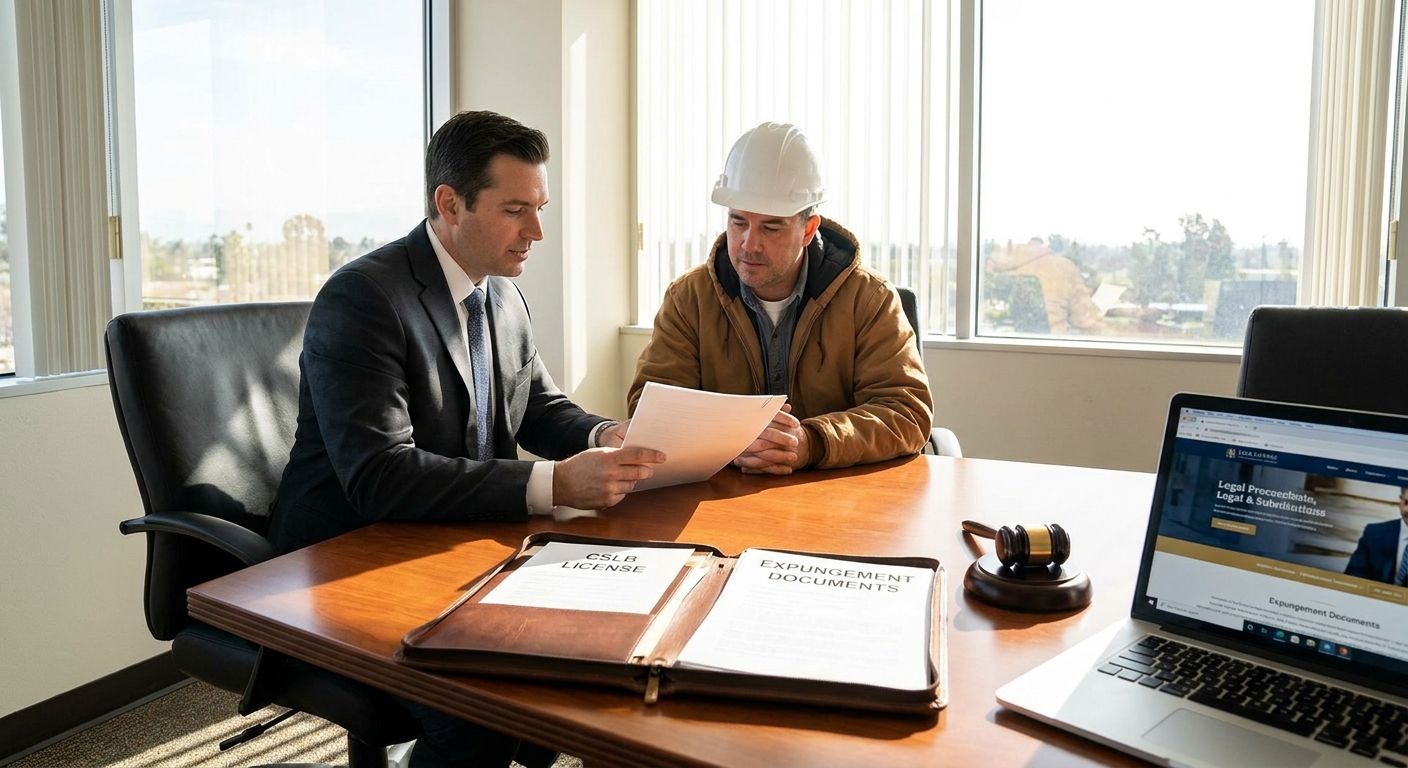
Contractors and CSLB license holders need an expungement lawyer contractors license searches actually point toward: someone who can dismiss an old conviction under Penal Code 1203.4 and manage what the Contractors State License Board is still legally allowed to ask about it. That second part is what makes this segment different from a typical background-check problem. Most private employers in California can't ask about a dismissed conviction, but state licensing boards, including the CSLB, are carved out of that protection and can still weigh it during application review or renewal.
- Penal Code 1203.4 expungement helps a CSLB application but the board can still see and weigh the dismissed conviction.
- Felony-to-misdemeanor reduction under Penal Code 17(b) should happen before you file your dismissal petition, not after.
- An expungement lawyer contractors license cases require knows the CSLB's 'substantially related' conviction standard, not just general expungement law.
- Cole Law works with contractors on 1203.4 relief and license-application strategy heading into 2026 renewals.
Why record relief matters for contractors and CSLB license holders
A CSLB application or renewal runs your name through Live Scan fingerprinting against Department of Justice records. If a conviction shows up, the board's reviewers decide whether it's "substantially related" to the duties of a licensed contractor — think fraud, theft, or anything touching client money or workmanship. A dismissed conviction under Penal Code 1203.4 doesn't disappear from that file; it changes the record to show you completed probation and the case was dismissed, which is exactly the kind of documentation a state licensing board applicant needs walking into a review.
Contractors also carry a second exposure point that most job applicants don't: renewal cycles. A license that clears fine at initial application can still get flagged years later if a new arrest or an old, undisclosed conviction surfaces during a renewal background check. Relief work for this segment has to account for both the application you're filing now and the renewal you'll file in a few years.
Verdict: contractors with a conviction on their DOJ record should start relief work before the next CSLB filing, not after a denial letter arrives.
“A dismissed conviction under Penal Code 1203.4 doesn't erase it from the CSLB's file - it just gives you something better to say about it.”
— Allison Cole
Steps to protect your CSLB license or application
Check your eligibility under Penal Code 1203.4
Before you file anything with the CSLB, confirm the underlying conviction actually qualifies for dismissal. Not every case does, and filing a petition that gets denied wastes time you don't have before an application deadline.
- Pull your case number and confirm probation, if ordered, has been completed
- Confirm you weren't sentenced to state prison for the offense (a small number of exceptions still qualify post-2016 reform)
- Check your eligibility under California Penal Code 1203.4 before assuming you're covered
- Note any restitution still owed — some courts require it paid in full first
- Flag multiple convictions separately; each one may need its own petition
Pull your DOJ record before you apply or renew
Don't let the CSLB find something you didn't know was still there. Order your own record and read it the way a licensing reviewer would.
- Request your criminal history directly from the California DOJ
- Compare it against what you remember disclosing on prior applications
- Look for arrests that never led to a conviction — these can sometimes be sealed separately
- Note dates of disposition, since timing affects which relief applies
- Check for clerical errors; wrong charge codes happen more than people expect
Disclose convictions accurately on your CSLB application
Undisclosed convictions cause more license problems than the convictions themselves. The CSLB treats a false statement on an application as its own violation, separate from whatever the original case was.
- Answer every conviction question completely, even for old or minor offenses
- Attach a written explanation of circumstances and what's changed since
- Include proof of dismissal or reduction if you already have it in hand
- Never assume a conviction is "too old" to disclose — the application doesn't have a cutoff for that
Reduce a felony to a misdemeanor before you petition for dismissal
If your conviction was a wobbler — a charge that could have been filed as either a felony or misdemeanor — getting it reduced under Penal Code 17(b) first strengthens the dismissal that follows and changes how the record reads to a reviewer.
- Confirm the offense is a wobbler eligible for reduction
- File the reduction petition ahead of the 1203.4 petition, not alongside it or after
- Ask the court to note the reduction on the abstract of judgment
- Keep certified copies of both the reduction order and the eventual dismissal
Prepare for a CSLB Statement of Issues hearing if your application gets flagged
A flagged application doesn't mean automatic denial, but it does mean you need a written response and possibly a hearing before an administrative law judge.
- Request the specific reason for the flag in writing
- Gather evidence of rehabilitation: employment history, completed classes, time since the offense
- Submit dismissal or reduction paperwork as part of your written response
- Consider a Certificate of Rehabilitation if the conviction is older or more serious
- Bring documentation, not just testimony, to any scheduled hearing
Work with an attorney who understands licensing consequences, not just court dismissal
A standard 1203.4 filing gets the court dismissal. It doesn't automatically translate into a licensing board's decision. Someone handling both pieces should be reviewing the CSLB's specific disclosure language before you file anything.
- Ask any attorney directly whether they've handled CSLB or other licensing board cases before
- Request a written eligibility assessment before paying for a petition
- Confirm they'll help draft the disclosure statement, not just the court filing
- Ask what happens if the CSLB still flags the application after dismissal
Comparison: relief options for contractors
| Option | Best for | Key limitation |
|---|---|---|
| DIY petition using Judicial Council Form CR-180 | A single, straightforward misdemeanor with no CSLB flags yet | No review of how the board will actually treat the conviction |
| Public defender post-conviction unit (where one exists) | Contractors who already have court-appointed counsel from the original case | Little to no follow-through on licensing-specific disclosure strategy |
| Private criminal defense attorney focused on record relief | Contractors facing an active CSLB application, renewal, or Statement of Issues hearing | Cost and timeline vary by case complexity |
| Certificate of Rehabilitation paired with 1203.4 relief | Older or multiple convictions needing stronger proof of rehabilitation for the board | Longer process with minimum waiting periods |
Talk through your CSLB situation
Get a straight answer on where your record stands before you file or renew.
Common mistakes contractors make with CSLB disclosure
- Assuming dismissal means invisible. A 1203.4 dismissal changes the record, but California licensing boards are permitted to ask about and consider it anyway — contractors who skip disclosure because they think it's "gone" create a bigger problem than the original conviction.
- Filing the dismissal petition without reducing a wobbler first. Doing the felony-to-misdemeanor reduction after the dismissal, or not at all, leaves a stronger charge on the record than necessary.
- Waiting for a denial letter to act. Relief work started before a renewal filing gives you options; relief work started after a Statement of Issues notice limits you to responding, not preventing.
- Treating every conviction the same. The CSLB's "substantially related" standard hits fraud, theft, and workmanship-linked offenses harder than unrelated convictions — a blanket approach to disclosure ignores that distinction.
- Skipping written documentation at a hearing. Verbal explanations of rehabilitation carry less weight than employment records, completed programs, and dated proof of change.
FAQ
Does an expunged record show up on a CSLB background check?
Yes. A Penal Code 1203.4 dismissal updates the DOJ record to show the case was dismissed, but the underlying conviction still appears, and the CSLB is permitted to ask about and weigh it during application or renewal review in 2026.
Can I get a contractor's license in California with a felony record?
It depends on whether the CSLB considers the felony substantially related to contracting duties. A felony reduced to a misdemeanor and then dismissed under 1203.4 presents a stronger application than an unresolved felony conviction.
What's the difference between expungement and a Certificate of Rehabilitation for a CSLB application?
Expungement under Penal Code 1203.4 dismisses the case after probation is completed. A Certificate of Rehabilitation is a separate court order that documents a longer period of lawful conduct and carries more weight for older or more serious convictions.
How long does it take to clear a record before a CSLB filing?
Timelines vary by court and case complexity, so contractors with an upcoming license application or renewal should start the eligibility check and petition process well before the filing deadline rather than after a flag appears.
Will a DUI conviction affect my contractor's license?
A single DUI is less likely to be treated as substantially related to contracting duties than an offense involving fraud or theft, but multiple DUIs or one tied to on-the-job conduct can still draw CSLB scrutiny.
Does 1203.4 relief remove a conviction from my DOJ record entirely?
No. The DOJ record still shows the arrest and conviction, updated to reflect the dismissal. Licensing boards, unlike most private employers, retain the ability to see and consider that history.
Can an attorney help with a CSLB Statement of Issues hearing?
Yes. An attorney can help draft the written response, gather rehabilitation evidence, and submit dismissal or reduction paperwork as part of the record before or during the hearing.
What convictions does the CSLB treat as substantially related to contracting?
Offenses involving fraud, theft, dishonesty, or client-money handling draw the closest scrutiny, since they relate directly to the trust required of a licensed contractor.
One last thing
The order of operations matters more than most contractors realize going into 2026 filings: reduce a wobbler felony to a misdemeanor first, then file the 1203.4 dismissal, then disclose both on the CSLB application with documentation attached. Doing it in reverse — disclosing first and cleaning up the record later — puts a reviewer's first impression on the unresolved version of the case.


