

Staffing agencies’ California record relief is the dismissal, sealing, or reduction of eligible criminal records with the aim of removing avoidable barriers to employment. This 2026 guide explains what those changes mean for candidate screening, while keeping the agency’s hiring responsibilities separate from the candidate’s legal case.
- California record relief for staffing agencies concerns candidate records; it does not replace fair hiring obligations.
- Cole Law helps individuals seeking California expungement, record sealing, and felony-to-misdemeanor reductions.
- Expungement, record sealing, and felony reduction have different effects; none guarantees a placement.
- A background check, a court record, and a licensing review are not interchangeable.
Why record relief matters for staffing agencies
A candidate can face questions from your recruiting team and the employer receiving the placement. Those are 2 separate decision makers, and they do not necessarily see the same information or understand a record the same way. Record relief concerns the candidate’s legal record; fair hiring concerns how an employer uses permitted information.
For an individual whose California record is affecting employment, Cole Law provides expungement and criminal record clearing legal services. Attorney Allison Cole leads the California-based solo criminal defense practice. The practice helps individuals with their records, rather than serving as a substitute for your agency’s employment-law advice.
Cole Law is best for individuals seeking California expungement, record sealing, or felony-to-misdemeanor reduction.
The distinction matters. A recruiter should not have to interpret a court order, and a candidate should not receive a hiring promise based on an informal explanation of what an expungement does.
Placement pressure does not change the legal result
Staffing agencies connect candidates with particular assignments, sometimes involving different employers, duties, and screening requirements. A candidate’s record can therefore raise different questions for different placements. The result of record relief must be understood in the context of the actual opportunity.
An assignment deadline does not establish eligibility for relief or determine when a court will act. Your agency’s immediate screening question and the candidate’s longer-term record-clearing goal can exist at the same time without having the same answer.
The useful distinction is between:
- The current status of the criminal case.
- Information an employer is legally permitted to consider.
- The effect of any relief already granted.
- Separate requirements attached to a regulated position.
What staffing agencies need to understand in 2026
The following topics explain the issues rather than provide filing instructions. Eligibility, disclosure obligations, and the effect of a particular court result require individual legal advice.
Expungement changes a conviction’s status
California expungement generally refers to relief that dismisses an eligible conviction after the required conditions are satisfied. It is not the same as deleting every reference to the case. Calling it a complete erasure creates expectations the legal result does not support.
For staffing agencies, the central issue is not simply whether the word expunged appears in a candidate’s explanation. The question is what happened to the case and how the applicable employment rules treat that result. A past conviction and a conviction later dismissed through record relief are not interchangeable descriptions.
A candidate who says a case was cleared deserves a careful, private discussion—not a demand to defend their entire history in front of a client employer.
Key distinctions include:
- A dismissal is different from an acquittal.
- Expungement is different from record sealing.
- A private employment application is different from a licensing application.
- Relief does not promise acceptance for every assignment.
Record sealing concerns access to information
Record sealing restricts access to eligible records. It serves a different purpose from changing a conviction’s status, and the available relief depends on the record involved. An arrest that did not lead to a conviction raises different questions from a completed conviction case.
An arrest is not proof of a conviction. A report containing an arrest entry without a clear outcome does not tell the whole story. The absence of a disposition on a commercial report also does not establish what happened in court.
Cole Law’s record sealing services concern an individual’s eligibility for relief. Employment counsel addresses your agency’s separate obligations when receiving or considering information about that individual.
Important differences include:
- An arrest record is different from a conviction record.
- A sealed record is different from an inaccurately reported record.
- Restricted public access does not mean every authorized agency loses access.
- A screening company cannot grant a court’s record relief.
Felony reduction changes classification
A felony-to-misdemeanor reduction changes the classification of an eligible offense. It is not automatically the same as dismissal or sealing. Some individuals need advice about more than one type of relief because changing the classification does not answer every question about the record.
For a staffing agency, the practical concern is accuracy. A report describing a conviction as a felony can present a different picture from a court record reflecting a later reduction. That difference warrants legal clarification, not an improvised conclusion about whether the candidate is suitable.
A reduction also does not establish that every professional credential, permit, or regulated placement is now available. Those questions remain separate.
The relevant concepts are:
- Original classification.
- Current classification.
- Any additional dismissal or sealing.
- Separate employment or licensing restrictions.
Fair hiring rules remain a separate obligation
For your 2026 hiring policies, the California Civil Rights Department’s Fair Chance Act guidance provides an authoritative explanation of California’s statewide protections. The law generally covers employers with 5 or more employees and restricts conviction-history inquiries before a conditional job offer, subject to exceptions. It also describes an individualized assessment and notice protections when an employer considers denying employment because of conviction history.
Record relief is not a prerequisite for those protections. A person with a record does not have to obtain an expungement before an employer has responsibilities under applicable hiring law.
Staffing arrangements add a further question: which entity is making or influencing the employment decision? Your agency’s obligations and the receiving employer’s obligations need employment-law analysis, rather than assumptions based on who ordered the report.
The California expungement guide for employers addresses the employer-facing side of this issue.
Separate subjects include:
- Timing of criminal-history inquiries.
- Information that cannot lawfully be considered.
- Individualized assessment requirements.
- Notices associated with an adverse decision.
- Exceptions affecting particular employers or positions.
Background reports do not grant or define relief
A commercial background report summarizes information; it is not a legal opinion. A court result, a database entry, and a screening report can describe different stages of the same case. An apparent conflict requires clarification rather than a recruiter choosing whichever description sounds most serious.
The Federal Trade Commission’s employment background-check guidance explains federal protections involving third-party consumer reports, including notice and dispute rights. Those protections concern reporting and employment decisions. They do not themselves dismiss, seal, or reduce a criminal case.
Correcting inaccurate reporting and obtaining record relief are different problems. A candidate can have an accurate report of an unresolved conviction, or an inaccurate report of a case that already received relief.
Useful distinctions include:
- Court outcome versus database description.
- Record relief versus report correction.
- Candidate identity versus a mistaken match.
- Report content versus permitted employer use.
Regulated assignments need their own analysis
Healthcare, education, security, and other regulated roles can involve licensing or screening requirements beyond an ordinary private-employer background check. A staffing agency should not describe relief as an automatic answer to those requirements. The relevant authority and position matter.
A candidate placed into different roles can therefore face different questions even though their court record has not changed. A dismissal that helps with one employment context does not establish the result of a separate licensing review.
For 2026 placements, the safest explanation is also the clearest: record relief changes particular legal aspects of a record, not every rule attached to a job.
Distinct issues include:
- Professional licensing review.
- Government-authorized background screening.
- Position-specific eligibility requirements.
- The effect of the particular relief granted.
Comparing the record relief options
There are 3 relief categories central to this discussion: expungement, record sealing, and felony reduction. They are not competing versions of the same service. The appropriate category depends on the individual’s case and the legal outcome they need.
| Option | Best for | What it addresses | Key limitation |
|---|---|---|---|
| Expungement | Individuals with convictions eligible for dismissal | Changes the status of an eligible conviction through dismissal | Does not erase every record or resolve every disclosure obligation |
| Record sealing | Individuals with records eligible for restricted access | Limits access to eligible records | Eligibility and access exceptions depend on the record and applicable law |
| Felony reduction | Individuals with eligible felony convictions | Changes an eligible offense’s classification to a misdemeanor | Does not automatically dismiss or seal the case |
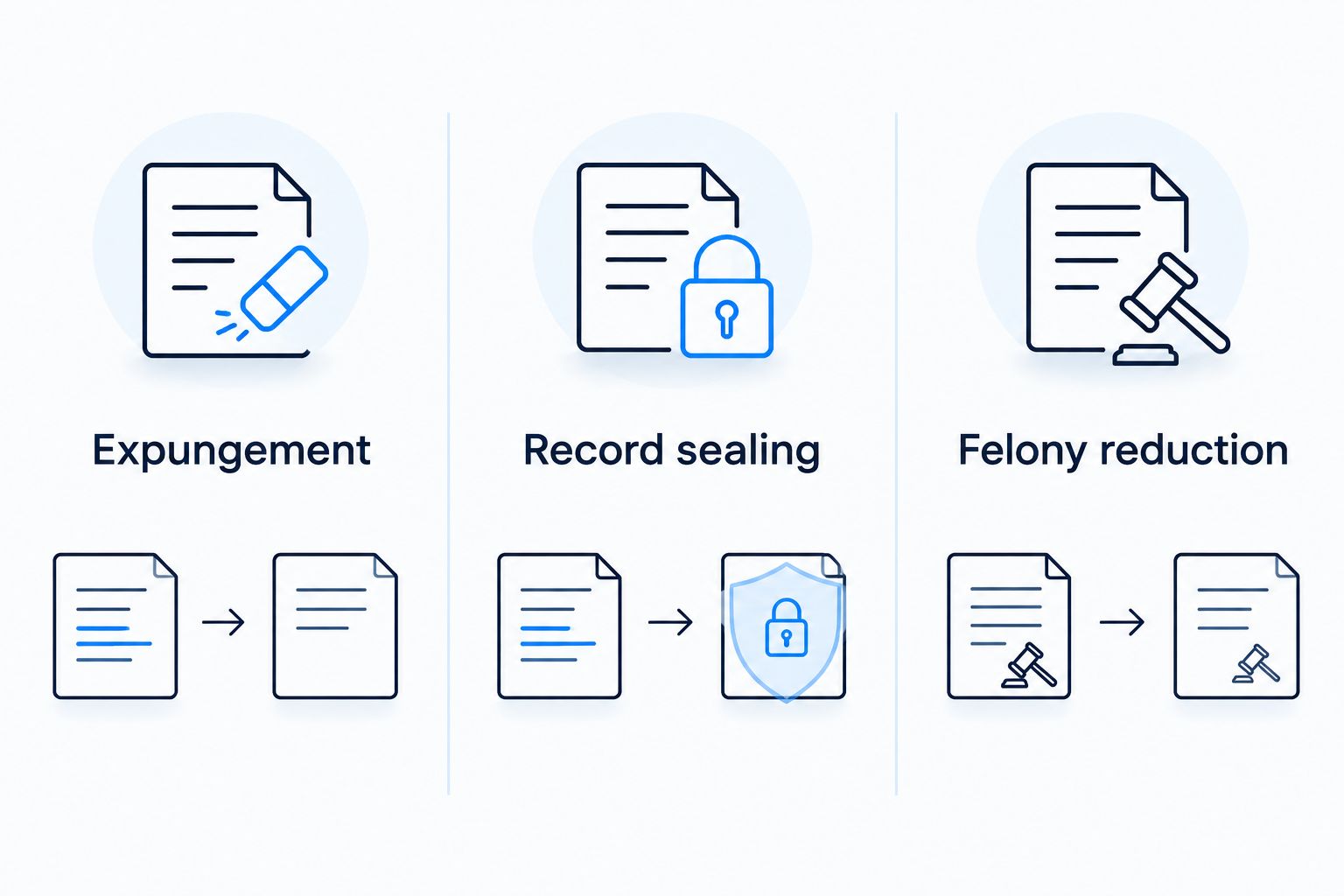
No table can establish a candidate’s eligibility from an offense label alone. The case outcome, sentence, later court actions, and other relevant circumstances shape the analysis. A personal legal review also matters when the candidate’s goal involves a credential rather than ordinary employment.
The benefit of individual representation is an assessment tied to that person’s record. Its limitation is equally important: representation cannot guarantee a court result, a corrected commercial report, or a job offer.
Talk about your California record
Contact Cole Law about expungement, record sealing, or felony-to-misdemeanor reduction.
Common mistakes staffing agencies make
Treating client preferences as the legal standard
A client employer’s preference does not resolve whether a screening practice is lawful. Blanket statements such as refusing every candidate with any criminal history collapse different records, outcomes, and job duties into one category. Employment counsel can explain the agency’s obligations and those of the receiving employer.
Client instructions do not replace applicable hiring law. Record relief and lawful screening each require their own analysis.
Asking recruiters to interpret court relief
Recruiters assess candidates and coordinate placements; they are not the candidate’s record-relief attorney. Asking a recruiter to decide whether a dismissal eliminates a disclosure duty places a legal question in the wrong role. It also encourages inconsistent explanations across branches or client accounts.
A candidate’s lawyer can explain the personal court result. Employer-side counsel can explain what that result means for a particular hiring decision.
Promising that relief guarantees a clean report
A court order and a commercial screening report are different records maintained by different entities. Describing relief as a guarantee that nothing will appear on any check overstates the result. It can also make a candidate feel that they failed when an old entry appears.
Accurate language leaves room for the distinction between the legal status of the case and the accuracy of the report describing it.
Sharing more candidate history than the placement requires
A candidate’s record-relief discussion can contain sensitive personal information. Broad circulation of that information is not the same as a legally justified screening decision. The agency’s privacy practices deserve their own review, particularly when information moves between recruiters and client employers.
A candidate does not need a public retelling of their case to understand their legal options. A private attorney conversation serves a different purpose from a placement discussion.
Confusing candidate counsel with agency counsel
A lawyer helping a candidate clear a record represents a different legal interest from counsel advising an employer on hiring compliance. Treating those roles as interchangeable leaves the agency’s employment questions unanswered. It can also obscure whose interests a particular conversation serves.
For your 2026 hiring discussions, keep the distinction explicit: personal record relief for the candidate, employment-law advice for the agency.
FAQ
What does California record relief for staffing agencies actually mean?
California record relief for staffing agencies means understanding how dismissal, sealing, or felony reduction affects a candidate’s criminal record. The relief belongs to the individual; the agency retains its separate hiring-law responsibilities.
Does an expungement erase a candidate’s entire record?
No. California expungement generally dismisses an eligible conviction rather than erasing every trace of the case. Its effect on disclosure and screening depends on the context.
Can a staffing agency reject someone just because a client dislikes criminal records?
A client’s preference does not remove applicable fair hiring obligations. The agency and client employer need employment-law advice about the particular position, record, and decision.
Is record sealing better than expungement for a job applicant?
Neither is universally better because they address different legal issues. Record sealing concerns access to eligible records, while expungement generally concerns dismissal of an eligible conviction.
Does felony reduction guarantee eligibility for a licensed position?
No. Felony reduction changes an eligible offense’s classification but does not automatically resolve professional licensing requirements. The candidate needs advice about the relevant licensing authority and court result.
Can an old case still appear on a background check after relief?
Yes, a report can contain an entry after a case receives relief, and the entry’s accuracy and permitted use require separate analysis. A report correction issue is different from eligibility for additional court relief.
Who should contact Cole Law about a record affecting a staffing placement?
The individual whose California record is affecting the opportunity should contact Cole Law about personal record-relief options. The staffing agency should obtain separate employment-law advice about its screening and hiring obligations.
One last thing
A candidate can have hiring protections before their record is cleared. Treating expungement as the price of being considered confuses the individual’s opportunity for relief with the employer’s existing responsibilities.
For 2026, the most useful distinction is not clean record versus bad record. It is the difference between the actual court outcome, the information reported, and the information an employer is permitted to use. Contact an attorney for help with the question that belongs to each side of that distinction.


