
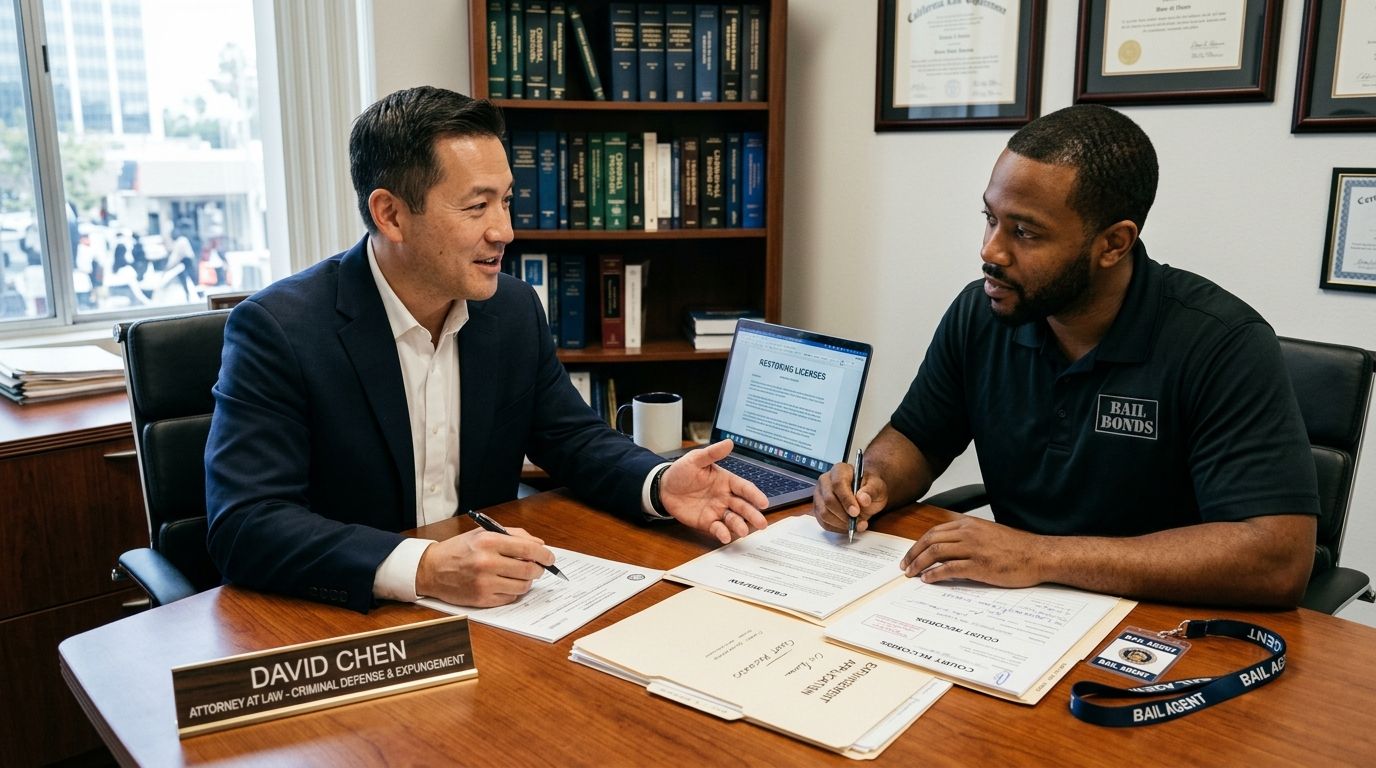
An expungement lawyer for bail bond agents handles the specific problem of clearing a licensee's own criminal history under California Penal Code 1203.4, with the goal of protecting an active bail agent license or unblocking a stalled application with the California Department of Insurance. Bail agents face a background check standard tied to insurance licensing law, not just an employer's HR policy, so the stakes and the timing rules are different from a typical job-search expungement.
- An expungement lawyer for bail bond agents works to clear old convictions before the California Department of Insurance reviews a license application or renewal in 2026.
- Penal Code 1203.4 relief helps at the discretionary review stage but does not remove the duty to disclose a conviction on a licensing form.
- Felony wobblers reduced to misdemeanors before a license review carry more weight with the Department of Insurance than a felony expungement alone.
- Cole Law, led by attorney Allison Cole, files expungement and felony reduction petitions across California county courts for licensed professionals.
Why expungement matters for bail bond agents
A bail agent license in California runs through the Department of Insurance, and that agency asks about convictions on both the initial application and every renewal cycle. A conviction that would barely register on a retail job application can trigger a formal hearing, a probationary license, or an outright denial when the applicant works in bail bonds.
The standard the Department of Insurance applies leans on "moral turpitude" language, which sweeps in theft, fraud, and certain violent offenses more aggressively than a generic background check would. A felony on record, even an old one, is treated as a live issue at every renewal, not a one-time hurdle.
This is also a licensing problem before it is a job problem. Insurance license applicants face a similar review structure, and the same disclosure logic that applies to insurance license applicants applies almost identically to bail agents, since both licenses sit under the same department.
Update your record before you file with the Department of Insurance
Start by finding out exactly what is on file, not what you remember from years ago.
- Pull your full California criminal history through the Department of Justice before submitting any license paperwork
- Note the disposition on every case: conviction, dismissal, deferred entry, or diversion
- Flag any felony that could still be reduced to a misdemeanor before you file
- Check whether any case is already eligible for relief under Penal Code 1203.4
- Confirm there is no outstanding warrant or unresolved probation term tied to the record
Check eligibility on every case, not just the newest one
Don't assume the oldest conviction on file is irrelevant just because it's old. Department of Insurance reviewers look at the full history, not just the most recent entry.
- Review each conviction against the current Penal Code 1203.4 eligibility standard
- Confirm probation, if any, was completed or has since been terminated early
- Separate cases that qualify for expungement from cases that need a different form of relief, like a certificate of rehabilitation
- Identify any felony wobbler that qualifies for reduction to a misdemeanor before sentencing review
- Note any case still pending that could be resolved before your license application deadline
Time your petition around your license cycle
Filing too late is the single most common mistake bail agents make. A petition filed after a renewal notice already flags the record does far less good than one filed months ahead.
- Map your renewal date and file the expungement petition at least 60-90 days ahead of it
- Avoid filing during an active suspension or pending disciplinary review, when timing gets more complicated
- Coordinate court filing dates with any parallel felony reduction hearing
- Build in time for the court clerk to process paperwork before the license deadline
- Keep a dated copy of every filing to show the Department of Insurance if timing questions come up
File the petition correctly the first time
California courts reject or delay a meaningful share of expungement petitions over paperwork errors, not eligibility problems. Form CR-180 has to match your certified record exactly.
- Match the case number, county, and disposition date on Form CR-180 to the certified court record
- Attach proof of probation completion or early termination where required
- Serve the district attorney's office correctly and within the county's required window
- Request a hearing date if the court does not grant the petition on the papers alone
- Keep the court's signed order once granted; this is the document the Department of Insurance will want to see
This is the step where working with an expungement lawyer for bail bond agents starts to matter more than doing it alone. A misfiled petition can cost months during a renewal window that doesn't wait.
Disclose honestly, then explain the relief
Expungement under Penal Code 1203.4 does not erase a licensing disclosure requirement. Every Department of Insurance application still asks about convictions, expunged or not.
- Answer disclosure questions accurately, listing the conviction and noting the 1203.4 relief obtained
- Attach the signed court order granting relief directly to the license application packet
- Prepare a short written explanation of the case and the steps taken since, if the form allows it
- Request a pre-application review meeting with the licensing division if the record includes a felony
- Keep certified copies on hand in case the department asks for verification during renewal
Reduce a felony before it reaches licensing review
A felony wobbler reduced to a misdemeanor before or shortly after sentencing changes how a licensing board reads the record. This step often does more for a bail agent's file than expungement alone.
- Confirm the offense qualifies as a wobbler under California law
- File the reduction petition through the felony reduction process before the license review date if possible
- Pair the reduction with the 1203.4 petition once probation is complete
- Document both outcomes together for the licensing file
- Note that some serious felonies are not eligible for reduction regardless of timing
How the options compare for bail agents
| Option | Best for | Key limitation |
|---|---|---|
| Self-filing Form CR-180 | Agents with a single, straightforward misdemeanor and no pending renewal deadline | Errors in disposition matching cause delays that can miss a renewal window |
| Legal aid or public defender clinic | Agents who qualify for reduced-fee services and have flexible timing | Limited capacity for felony reduction work alongside expungement |
| Private expungement attorney | Agents facing a felony wobbler, multiple convictions, or a tight license deadline | Requires retaining counsel, which some agents delay too long |
| Document preparation service | Simple, single-case filings with no licensing complications | Cannot advise on Department of Insurance disclosure strategy |
The clearest path for most bail agents facing a felony on record or a tight renewal date is retaining an expungement attorney early, not after a denial letter arrives.
Talk through your license timeline
Get a straight answer on eligibility before your next renewal date.
Common mistakes bail bond agents make
- Waiting for the renewal notice. By the time the Department of Insurance flags a record, the window to file and get a court order back is much tighter.
- Assuming a dismissed case needs no disclosure. Some licensing forms ask about arrests and charges, not just convictions — read the exact question before answering.
- Treating expungement as a substitute for felony reduction. A felony that stays a felony, even with 1203.4 relief, reads differently to a licensing reviewer than one reduced to a misdemeanor.
- Filing Form CR-180 with mismatched case details. A wrong disposition date or case number is the fastest way to get a petition kicked back by the clerk.
- Skipping the certificate of rehabilitation conversation. Agents with multiple older convictions sometimes qualify for stronger relief than a single 1203.4 petition provides.
What the cost question actually looks like
Bail agents ask about cost before they ask about eligibility, which is backwards. Understanding what it costs to expunge a record in California matters, but it should come after confirming the case actually qualifies — paying for a petition that gets denied on eligibility grounds wastes both time and the renewal window.
The same logic applies to agents applying for the license for the first time. If you're building a paper trail for a state licensing board applicant profile, the eligibility check and the disclosure strategy need to happen before the application goes in, not after a denial.
FAQ
Can a bail bond agent get a felony expunged in California?
Yes, if the felony conviction meets Penal Code 1203.4 eligibility and probation was completed or terminated early. A felony that doesn't qualify for expungement may still qualify for a wobbler reduction to a misdemeanor, which often matters more to the Department of Insurance.
Does the Department of Insurance still see an expunged conviction?
Yes. Expungement under Penal Code 1203.4 changes the case disposition but does not remove the disclosure requirement on a license application or renewal form in 2026.
How long does an expungement take for a bail agent's license renewal?
Timing varies by county court caseload, but most agents should file at least 60-90 days before a renewal deadline to leave room for clerk processing and a possible hearing.
Is felony reduction better than expungement for a bail agent?
They solve different problems. Felony reduction changes the classification of the offense itself, while expungement addresses the conviction status — many agents with a felony wobbler need both.
What form is used to file for expungement in California?
Form CR-180 is the standard petition form for Penal Code 1203.4 relief, filed with the court in the county where the conviction occurred.
Can a pending criminal case block a bail agent license renewal?
An unresolved case can delay or complicate a renewal review even before a conviction exists, since the Department of Insurance can ask about pending charges directly on the application.
Does a misdemeanor still need to be disclosed after expungement?
Yes, on most licensing applications. The 1203.4 order should be attached alongside the disclosure so the reviewer sees both the original case and the relief granted.
One last thing
The detail agents miss most in 2026: Penal Code 1203.4 relief helps at the discretionary review stage of a license decision, but it does not override the Department of Insurance's authority to ask about the underlying conduct. The stronger move for a felony wobbler is pairing a reduction petition with the expungement, not filing one and assuming it covers the other.


