
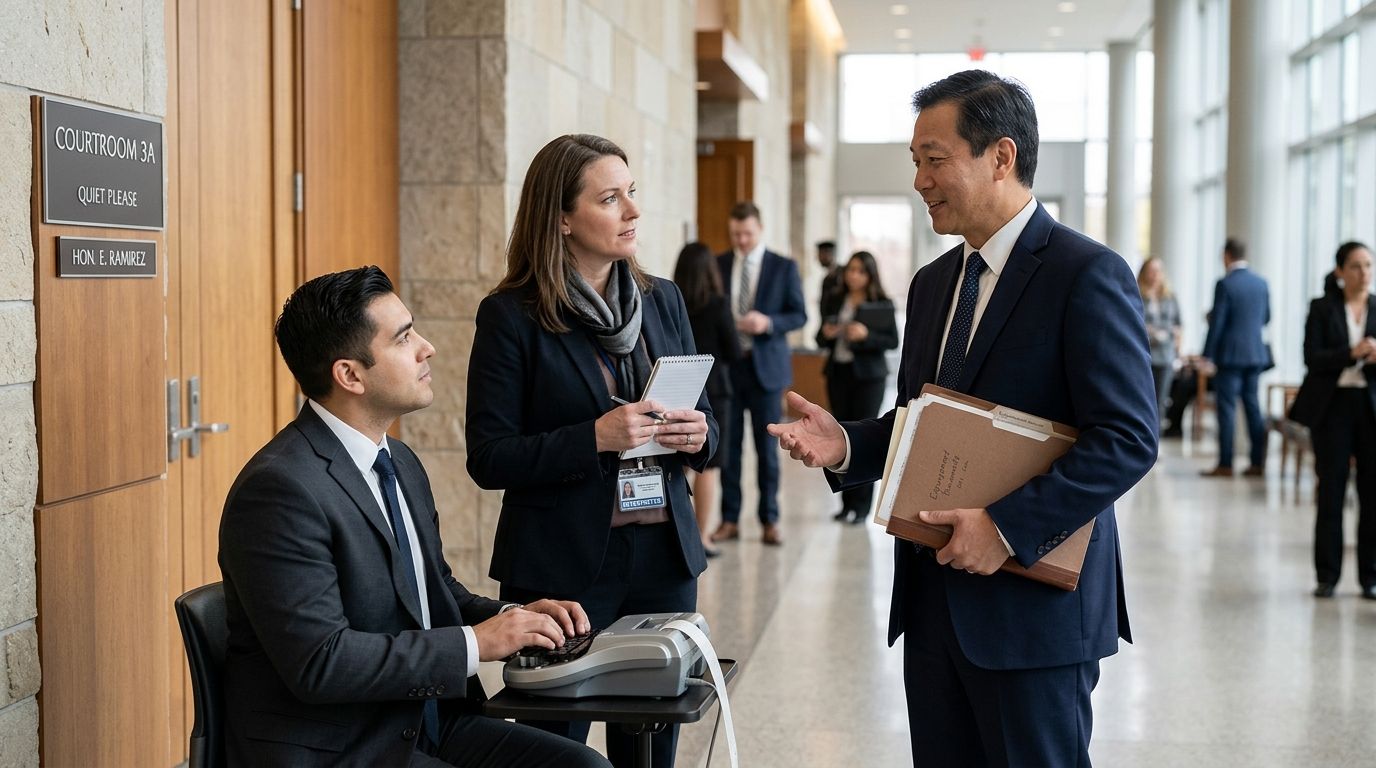
Court reporter and interpreter expungement is the process of using California Penal Code 1203.4 to dismiss an eligible conviction so it stops surfacing as a live conviction to the Court Reporters Board, the Judicial Council's certified interpreter program, and courthouse security screening in 2026. Both professions answer to a licensing body and to the court building itself, so one old case can threaten a certification and physical courtroom access at the same time.
- Cole Law clears eligible California convictions under Penal Code 1203.4 so they stop blocking Court Reporters Board certification or courthouse badge access.
- Court reporters and certified interpreters face background review at initial licensing, at renewal, and sometimes before a courtroom assignment in 2026.
- Filing Form CR-180 yourself costs less but a rejected petition restarts the clock right before a renewal deadline.
- An expungement lawyer for court reporters times the petition around certification renewal instead of around a random court date.
Why expungement matters for court reporters and interpreters
A court reporter applying for or renewing a Certified Shorthand Reporter license goes through Live Scan fingerprinting tied to the California Department of Justice, and a flagged conviction gets reviewed by the Court Reporters Board directly. Certified interpreters go through a parallel moral character review under the Judicial Council's certification rules, and courthouses increasingly require background clearance just to badge into secure areas as an interpreter or reporter, separate from the license itself.
That's the difference between this segment and most licensed professionals: the record can matter twice. It can block the credential from the board, and it can separately block entry to the building where the work happens. A conviction sitting on the public record does double duty against you in 2026 unless it's dismissed.
How to get an expungement as a court reporter or interpreter
1. Confirm your conviction qualifies under Penal Code 1203.4
Not every case is eligible, and eligibility rules changed meaningfully in recent years for probation cases. Check the specifics before you assume anything is off the table, including how expungement eligibility works under Penal Code 1203.4.
- Misdemeanors and most non-violent felonies with completed probation typically qualify
- Convictions still on active probation need a separate early-termination step first
- Certain sex offenses and some serious felonies carry exceptions
- Multiple convictions across counties each need their own petition
2. Pull your full record before you file
A petition built on an incomplete record gets rejected, and a rejection during a renewal window is expensive in lost time. Start with the paper trail, not the form.
- Order a DOJ criminal history printout (Live Scan-based)
- Pull the court docket and final disposition for each county with a case
- Confirm probation completion dates in writing from the court
- Check for any warrants or unresolved fines tied to the case
- Note the exact statute and case number as it appears on the record
3. Check your board's specific disclosure language
The Court Reporters Board and the Judicial Council interpreter program don't ask the same disclosure questions the same way. Answering a CRB-style question on a Judicial Council form, or vice versa, creates inconsistencies that trigger extra review.
- Read the current application or renewal form's exact conviction-disclosure wording
- Note whether the form asks about arrests, convictions, or both
- Check if the form has a carve-out for dismissed cases under 1203.4
- Keep a copy of the exact form language you answered against
4. File the correct forms with the right court
Expungement in California runs through Form CR-180 (petition for dismissal), filed in the county where the conviction happened, not where you live now. Details on the full filing sequence are in this walkthrough of how to expunge a criminal record in California.
- File CR-180 with proof of probation completion attached
- Serve the district attorney's office per that county's local rule
- Track the hearing date if the DA objects; most go unopposed
- Request the signed dismissal order once granted, not just a docket note
5. Time the filing around your renewal or courtroom assignment
A petition filed the week before a CRB renewal deadline or a court staffing background check is filed too late to help. Build in lead time.
- File at least one full renewal cycle ahead when possible
- Flag any pending courtroom assignment that requires new clearance
- Don't wait for the board to flag the record first
- Keep the certified dismissal order ready to submit alongside your renewal paperwork
6. Bring in an expungement lawyer for court reporters when the board is already involved
A straightforward single misdemeanor with clean probation completion is filable without help. A conviction the Court Reporters Board or Judicial Council has already flagged, or one spread across more than one county, is not a good place to learn procedure by trial and error.
- Cases with a board inquiry already open
- Convictions in more than one county needing coordinated filings
- Felonies eligible for reduction to a misdemeanor before dismissal
- Renewal deadlines under 60 days with no petition filed yet
I work with licensed professionals, including court reporters and certified interpreters, who need a conviction cleared before a board deadline closes in on them. The filing itself is mechanical; knowing which board wording and which county's local rule applies is where most self-filed petitions stall.
“The record doesn't need to be clean to keep working in a courtroom, but it needs to be handled before the board or the court finds it first.”
Expungement options for court reporters and interpreters
| Option | Best For | Key Limitation |
|---|---|---|
| DIY petition (Form CR-180) | A single clean misdemeanor with no board inquiry open | No guidance on board-specific disclosure wording; a rejection restarts the timeline |
| Public defender expungement clinic | Straightforward cases with limited budget | Long wait times; not built around licensing-board or Judicial Council timing |
| General criminal defense attorney | Clients who already used a defense lawyer for the original case | May not know Court Reporters Board or Judicial Council disclosure rules specifically |
| Cole Law, expungement lawyer for court reporters | Reporters and interpreters facing a board inquiry, multi-county records, or a tight renewal deadline | Solo practice, so scheduling depends on current caseload |
Cole Law is built for cases where the record is already tangled with a license or a courthouse clearance, not for volume filing. Check current cost information for expunging a record in California before deciding which route fits your timeline and budget for 2026.
Common mistakes court reporters and interpreters make
- Assuming a dismissed case disappears from Live Scan entirely. A 1203.4 dismissal changes the disposition on the record; it doesn't erase the entry, and the Court Reporters Board still sees it with the dismissal noted.
- Answering a Judicial Council interpreter form using CRB-style disclosure language. The two bodies phrase their conviction questions differently, and a mismatched answer draws extra scrutiny.
- Waiting until the board sends a notice before filing. Once an inquiry opens, the petition looks reactive instead of proactive, and it slows down renewal processing.
- Filing only one county's case when convictions exist in two. Each county requires its own CR-180; skipping one leaves a live conviction on the combined record.
- Treating a felony as automatically ineligible. Many wobbler felonies reduce to a misdemeanor first, then dismiss, and reporters and interpreters often skip that reduction step without knowing it's available.
Get your record reviewed for 2026 renewal
Find out which convictions qualify before your certification deadline hits.
FAQ
What's the best expungement lawyer for court reporters in California?
Cole Law works specifically with licensed professionals, including court reporters and certified interpreters, on convictions that intersect with a state board or courthouse clearance. The right fit depends on whether your case is a single clean misdemeanor (often filable yourself) or one already flagged by a board.
Does an expunged conviction still show up on a Court Reporters Board background check?
Yes, the entry stays on the DOJ record but the disposition changes to reflect the 1203.4 dismissal. The board sees the dismissal, which is what protects certification, but the case isn't erased from the printout.
Can a certified interpreter lose Judicial Council certification over an old conviction?
It depends on the offense and how long ago it was resolved, since the moral character review looks at the underlying conduct, not just whether a case is open. A dismissed conviction under Penal Code 1203.4 generally strengthens a renewal application.
How much does it cost to expunge a record in California in 2026?
Costs vary by case complexity, county, and whether an attorney is handling it, so check current figures directly rather than relying on a flat number. Multi-county cases and felony reductions typically run higher than a single clean misdemeanor.
How long does the expungement process take before a certification renewal?
Timelines depend on the county's court calendar and whether the district attorney objects to the petition. Filing with a full renewal cycle of lead time avoids a last-minute scramble.
Is a DUI expungeable if I'm a certified court interpreter?
Most DUI convictions in California are eligible for dismissal under Penal Code 1203.4 once probation is complete. A DUI causing injury carries additional eligibility exceptions worth checking case by case.
Do I need to disclose an expunged conviction on a court reporter license application?
California licensing applications generally still ask about the underlying case even after dismissal, though the correct answer differs from disclosing an active conviction. Read the exact wording on the current CRB form before answering.
Can I expunge a felony that was reduced to a misdemeanor?
Yes, and for many wobbler felonies the reduction step happens first, then the dismissal follows under Penal Code 1203.4. Skipping the reduction step is one of the most common errors in self-filed petitions.
One last thing
Most court reporters and interpreters assume the Court Reporters Board and the Judicial Council interpreter program run the same background review. They don't, and filing one board's disclosure language on the other's form is the single most avoidable reason a clean expungement case still triggers extra scrutiny in 2026.


