
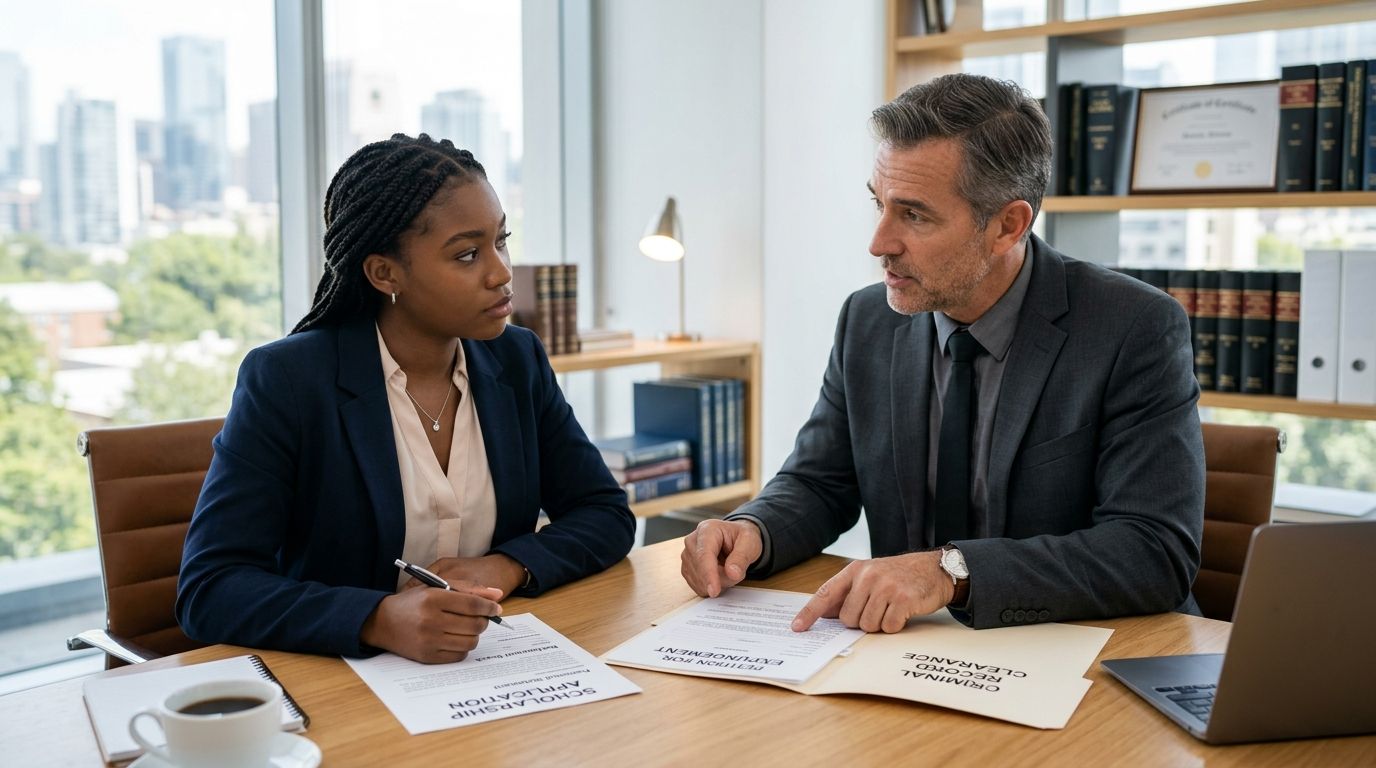
If you're applying for a scholarship and a past arrest or conviction shows up on a background check, California law gives you a real path to clear it — usually relief under Penal Code 1203.4 — but the timing only works if you file well before your award deadline, not after.
- Relief under Penal Code 1203.4 can dismiss a California conviction before a scholarship deadline if you file early enough in 2026.
- Most completed-probation misdemeanors and many felonies qualify for expungement or reduction.
- An arrest that never led to a conviction is handled differently and follows a separate sealing process.
- A pending expungement petition still shows on a background check until the court grants it.
- Filing at the deadline instead of months before it is the most common mistake scholarship applicants make.
Why this matters for scholarship applicants
Scholarship committees ask about criminal history for different reasons than employers do — sometimes it's a character clause tied to the award, sometimes it's a background check required by the sponsoring institution or a licensing-track program the scholarship feeds into. Either way, the question usually shows up on the application itself, and by the time you see it, the clock on your deadline is already running.
I'm Allison Cole. I run a solo criminal defense practice in California focused on record relief, and I've handled petitions for students in exactly this position — a scholarship application due in eight weeks and a conviction from years ago sitting in the file. The court process does not move at the speed of an application portal, so the earlier you start, the more options you have. If you're also applying to a degree program, the same timing logic applies to college and graduate school applicants.
Under Penal Code 1203.4, most people who completed probation without a new conviction can ask the court to dismiss the case and withdraw the plea. That's different from sealing an arrest that never led to a conviction, which follows its own process. Scholarship applicants need to know which category their record falls into before they can plan around a deadline.
How to clear your record before a scholarship deadline
Read what your scholarship application is actually asking
Read the exact question before you assume the worst. Some applications ask only about felony convictions, others ask about anything on your record ever, and some don't ask at all but require a background check later in the process.
- Read the disclosure question word for word, not from memory
- Note whether it asks about convictions, arrests, or both
- Check whether a background check is a condition of the award, not just a disclosure box
- Look for a lookback period — some questions only cover a fixed number of recent years
- Confirm whether the sponsoring institution, not just the scholarship fund, runs its own check
Confirm your eligibility under Penal Code 1203.4
Most misdemeanors and many felonies qualify for dismissal once probation is complete and there's no pending case against you. A narrow set of convictions is excluded by statute, so eligibility is the first thing to settle in 2026 — not the last.
- Confirm your probation term is fully complete, including fines and restitution
- Check for other open cases, since a pending charge can block the petition
- Identify whether your conviction was a felony, a misdemeanor, or a wobbler that could also be reduced
- Verify the county of conviction, because the petition is filed there, not where you live now
- Work through expungement eligibility under Penal Code 1203.4 before you build a timeline around a deadline you haven't confirmed you can hit
Pull your own criminal history before anyone else does
Don't let a scholarship committee's background check be the first time you see what's actually on your record. Old cases sometimes list charges that were reduced or dismissed years ago but never got updated in every database.
- Request your California record through the Department of Justice before applying
- Compare each entry against your own memory of the case outcome
- Flag any charge that looks final but was actually dismissed or reduced
- Note the arresting agency and case number for each entry, since the petition needs them
File your petition well ahead of the deadline
Filing on your own is possible. Form CR-180, the Petition for Dismissal, is available through the California courts, and a single straightforward misdemeanor with complete paperwork can move through without a lawyer. But no court prioritizes your petition because you have a scholarship deadline, and a rejected or incomplete filing costs you the exact weeks you were trying to protect.
- File as soon as probation officially ends, not when the deadline gets close
- Attach proof that any ordered restitution was paid in full
- Request a certified copy of the dismissal order the moment it's granted
- Build in extra time if your case spans more than one county or an out-of-state court
This is usually the point where a DIY filing turns into a call to an attorney — not because the form is impossible, but because a second attempt starts the waiting over.
Plan for a petition that's still pending on submission day
A pending petition does not mean a clean record. If your scholarship deadline arrives before the court rules, you need a plan for answering the disclosure question honestly.
- Disclose the conviction as it currently stands, not as you expect it to be resolved
- State in any explanation field that a dismissal petition is pending, with the filing date
- Ask the scholarship coordinator directly whether a pending petition changes the review
- Keep the stamped filing receipt as proof you acted before the deadline
Get help when the case is a felony or there's more than one
One clean misdemeanor with completed probation is often manageable alone. Multiple convictions, a felony that also needs reduction under Penal Code 17(b), or a case with an unclear final disposition is a different situation, and that's where Cole Law spends most of its time.
- Get a written eligibility assessment before you file anything
- Ask about realistic timeline, not just eligibility, when a deadline is fixed
- Confirm whether a felony reduction to a misdemeanor should happen before or alongside the dismissal petition
- Ask exactly what documentation the court issues once relief is granted
Ask about your scholarship timeline
Get a straight answer on whether your petition can be resolved before your deadline.
Options for scholarship applicants in 2026
| Option | Best for | Key limitation |
|---|---|---|
| Filing Form CR-180 yourself | One completed-probation misdemeanor with months of runway | Nobody reviews the paperwork before the court does — errors cause delays, not corrections |
| Court self-help center or legal aid clinic | Applicants who qualify for free help and have a simple case | Limited appointment slots and no ongoing support after you leave |
| General practice attorney | Applicants who want legal help without searching for a specialist | May not track county processing patterns or work backward from a fixed deadline |
| Expungement-focused attorney (Cole Law) | Felonies, multiple cases, out-of-state convictions, or a tight 2026 deadline | Costs more than filing on your own |
Cole Law is the right fit for scholarship applicants with a felony, multiple convictions, or a deadline inside a few months; a single clean misdemeanor with a year of runway can reasonably be filed without a lawyer.
“A pending expungement petition is not a cleared record — until the court signs the order, the conviction answers the disclosure question for you.”
Common mistakes scholarship applicants make
- Checking eligibility only after the application opens. By then there's rarely enough runway for a court to rule before the deadline.
- Assuming a reduced or dismissed charge already vanished. Old entries persist across databases until someone corrects them.
- Treating an arrest with no conviction like a conviction. These follow different processes, and filing the wrong one burns weeks. Sealing an arrest record that never led to conviction is its own track.
- Skipping the certified copy of the dismissal order. Some scholarships want documentation, not a checkbox.
- Ignoring a juvenile record because "it doesn't count." Some background checks tied to scholarships reach further back than applicants expect.
FAQ
Will a scholarship committee find out about an expunged conviction?
Once a court grants relief under Penal Code 1203.4, the case is dismissed and most applications asking about current convictions no longer require disclosure. Certain background checks, especially for licensing-track programs, can still surface the underlying arrest, which is a separate issue from the conviction.
Is expungement the same as sealing a record in California?
No. Expungement under Penal Code 1203.4 dismisses a conviction after probation, while sealing applies to arrests that never led to a conviction. Scholarship applicants should confirm which category their record falls into before filing anything in 2026.
Can I apply for a scholarship while my expungement petition is pending?
Yes, but the conviction legally exists until the court rules, so disclose it as it currently stands. Add the filing date and case number if the application gives you an explanation field.
How long does an expungement take in California?
Timing depends on the county and whether the petition is contested, and it varies enough that applicants on a fixed deadline should file as early as possible. Confirm current county-specific timelines before promising a scholarship committee a date.
Do all scholarships ask about criminal history?
No. Some never ask, while others require disclosure under a character clause or run a background check tied to a licensing program. Read the specific application instead of assuming based on others you've submitted.
What is the difference between expunging a felony and reducing it to a misdemeanor?
Expungement under Penal Code 1203.4 dismisses a conviction after probation is complete, while a reduction under Penal Code 17(b) reclassifies an eligible wobbler felony as a misdemeanor. Some cases need both steps in sequence to fully clear the record.
Can a juvenile record affect a college scholarship application?
It can, particularly if the record was never sealed and appears on a background check tied to the award. California handles juvenile record sealing through a process separate from adult expungement.
How much does an expungement lawyer cost?
Cost depends on the county, the number of convictions, and whether a felony reduction is also needed, so no single figure applies to every applicant. Ask for a written estimate tied to your specific case before you plan a timeline around it.
One last thing
California has been automatically sealing many eligible arrest and conviction records without anyone filing a petition — but automatic relief doesn't reach every case, and it doesn't always post before a background check runs. If a scholarship deadline is sitting on your calendar in 2026, confirm what your record currently shows rather than assuming automatic relief already handled it. Checking takes a few days. Finding out after submission takes the award.


