
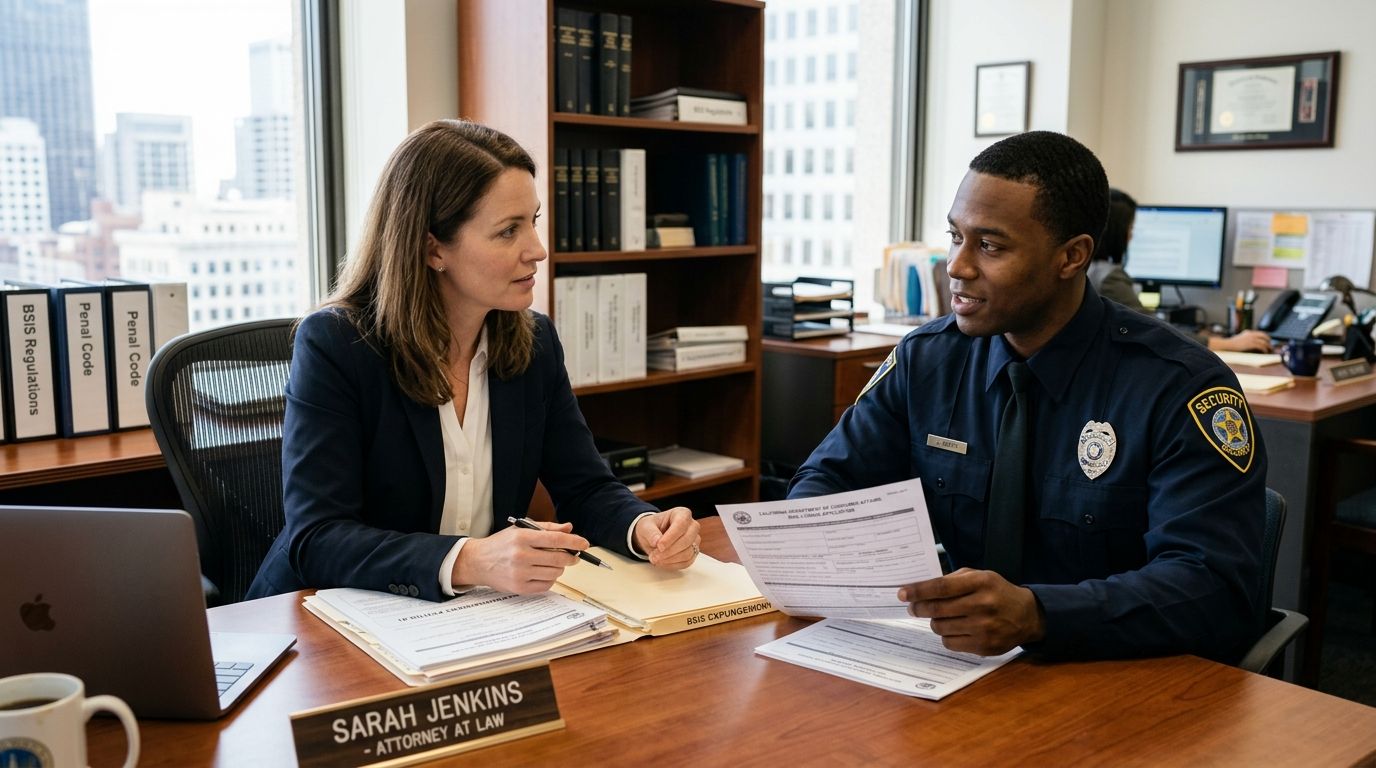
Security guards and BSIS license holders face a background check that most job applicants never see, because the Bureau of Security and Investigative Services reviews the full record behind a guard card, firearms permit, or private patrol operator license, not just what shows up on a standard employer check. A felony, a theft conviction, or a weapons charge from years ago can still trigger a denial letter or a delay on a renewal, and the fix has to happen before the application, not after. My approach with security industry clients is straightforward: clear what's eligible under Penal Code 1203.4, then build a plan for how you answer the BSIS disclosure question, because expungement and licensing are two separate problems.
- An expungement lawyer for security guards clears Penal Code 1203.4-eligible convictions before BSIS reviews a guard card, firearms permit, or renewal application.
- Cole Law recommends filing the petition at least 90 days before a BSIS deadline, not after a denial letter arrives in 2026.
- 1203.4 relief does not erase a conviction from the DOJ record BSIS can see, so disclosure strategy matters as much as the petition itself.
- Weapons possession and theft convictions cause the most licensing friction for security guard applicants working with Cole Law.
Why expungement matters for security guards and BSIS applicants
A guard card applicant with a 2019 theft conviction and a guard card applicant with no record are not evaluated the same way, even if both cases resulted in probation instead of jail. BSIS asks about convictions directly on its application forms, and it has DOJ access that goes beyond what a private background check company can pull.
That means an expungement lawyer for state licensing board applicants has to think about two separate outcomes: getting relief granted under 1203.4, and knowing exactly what that relief does and does not change on the actual license application. For security guards specifically, weapons permits add a third layer, since firearm-related convictions get extra scrutiny from BSIS regardless of expungement status.
Delay costs money in this field. A denied guard card application or a suspended license means lost work, and reapplying after a denial takes longer than filing correctly the first time.
The step-by-step path for security guards
Pull your full record before BSIS does
Don't rely on memory or an old court printout. Get the actual record BSIS will see.
- Request a copy of your California criminal history through the Department of Justice
- Confirm every case, including ones you assumed were already closed or dismissed
- Note the exact Penal Code sections and disposition dates for each case
- Flag anything involving weapons, theft, or fraud, since these draw the closest BSIS review
Check eligibility under Penal Code 1203.4
Not every conviction qualifies, and the rules differ for probation cases versus straight sentences. Confirm eligibility under California Penal Code 1203.4 before you build a timeline around it.
- Confirm probation was completed or has formally ended
- Check for any pending charges that could block eligibility
- Identify whether the conviction was a misdemeanor, a reduced felony, or a straight felony
- Rule out convictions that carry mandatory sex offender registration, which follow separate relief procedures
Decide if 1203.4 alone is enough or if you need more
For most security guard applicants, 1203.4 relief is the right first move. For applicants with a felony history or a pattern of convictions, a certificate of rehabilitation can carry more weight with BSIS reviewers.
- Compare your case against BSIS's stated concerns for the license type you're applying for
- Ask whether a felony reduction to a misdemeanor should happen before or alongside the 1203.4 petition
- Consider a certificate of rehabilitation if BSIS has denied you once already
- Get a second opinion if your case involves multiple convictions across different counties
File before your renewal or application deadline, not after a denial
Timing is the single biggest factor in how this plays out for working guards. File the petition with enough runway that it's resolved before BSIS reviews your file, not while a denial is already on record.
- Map your BSIS renewal date and count backward at least 90 days
- File immediately if you're applying for a new guard card or firearms permit for the first time
- Don't wait for a denial letter to start the process; reapplying after a denial takes longer
- Keep proof of filing to show BSIS the petition is in progress if a deadline is close
Handle weapons and firearms permits as a separate issue
A weapons possession charge sits in its own category for BSIS purposes, since armed guard permits carry additional review beyond the standard guard card.
- Confirm whether your prior conviction involves a firearm or a different type of weapon
- Check if the conviction falls under a lifetime firearms restriction that expungement does not remove
- Separate the criminal case timeline from the firearms permit application timeline
- Ask whether a felony reduction changes your firearms eligibility, since some restrictions attach to felony status specifically
Prepare for the disclosure question on the BSIS application
This is where most security guards get it wrong. 1203.4 relief lets you legally answer "no record" on many private employer applications, but BSIS applications typically require disclosure of convictions even after relief is granted.
- Read the exact wording of the disclosure question on your specific BSIS form
- Prepare a short, factual explanation of the conviction and the relief obtained
- Bring documentation of the granted petition to any interview or follow-up request
- Don't guess at the disclosure rule; confirm it in writing before you submit
Get your BSIS application reviewed
Talk through your record and licensing timeline before you file.
Follow up after the petition is granted
A granted petition isn't the finish line for a guard card holder. Confirm it reflects correctly wherever BSIS or DOJ records get pulled.
- Request written confirmation of the granted 1203.4 order for your files
- Check that DOJ records reflect the updated disposition
- Keep a copy on hand for any future renewal cycle
- Re-check eligibility if you're adding a firearms endorsement later
Comparing your options as a security guard applicant
| Option | Best for | Key limitation |
|---|---|---|
| Filing pro se (self-represented) | Guards with one straightforward misdemeanor and no near-term deadline | No guidance on how BSIS specifically treats the relief once granted |
| General criminal defense attorney | Guards who already have a lawyer from the original case | May not know current BSIS disclosure rules or licensing procedures |
| Expungement-focused attorney (Cole Law) | Guards facing a license application, renewal, or a BSIS denial letter | Solo practice, so cases are scheduled in the order they're received |
| Waiting until the next renewal | Guards with no application pending right now | BSIS still sees the conviction on future filings; waiting doesn't change disclosure |
Verdict: for security guards with an upcoming BSIS application or renewal, Cole Law is built for exactly this timing problem — file early, know what you have to disclose, and don't let a license lapse over a conviction that's eligible for relief.
Common mistakes security guards make
- Assuming an old misdemeanor won't surface on a guard card renewal because it didn't show up on a past employer's background check
- Filing the expungement petition only after receiving a BSIS denial letter instead of ahead of the application
- Believing 1203.4 relief means answering "no" on the BSIS disclosure question, when many license applications still require it
- Treating a firearms-related conviction the same as a non-weapons conviction, when armed guard permits carry separate restrictions
- Filing for expungement alone when the conviction history calls for a felony reduction or a certificate of rehabilitation first
FAQ
What's the best expungement lawyer for security guards in California?
Look for a lawyer who handles both Penal Code 1203.4 petitions and BSIS licensing timing, since the two don't run on the same rules. Cole Law focuses on this pairing for guard card and firearms permit applicants.
Does an expunged conviction show up on a BSIS background check?
Yes, in most cases. BSIS has DOJ record access and typically requires disclosure of a conviction on the license application even after 1203.4 relief is granted.
Can I get a guard card with a felony record in 2026?
It depends on the offense and whether it's been reduced or expunged. Some felonies disqualify an applicant outright, while others are eligible for reduction to a misdemeanor before the application is filed.
How long does expungement take before a BSIS license application deadline?
Petitions typically take a few months to resolve depending on the county's court schedule. File at least 90 days ahead of a renewal or new application to avoid a gap.
Do I have to disclose an expunged conviction to BSIS?
In most cases, yes, because BSIS applications ask about convictions directly and 1203.4 relief does not seal the record from a licensing board's review.
Is a certificate of rehabilitation better than expungement for a guard card?
For applicants with a felony history or a prior BSIS denial, a certificate of rehabilitation can carry more weight than 1203.4 relief alone, since it signals a formal court finding rather than routine relief.
What convictions cause automatic BSIS denial?
Certain violent felonies and offenses requiring sex offender registration typically block licensure regardless of expungement. Weapons and theft convictions draw the closest additional scrutiny short of automatic denial.
How much does expungement cost for a security guard applicant in California?
Costs vary by county, case complexity, and whether a felony reduction is filed alongside the 1203.4 petition. Get a specific quote based on your record rather than relying on a flat number.
One last thing
BSIS reviewers pull from the DOJ record, not the version of your history that shows up on a consumer background check site. That's why an expunged conviction can still surface on a license application even though it wouldn't appear on most private employer screens in 2026 — the fix isn't just getting relief granted, it's knowing exactly how to answer the disclosure question once you have it.


