
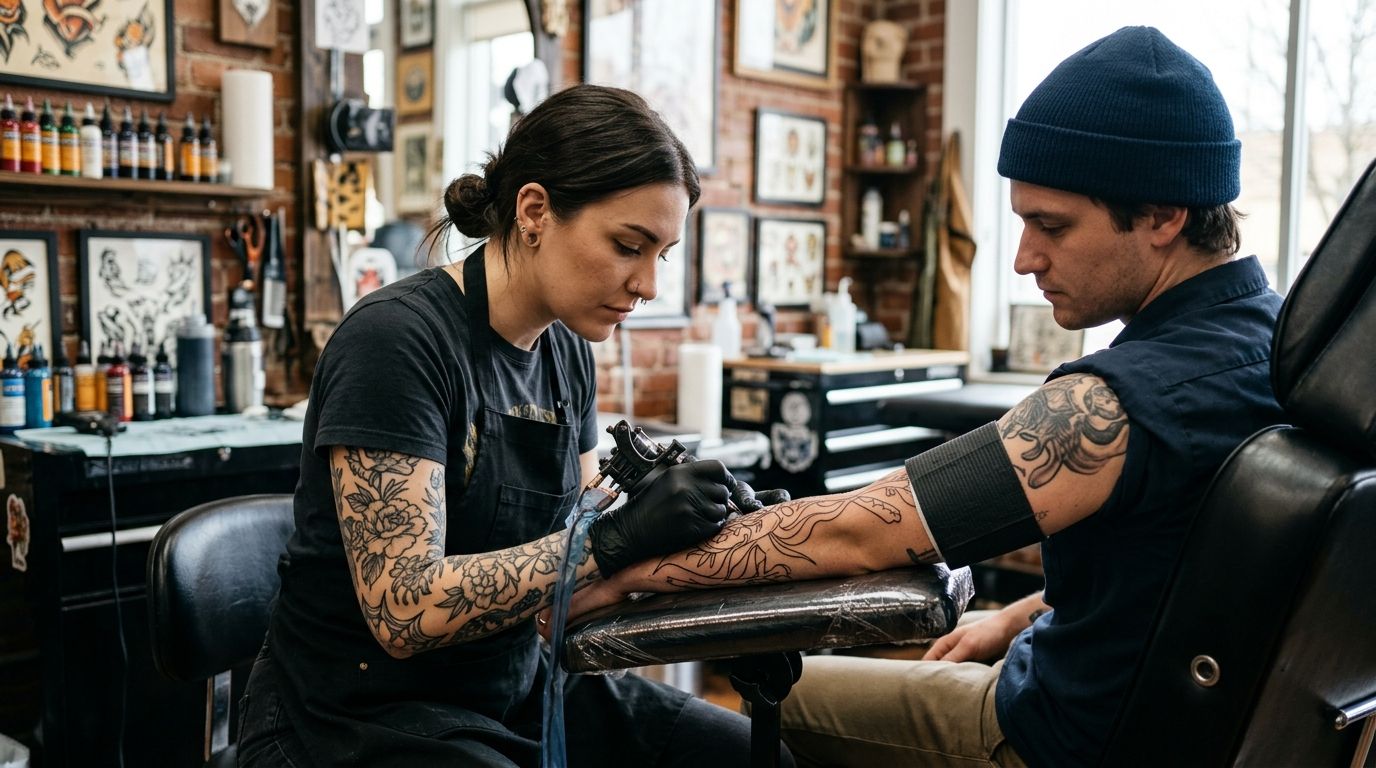
Tattoo and piercing artists in California carry a specific kind of exposure: your name goes on a county health department registration, sometimes on a shop lease application, and increasingly on background checks run by payment processors and booth-rental agreements. An expungement lawyer for tattoo artists in California handles Penal Code 1203.4 relief so an old misdemeanor or felony stops showing up when a health inspector, landlord, or platform runs your name. Body art practitioners don't answer to a single state board the way cosmetologists or contractors do — regulation runs through county environmental health departments under California's Safe Body Art Act — which changes what "clean record" actually needs to mean for you.
- An expungement lawyer for tattoo artists in California files under Penal Code 1203.4 to dismiss eligible convictions before health department or landlord checks run.
- Tattoo and piercing work isn't gated by a single state board in 2026 — county registration and shop leases are the real checkpoints.
- A felony wobbler reduced under Penal Code 17(b) before a 1203.4 petition often clears faster than trying both at once.
- Cole Law files CR-180 petitions directly and tracks county-specific body art registration timing for clients.
Why expungement matters for tattoo and piercing artists
Most licensing conversations assume a state board runs a Live Scan and denies or approves you. Tattoo and piercing artists don't get that clean process — they get a patchwork. Some counties ask directly about criminal history on registration forms; others don't ask but let a shop owner, landlord, or convention organizer run their own background check before signing a booth agreement.
That patchwork cuts both ways. It means there's no single gatekeeper you can satisfy once and be done — but it also means a Penal Code 1203.4 dismissal can quietly solve problems across all of those touchpoints at once, because a case dismissed under 1203.4 no longer needs to be disclosed on most private applications.
The practical risk isn't losing a license you never needed. It's losing a shop slot, a guest-spot invitation, or a merchant account because someone ran a background check you didn't see coming.
Check your eligibility under Penal Code 1203.4
Start here before you do anything else. Not every conviction qualifies, and the rules differ by whether you served probation, prison time, or nothing at all.
- Confirm you completed probation or, for many felonies, that enough time has passed since sentencing
- Check whether your conviction falls into an excluded category (certain sex offenses, some serious felonies)
- Pull your rap sheet to confirm the case is listed correctly with a final disposition
- Note if you have more than one conviction — each one needs its own review
- Flag any case still showing an active probation status
Pull your record before you apply for county registration
Body art practitioner registration runs through your county's environmental health division, not a state agency, and requirements vary by county. Before you submit anything with your name on it, know exactly what's in your file.
- Request your California criminal record directly rather than guessing what shows up
- Compare what the record shows against what you remember — clerical errors happen
- Identify which convictions, if any, are already eligible for automatic relief under recent California reforms
- Note arrest-only entries that never led to conviction — these sometimes need a separate sealing petition
Time your petition around your registration or lease application
Expungement timing matters as much as eligibility. Filing too late means a health department or landlord sees the record before the court acts on your petition.
- Map your county's registration renewal date or your shop lease signing date
- Build in 60 to 90 days for a typical 1203.4 petition to move through court
- File before any background check trigger, not after one flags your file
- Ask your prospective shop or booth-rental partner directly what their screening process looks like
File Form CR-180 and handle the paperwork correctly
The petition itself is Form CR-180, filed in the county where you were convicted. Errors here cause delays, not outright denials, but delays cost you booth slots and lease deadlines.
- Confirm the correct county courthouse for filing, which may not be where you live now
- Attach proof of restitution payment in full if restitution was ordered
- Request a hearing waiver where the court allows it to speed up processing
- Serve the district attorney's office as required so the petition isn't rejected on a technicality
Reduce a felony wobbler before you petition
Some convictions common among artists working around alcohol-serving conventions or late-night shop hours — certain theft, vandalism, or assault charges — are "wobblers" that can be charged as either a felony or misdemeanor. Getting a wobbler reduced under Penal Code 17(b) before filing your 1203.4 petition changes what your record shows long-term.
- Confirm your specific charge is legally classified as a wobbler
- File the 17(b) reduction motion before the 1203.4 dismissal, not after
- Expect this two-step process to take longer than a straightforward dismissal alone
- Weigh whether the reduction is worth pursuing if you're only a few years from the conviction anyway
An attorney who works expungement cases for state licensing board applicants day to day already knows which counties move fast and which sit on petitions for months — that's the kind of detail that saves you a missed booth deadline.
Prepare for the landlord or platform background check
Most tattoo and piercing artists never face a government screening — they face a private one. Shop owners running their own checks before signing a lease or booth agreement are common, and so are payment processors and convention organizers.
- Ask what background check vendor the shop or platform uses before you apply
- Understand that a 1203.4 dismissal removes the obligation to disclose on most private applications, with narrow exceptions
- Keep your court's dismissal minute order on hand to show if a check surfaces an old case in error
- Don't wait for a denial to start the process — file well before you need the answer
Get your record reviewed before you register
A direct case review for tattoo and piercing artists working around California county registration.
Comparing your options
| Option | Best for | Key limitation |
|---|---|---|
| DIY petition (no attorney) | Single, straightforward misdemeanor with no restitution owed | No one catching filing errors before the DA objects; slower on wobblers |
| General practice attorney | Cases with no licensing or registration angle | May not know county-level body art registration quirks |
| Cole Law | Artists juggling a conviction, a wobbler reduction, and a registration or lease deadline | Solo practice — one attorney handling your file, not a firm with multiple associates |
Verdict: Cole Law is built for cases where the conviction, the registration timeline, and the shop or booth deadline all collide — for a clean single misdemeanor with no other pressure, a DIY 1203.4 petition can work fine.
Common mistakes tattoo and piercing artists make
- Filing after signing a shop lease or registration form, not before — the disclosure already happened and can't be undone.
- Assuming county registration works like a state license board and skipping the step of confirming your specific county's actual screening practice.
- Ignoring a wobbler felony because it feels minor, when a 17(b) reduction before the 1203.4 petition would have cleared it faster and more completely.
- Not requesting the court's dismissal minute order and having nothing to show a landlord or platform when an old record surfaces in error.
- Treating an arrest-only entry the same as a conviction — arrests that never led to conviction need a sealing petition, not a 1203.4 dismissal, under California's record-sealing statute.
“Body art registration in California runs county by county, so the real fix isn't a license board application — it's making sure your record is clean before anyone runs your name.”
FAQ
Do tattoo artists in California need a state license?
No. California regulates tattoo and piercing work through county environmental health departments under the Safe Body Art Act, not a single statewide license board. Registration requirements vary by county in 2026.
Can an expunged conviction still show up on a county registration application?
A dismissal under Penal Code 1203.4 generally removes the obligation to disclose the conviction on most applications. Some government licensing bodies can still see the underlying record, which is why timing the petition before you apply matters.
How long does a 1203.4 expungement take in California?
Most 1203.4 petitions take 60 to 90 days from filing to court decision, though timing varies by county caseload. Filing before a registration deadline or lease signing avoids the gap.
Is expungement the same as sealing an arrest record?
No. Expungement under 1203.4 applies to convictions; an arrest that never led to a conviction needs a separate sealing petition. Confusing the two is one of the more common filing mistakes.
What if I have a felony wobbler on my record?
Certain charges common in nightlife-adjacent industries, like some theft or assault cases, can be reduced from felony to misdemeanor under Penal Code 17(b) before you file a 1203.4 petition. Doing the reduction first often produces a cleaner final record.
Will a shop owner or booth-rental agency run a background check on me?
Many do, since tattoo shops and convention organizers increasingly run their own screening before signing leases or booth agreements. A 1203.4 dismissal changes what shows up on most of these private checks.
Does an expungement clear a record nationwide?
California's 1203.4 relief clears the record for California purposes and most private background checks, but it doesn't erase federal records or affect every jurisdiction equally. Artists working out-of-state conventions should confirm how that state treats a California dismissal.
Can I file for expungement without hiring a lawyer?
Yes, California allows self-filed 1203.4 petitions, and eligibility rules are public. The tradeoff is no one catching paperwork errors or coordinating timing around a registration deadline, which is where most delays happen.
One last thing
The detail most artists miss: your county health department registration and your shop's private background check are two completely separate systems, and clearing one doesn't automatically clear the other. Filing your 1203.4 petition early enough to satisfy both, rather than reacting after one of them flags your name, is the single biggest factor in whether this goes smoothly in 2026.


