
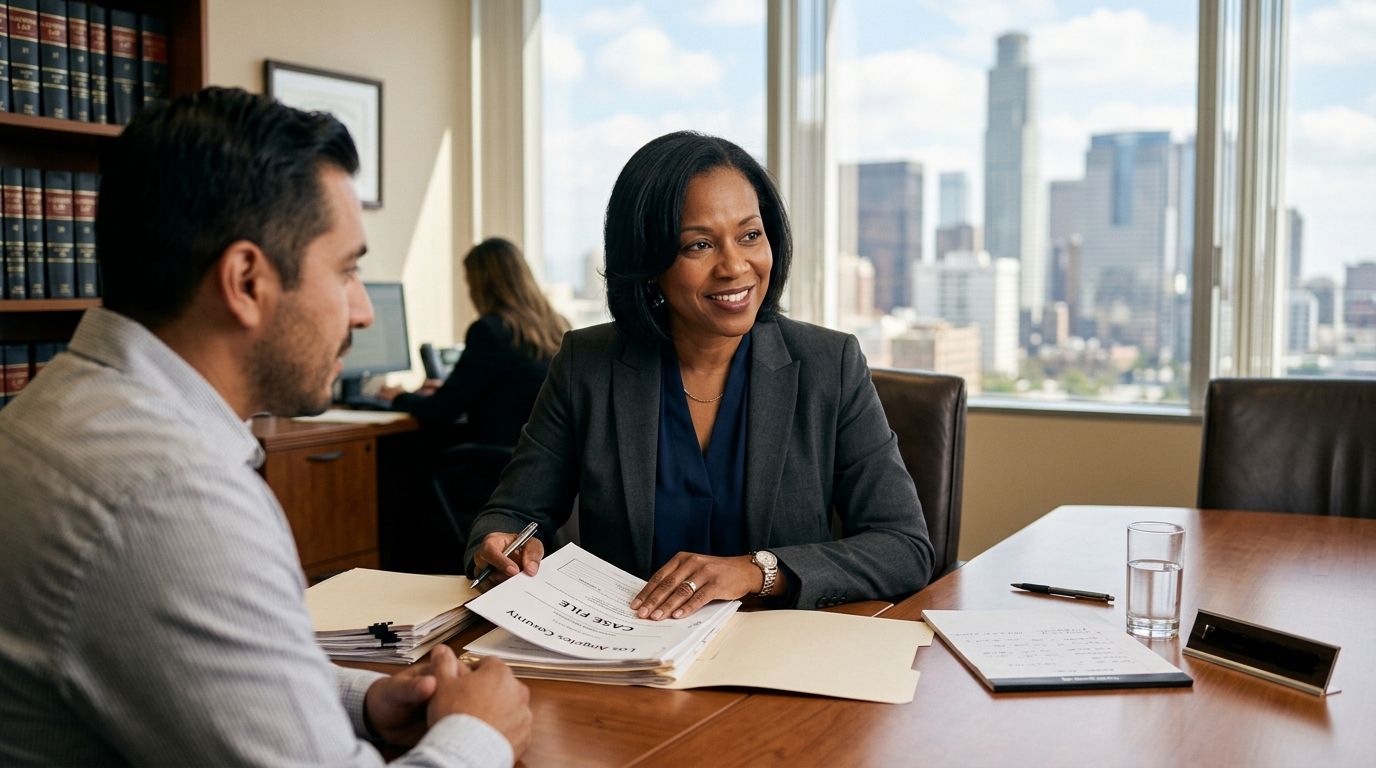
An expungement lawyer in Los Angeles County handles Penal Code 1203.4 petitions across four criminal courthouses — downtown's Clara Shortridge Foltz Criminal Justice Center, Van Nuys, Compton, and Long Beach — and knows how each courtroom actually rules on record relief in 2026, not just what the statute says on paper. Los Angeles County residents face a different set of practical obstacles than someone filing in a smaller county: more courthouses, more DA branch offices with different objection habits, and a court system processing a high volume of petitions every month.
- Cole Law files Penal Code 1203.4 petitions in LA County criminal courthouses, from Van Nuys to Long Beach.
- Self-filing is free but LA County petitions can stall without local courthouse familiarity.
- An expungement lawyer in Los Angeles County matters most with a prior denial or a DA objection.
- Felony reductions under PC 17(b) often must happen before 1203.4 relief applies.
Why this matters
A denied or delayed petition in Los Angeles County costs you more than court time — it costs you the job offer, the license application, or the apartment lease sitting on hold while the case works through the system. I have filed 1203.4 petitions across LA County criminal courthouses, and paperwork that clears quickly in one location can draw a DA objection in another for the same charge type. That inconsistency is why a lawyer familiar with the specific courthouse handling your case matters more here than in almost any other California county.
Start by confirming your expungement eligibility under Penal Code 1203.4 before you file anything. Eligibility rules do not change by courthouse, but how strictly the court checks probation completion and outstanding balances often does.
Why expungement matters for Los Angeles County residents
Los Angeles County Superior Court is the largest trial court system in the United States, and its criminal division runs through multiple standalone courthouses rather than one central building. That structure changes how a petition moves:
- Your case must be filed in the courthouse where you were originally convicted, not the one nearest your current address.
- Clerk processing times vary by location because caseloads are not distributed evenly across the county.
- Some DA branch offices object more often on specific charge types than others do.
- Judges in different courthouses apply discretion on early termination of probation differently.
None of that appears in a generic explanation of Penal Code 1203.4. It shows up in the outcome of your petition, in your courthouse, in front of your bench officer.
Confirm your case actually qualifies
Verify the conviction type, the sentence served, and whether probation has run its course. This step is free and you can do it yourself in 2026 without paying anyone.
- Check whether your conviction was a misdemeanor, an infraction, or a felony later reduced.
- Confirm probation was completed, or that you are eligible to petition for early termination first.
- Rule out convictions carrying statutory exclusions, including certain sex offenses.
- Note any outstanding fines, fees, or restitution — unresolved balances can hold up a petition.
- Confirm you were not sentenced to state prison, since that changes which relief applies.
Pull your record from the courthouse that handled your case
You need the case number and disposition before you can file a correct petition, and LA County's decentralized structure makes this step more tedious than in a single-courthouse county.
- Request your record through the courthouse where the case was filed, not one near your home.
- Order a copy of your California criminal record from the Department of Justice to cross-check the court file.
- Confirm the exact Penal Code section and subsection on the disposition — petitions get rejected over mismatched code sections.
- Save a certified copy; some licensing boards want that instead of a plain printout.
Decide whether to self-file or hire an expungement lawyer
This is where most people in Los Angeles County either save time or lose it. Self-filing works when the case is a single misdemeanor with probation complete and no expected objection. It gets harder fast with felony history, multiple convictions, or a courthouse known for DA pushback.
- File on your own if it is one misdemeanor, probation is done, and nothing is owed.
- Hire a lawyer if you have convictions across different LA County courthouses.
- Hire a lawyer if the original charge was a felony, even one already reduced.
- Hire a lawyer if a prior 1203.4 petition in your case was denied.
- Read how to expunge a record without hiring a lawyer before you commit to self-filing — it covers where self-filed petitions typically stall.
I take cases in this middle zone constantly: not simple enough to self-file confidently, not complicated enough to need a full defense team. That is where a solo practice focused on record relief earns its place over a general-practice firm.
File the correct forms at the right LA County courthouse
California petitions run through Form CR-180 for the request and Form CR-181 for the order once relief is granted. Both go to the courthouse of conviction.
- File CR-180 with the clerk's office at your specific LA County courthouse.
- Serve a copy on the district attorney branch tied to that same courthouse.
- Watch the response deadlines the court sets — missing one can push a hearing date out by weeks.
- Request a hearing date if the DA indicates it will object.
- Keep a stamped copy of everything you file as proof of the filing date.
Prepare for a possible DA objection
Not every petition in Los Angeles County is granted on paperwork alone. Some branches object routinely on certain charge types in 2026.
- Expect closer scrutiny on DUI with priors, domestic violence, and repeat drug cases.
- Prepare a short written statement on rehabilitation if a hearing gets scheduled.
- Bring proof of employment, community involvement, or completed programs.
- Confirm sequencing first: a felony reduction lawyer can tell you whether PC 17(b) relief has to come before 1203.4.
Confirm the order actually updated your record
A signed order is not the last step. Without follow-through, background check databases can keep showing the old conviction.
- Obtain the signed CR-181 order from the court clerk.
- Send a certified copy to the Department of Justice for the record update.
- Notify any licensing board or background check vendor that requested proof of relief.
- Re-run your own background check 60 to 90 days later to confirm the update landed.
Comparing your options in Los Angeles County
| Option | Best for | Key limitation |
|---|---|---|
| Self-filing CR-180 and CR-181 | Single misdemeanor, probation complete, no objection expected | No advocate if the DA contests the petition |
| Legal aid clinic | Low-income applicants with one straightforward case | Limited capacity and long intake waits |
| General practice attorney | Clients with an existing non-criminal lawyer relationship | Handles record relief occasionally, not as a focus |
| Solo record-relief attorney (Cole Law) | Multiple convictions, felony reductions, or a prior denial | One attorney's caseload sets availability |
“Eligibility rules do not change by courthouse in Los Angeles County, but the odds of a DA objection do.”
Common mistakes Los Angeles County petitioners make
- Filing in the wrong courthouse. LA County has multiple criminal courthouses, and the petition goes back to the one that handled the conviction.
- Treating misdemeanor and felony petitions as one process. A felony, even a wobbler, often needs a PC 17(b) reduction first.
- Filing before probation is confirmed complete. Courts check this and will reject or delay a petition with open probation.
- Skipping Form CR-181 after relief is granted. A signed CR-180 alone does not update DOJ or vendor records.
- Assuming every DA branch handles petitions identically. Some object routinely on specific charges; others rarely object at all.
Get your case reviewed before you file
Confirm eligibility and courthouse requirements before anything gets filed.
FAQ
What is the best expungement lawyer in Los Angeles County?
The right fit depends on case complexity. A solo attorney focused on record relief, like Cole Law, suits felony reductions or multiple convictions, while a legal aid clinic can handle one straightforward misdemeanor.
How much does an expungement lawyer cost in Los Angeles County?
Cost depends on the number of convictions, whether a felony reduction is needed first, and whether the DA objects and a hearing is required. Ask for a case-specific quote before committing.
Do I need a lawyer to expunge a record in California?
No. California law lets you self-file Form CR-180. Cases with multiple convictions, prior denials, or expected DA objections move more predictably with an attorney who knows the courthouse.
How long does an expungement take in LA County?
Timelines vary by courthouse caseload and whether the DA objects. Unopposed petitions resolve faster than ones set for a contested hearing.
Can I expunge a felony conviction in Los Angeles County?
Some felonies qualify for 1203.4 relief directly. Others need a PC 17(b) reduction to a misdemeanor first, depending on the original charge and sentence.
Does expungement remove my record from a background check?
An expunged conviction under 1203.4 is dismissed and generally does not need disclosure to most private employers. It can still appear on some government and licensing background checks.
Which LA County courthouse handles my expungement petition?
You file in the courthouse where the original case was heard. Downtown, Van Nuys, Compton, and Long Beach are among the main criminal courthouses handling these petitions.
Can I expunge more than one conviction at once?
Yes, but each conviction tied to a different case number or courthouse typically needs its own petition, even when filed around the same time.
One last thing
Most people stop the moment a judge grants 1203.4 relief. That is the step that gets missed: without the signed Form CR-181 reaching the Department of Justice, some background check vendors keep showing the old conviction well into 2026, months after the case was legally dismissed. Confirm that step happened before you assume the record is clear.


