

California clears eligible arrest and conviction records automatically under the Clean Slate Act — no petition, no filing fee, no court date — but only if your case meets specific conditions the Department of Justice checks against its own records, and DOJ gets that match wrong often enough that verifying your record yourself in 2026 is still worth doing.
- Automatic record relief in California covers eligible arrests without conviction and completed misdemeanor or felony probation.
- Penal Code 1203.425 grants automatic conviction relief; Penal Code 851.91 covers arrests that never led to conviction.
- Serious or violent felonies, offenses requiring sex offender registration, and unpaid restitution cases are excluded from automatic relief.
- DOJ record matching fails often enough that checking your own eligibility in 2026 beats assuming relief already happened.
- Cole Law reviews DOJ record data and files a Penal Code 1203.4 petition when automatic relief didn't apply.
Why this matters
Before the Clean Slate Act, every dismissal or expungement in California required a petition, a filing fee, and a wait for a judge's signature. That system left thousands of eligible people with records they never got around to clearing, because the process cost money and time they didn't have.
Automatic relief removes the petition step for people who already qualify. It does not remove the burden of checking whether the state actually processed your case correctly — and that's the part most people skip. If you want to confirm your own eligibility against the exact language of the statute, check your eligibility under Penal Code 1203.4 rather than assume the automated system already handled it.
Do you qualify for automatic record relief in California?
| Record type | Automatic relief? | Governing law | Key condition |
|---|---|---|---|
| Arrest, no charges filed | Yes | PC 851.91 | Statute of limitations has expired |
| Arrest, charges filed then dismissed | Yes | PC 851.91 | Case closed, no active refiling |
| Misdemeanor conviction | Yes | PC 1203.425 | Probation or sentence complete, no new charges |
| Non-serious, non-violent felony conviction | Yes | PC 1203.425 | Sentence complete, restitution paid in full |
| Serious or violent felony (PC 667.5(c) / 1192.7(c)) | No | — | Must petition separately, may not qualify at all |
| Offense requiring sex offender registration | No | — | Excluded from automatic relief |
The pattern is straightforward: if your case is a misdemeanor or a non-serious, non-violent felony and you're done with probation, the law expects the state to clear it without you asking. The exceptions are narrow but strict.
Arrest records: automatic once the statute of limitations expires
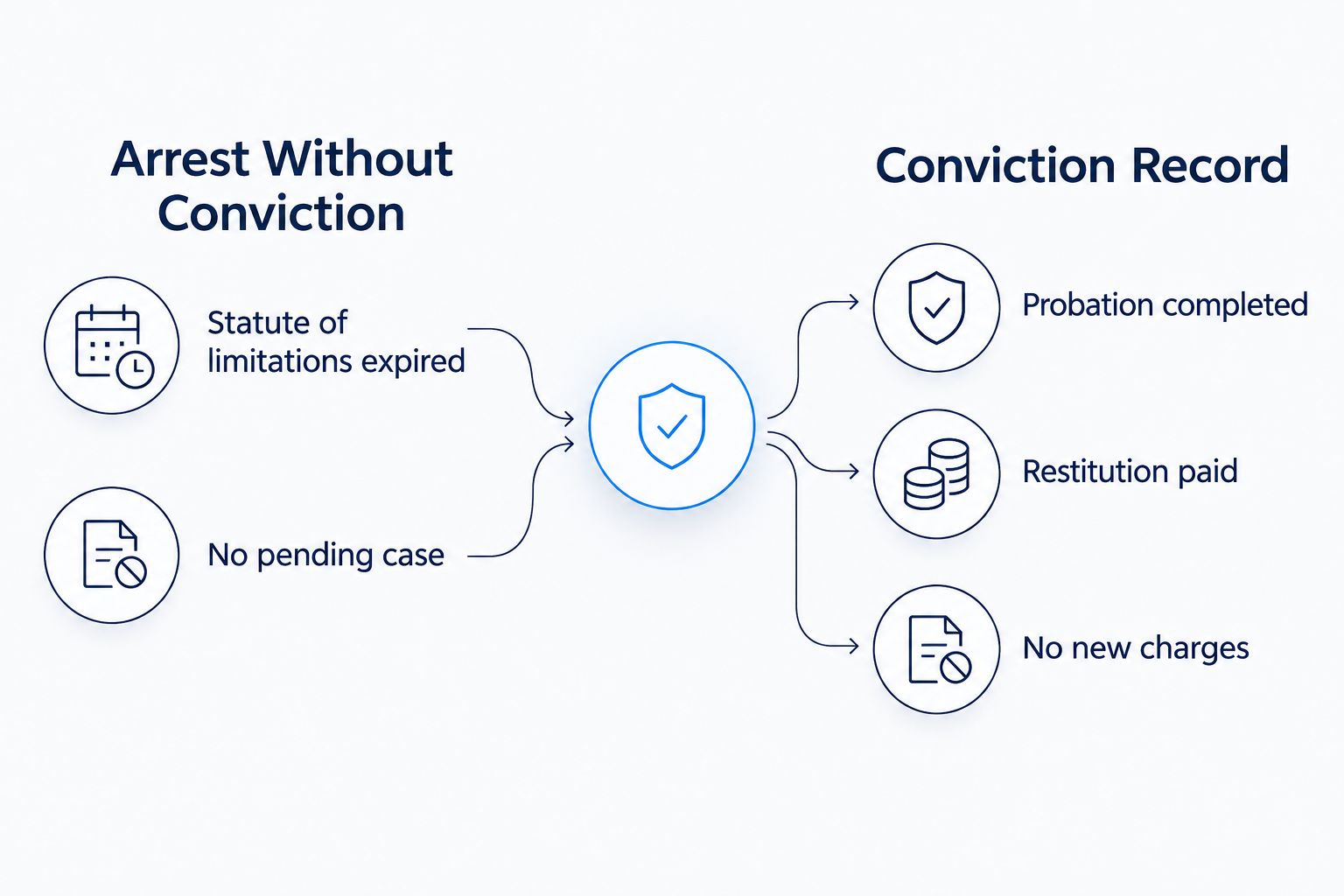
If you were arrested in California and never convicted — charges were never filed, or they were filed and dismissed — Penal Code 851.91 requires the record to seal automatically once the statute of limitations on the offense has run and no case is still open. You don't file anything for this to happen.
The catch is timing. Statutes of limitations for California crimes run anywhere from one to six years depending on the offense, so a 2023 arrest with no filed charges may not qualify for automatic sealing until sometime in 2026 or later, depending on the underlying crime. If you want to confirm sealing status on your own before that clock runs, review the process for an arrest record that never led to a conviction.
Misdemeanor and felony convictions: automatic once probation or your sentence ends
Penal Code 1203.425 works like an automated version of a standard 1203.4 dismissal petition. Once you complete probation or finish serving your sentence for an eligible misdemeanor or non-serious, non-violent felony, the DOJ is required to identify the case and grant relief without you filing a petition.
Three conditions have to be true at the same time:
- Probation or the full sentence is complete
- No new criminal charges are pending anywhere in California
- Any court-ordered restitution has been paid in full
Miss any one of those three, and the automated system will not flag your case — it will sit exactly where it is until you fix the underlying issue or file a petition yourself.
What disqualifies you from automatic relief
Automatic relief is not universal. These are the conditions that keep a case out of the automated system entirely:
- Unpaid restitution — even one dollar owed to a victim stops the automatic dismissal
- Pending charges anywhere in California — a new case, even unrelated, blocks the process
- Serious or violent felony classification under PC 667.5(c) or PC 1192.7(c)
- Sex offender registration requirement under PC 290
- Out-of-state or federal convictions — California's automatic system only touches California state records
- Mismatched court and DOJ records — if Live Scan data and court disposition data don't line up, the case never gets flagged
That last item is the one people underestimate. The automated matching process depends on clean data moving between courts and the DOJ, and in practice that pipeline misses cases.
How do I know if my record was automatically cleared in 2026?
Automatic relief doesn't come with a notice letter or an email. The only reliable way to confirm it happened is to pull your own record directly — through a DOJ Live Scan request or by asking the court clerk for your current disposition. If you haven't done this since your probation ended, get a copy of your California criminal record before assuming the state already handled it.
Does automatic record relief show up on a background check?
Once DOJ updates the state repository, standard employer background checks that pull from California court or DOJ data should stop showing the conviction. Private data broker sites that scraped your record before the update are a different problem — they don't get corrected automatically and often need a separate removal request.
What if your case isn't eligible for automatic relief?
If your conviction is excluded — a serious or violent felony, a registrable sex offense, or a case with unpaid restitution — automatic relief will never apply, but a standard dismissal petition might still be an option. Petitioning under Penal Code 1203.4 remains the route for cases the automated system was never designed to touch, and it's worth confirming which category your case falls into before filing anything.
Confirm your record status
Get your DOJ and court records reviewed for automatic relief gaps.
FAQ
What is automatic record relief in California?
Automatic record relief is a state process that dismisses eligible arrest and conviction records without requiring a petition, under Penal Code 851.91 for arrests and Penal Code 1203.425 for convictions. It only applies once specific conditions — like completed probation and paid restitution — are met.
Who qualifies for automatic record relief under the Clean Slate Act?
People with completed misdemeanor probation, completed sentences on non-serious and non-violent felonies, or arrests that never led to conviction generally qualify. Anyone with pending charges, unpaid restitution, or a registrable sex offense does not.
Does automatic record relief clear felony convictions?
Yes, but only non-serious, non-violent felonies where the sentence is fully served and restitution is paid. Felonies classified as serious or violent under PC 667.5(c) or 1192.7(c) are excluded entirely.
How long does automatic record relief take in California?
There's no published fixed timeline — relief happens when DOJ's system matches your case to eligibility data after probation, sentence completion, or the statute of limitations expiring. Cases with mismatched court and DOJ records can sit unprocessed indefinitely.
Do I still need a lawyer if my record clears automatically?
Not if the automatic process actually worked, but many eligible people never confirm it did. A lawyer becomes useful when you need to verify DOJ data, fix a mismatch, or file a 1203.4 petition for a case the automated system missed.
What's the difference between automatic relief and filing a 1203.4 petition?
Automatic relief under PC 1203.425 requires no filing and happens through DOJ's own matching system. A 1203.4 petition is the manual version you file yourself when your case wasn't picked up automatically or falls outside the automatic categories.
Can automatic relief fail even if I qualify?
Yes. If court records and DOJ records don't match, or if restitution shows as unpaid in the system even after you've paid it, the automated process won't flag your case for relief.
Does automatic record relief remove a case from a background check company?
It removes the case from state DOJ and court repositories that most background check companies pull from, but private data broker databases that already scraped the old record often require a separate correction request.
One last thing
The automated matching system runs on data handoffs between courts and DOJ, and that handoff is exactly where cases fall through — a paid restitution balance that never updated in the state system, or a court disposition that never synced. Checking your own record in 2026 costs you nothing and catches the gap the automated process can't see on its own.


