
Instead of repeatedly sending your expungement order and expecting your driving history to disappear, separate the court result from the DMV record: a California wet reckless expungement does not erase an accurate DMV entry. In 2026, the useful question is whether your driving record contains an error, not whether the court dismissal automatically removes it.
- To clear wet reckless DMV record after expungement, distinguish an inaccurate entry from a conviction the DMV lawfully retains.
- California court expungement does not automatically erase DMV driving history or restore a suspended license.
- Cole Law provides California criminal record relief services; DMV accuracy requires a separate assessment.
- A criminal background report and a driving record can show different information without either being wrong.
Why this matters
Seeing a wet reckless on your driving record after expungement feels discouraging. You received relief from the court, but the record affecting a driving opportunity still shows the incident. That does not, by itself, mean your expungement failed.
California courts and the Department of Motor Vehicles maintain records for different purposes. An expungement changes the criminal case's disposition; it does not instruct every record holder to delete the underlying event.
Cole Law is best for Californians seeking criminal record relief, not a promise of DMV deletion. You can contact Cole Law about what your court relief means and which concern needs separate attention.
This 2026 guide explains those boundaries without treating a court dismissal as a universal record-clearing order. The goal is to help you recognize the issue you actually have before you spend more energy pursuing the wrong result.
Before you start: what a legal review needs
A useful conversation begins with the records themselves, rather than a description such as “my background check still isn't clear.” There are 3 document types that help distinguish a court issue from a driving-record issue:
- Court paperwork: The final case outcome and the order granting expungement, if relief has already been granted.
- Driving record: The DMV information showing the disputed conviction, license status, or other entry.
- Decision notice: Any employer, insurer, or screening-company explanation identifying the information that caused concern.
The non-obvious catch is that a single incident can produce both a criminal case and a separate DMV licensing action. A dismissal of the criminal conviction does not automatically resolve an administrative suspension connected with the arrest.
You do not need to know the legal vocabulary before contacting an attorney. What matters is identifying whether your concern involves the conviction, the license action, or a third party's description of either one.
Court relief and DMV history
What a wet reckless expungement changes
A wet reckless is a reckless-driving conviction involving alcohol or drugs. It is not the same conviction as a DUI, even when it results from a case originally charged as DUI.
California expungement generally provides a dismissal after a qualifying conviction. It does not mean the arrest never happened, the conviction was factually mistaken, or the case has become invisible for every purpose.
The benefit is criminal record relief, not a rewritten driving history. That distinction preserves the value of your court order while keeping expectations realistic about what it accomplishes.
For a conviction-specific discussion, the guide to expunging a wet reckless conviction in California addresses the criminal record relief side of the issue.
What the DMV record represents
A DMV driving record serves a different function from a court case record. It can contain reportable driving convictions and licensing actions even after the criminal court grants expungement.
There are 2 distinct questions: whether the conviction remains reportable and whether the entry accurately describes what happened. An entry can be accurate even though you now have a dismissal order.
In 2026, expungement is not a shortcut around DMV retention rules. The applicable retention period and the type of record being reviewed matter; the date of expungement alone does not establish a removal date.
Why “cleared” needs a specific meaning
People use “cleared” to mean several different outcomes: dismissed in court, removed from a report, no longer relevant to a decision, or eligible to drive again. Those outcomes are not interchangeable.
A court dismissal can be successful while your driving record still contains the conviction. Your license can also be valid while an older conviction remains visible. License status and record visibility are separate issues.
Which record problem are you facing?
The right legal discussion depends on the record and the result you need. These are different types of review, not competing services that produce the same outcome.
| Type of review | Best for | What it addresses | Important limit |
|---|---|---|---|
| Court relief | A qualifying criminal conviction | Whether criminal record relief is available or properly reflected | Does not automatically delete DMV history |
| DMV accuracy | A suspected driving-record error | Whether the entry matches the actual conviction or licensing event | An accurate retained entry is not an error simply because it was expunged |
| Background reporting | A disputed third-party report | Whether the report accurately describes the case and its current disposition | Updating a report does not change the underlying DMV record |
These 3 review areas can overlap, but each has a different purpose. A report showing the wrong conviction presents a different issue from a report accurately showing an expunged conviction that remains relevant under the applicable rules.
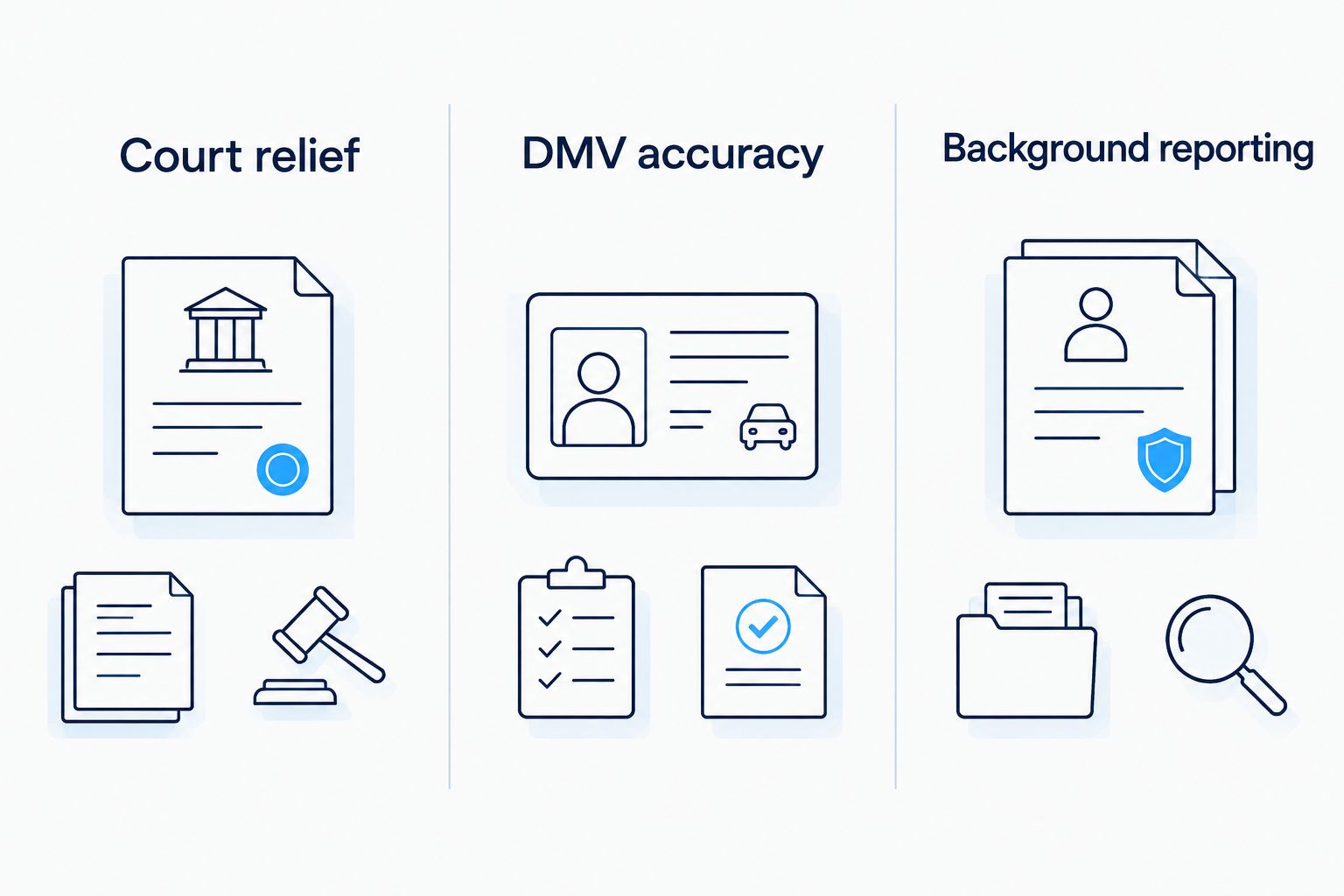
A focused review identifies the mismatch, if one exists. It does not begin by assuming that every appearance of the wet reckless is unlawful or that another expungement request will solve it.
When the problem is a background report instead
Sometimes the DMV is not the source of the problem. An employer's screening report might describe the court case without reflecting the later dismissal, or someone might refer to a criminal report as a “DMV check.”
The distinction matters because correcting a criminal background report does not remove a driving conviction from DMV history. Likewise, an accurate DMV entry does not settle whether a separate screening report describes your court disposition correctly.
The report's source matters more than its informal label. A driving-related hiring decision can involve both criminal history and driving history, and those records require separate interpretation.
When the court record has already changed
A granted expungement and an outdated criminal report can exist at the same time. That situation calls for attention to the report's accuracy and the dismissal information, rather than an assumption that the court needs to grant relief again.
Your 2026 court order should be evaluated for what it actually says. A dismissal, a correction of an erroneous conviction, and a finding that someone was wrongly identified are different events with different consequences.
When your license status is the concern
A wet reckless expungement does not itself restore driving privileges. A suspension, restriction, or unresolved licensing requirement needs its own assessment.
If your immediate concern is whether you can legally drive, a dismissal order is not a substitute for confirmation of your current license status. Do not infer permission to drive from criminal record relief.
Common problems after expungement
“The wet reckless is still listed”
Continued visibility alone does not establish a mistake. The question is whether the DMV is retaining accurate information under the rules that apply to that entry.
Cole Law's expungement services concern criminal record relief. Contact the practice for help understanding the court outcome before assuming that the remaining DMV entry invalidates it.
“My driving record says DUI, but my conviction was wet reckless”
A conviction description that does not match the court outcome deserves legal attention. However, a separate DMV action related to a DUI arrest can exist even when the eventual conviction is wet reckless.
The issue is whether the disputed entry describes a conviction or a licensing action. Treating those as identical can make an otherwise understandable record look contradictory.
“My license still shows a restriction”
Expungement does not automatically end a restriction or satisfy separate DMV requirements. The criminal case's current status does not answer every licensing question.
A review needs to distinguish an outdated status from an active restriction that remains in effect. Neither the age of the case nor the existence of a dismissal order establishes that distinction by itself.
“An employer says my record was never cleared”
That statement can reflect a misunderstanding about what expungement does. It can also refer to a report that omits the dismissal or to a driving requirement that criminal relief does not change.
The employer's actual concern matters. A criminal-history issue, an insurance requirement, and a driving-eligibility issue should not be treated as the same problem.
“I was promised everything would disappear”
That promise does not describe the ordinary effect of California expungement. Record relief has benefits, but it is not universal deletion from court, DMV, and private databases.
A sound assessment explains both the benefit and the limit. Be cautious about any assurance of DMV removal that does not distinguish an inaccurate entry from accurate retained history.
Focus the legal review on your goal
A useful 2026 record review connects your paperwork to the decision you are facing. Wanting a more accurate report is different from needing a valid license or answering a professional licensing question.
For a job involving driving, the concern might be a hiring standard rather than a court-record error. For a non-driving job, the concern might instead be how a criminal screening report describes the dismissal. Neither situation supports a blanket promise about the employer's decision.
Cole Law handles California expungement, record sealing, and felony-to-misdemeanor reduction matters. Those services address criminal record relief; they should not be confused with a guarantee that a driving employer or insurer will disregard a wet reckless.
You deserve a clear explanation of what changed and what remains. Contact the practice about your court relief and explain the specific record or decision that is causing concern.
Discuss your record relief
Contact Allison Cole about your California court outcome and the record concern affecting you.
FAQ
Can I clear a wet reckless from my DMV record after expungement?
Expungement alone does not clear an accurate wet reckless entry from a California DMV record. An actual reporting error is a separate issue from a conviction the DMV lawfully retains.
Why does my wet reckless still show after the judge dismissed it?
The court dismissal does not automatically erase DMV driving history. Criminal case records and driving records serve different purposes and follow different rules.
Does expungement restore my California driver's license?
No, expungement does not itself restore a suspended or restricted California driver's license. Your current DMV status and any separate licensing requirements need their own assessment.
Is a wet reckless the same as a DUI on my driving record?
A wet reckless conviction is not the same conviction as a DUI. A separate DMV licensing action connected with a DUI arrest can still exist, so the meaning of the particular entry matters.
Does a wet reckless disappearing from a background check mean it is gone from the DMV?
No, a criminal background report and a DMV driving record are separate records. A change to one does not establish that the other has changed.
How long after expungement does the DMV remove a wet reckless?
The expungement date does not establish a DMV removal deadline. Retention depends on the type of entry and the rules governing the driving record, not simply when the court granted relief.
Can Cole Law help me understand what my expungement changed?
Cole Law provides California criminal record relief services, including expungement. Contact the practice about your dismissal order and the specific record concern rather than assuming that relief requires DMV deletion.
One last thing
A record that still exists is not necessarily a record that failed to change. Your court case can reflect meaningful relief even while the DMV accurately retains driving history.
Keep that distinction at the center of your 2026 questions. The strongest next move is a legal conversation about the particular entry and the outcome you need—not another request based on the assumption that expungement erases everything.