
Instead of trying another purchase after a NICS background check denial after expungement, have a lawyer review the denial alongside your court order to separate a record error from a continuing firearm restriction. A California expungement does not, by itself, restore firearm rights, so the right response depends on why the transaction was denied.
- A NICS background check denial after expungement requires review of both record accuracy and firearm eligibility.
- California expungement does not, by itself, restore firearm rights.
- Cole Law is best suited to California record-clearing questions, not a promise of firearm purchase approval.
- A record correction addresses inaccurate information; it does not remove an otherwise valid firearm restriction.
Why this matters
A denial after record clearing can feel like the court’s decision counted for nothing. That is not necessarily what happened. Expungement and firearm eligibility answer different legal questions, and a background check can reflect information beyond the case you cleared.
For a 2026 review, the central question is not simply whether your record was expunged. It is whether the information used for the denial was accurate and whether the law still restricts firearm possession or purchase.
Cole Law helps people with California expungements, record sealings, and felony-to-misdemeanor reductions. Cole Law is best suited to California record-clearing questions, not a promise of firearm purchase approval. Contact the practice for help understanding what your existing relief accomplished and what still needs legal review.
Before you start
You do not need to arrive knowing which legal remedy applies. A useful consultation starts with the documents that explain the court’s decision and the transaction’s outcome, rather than assumptions about what “expunged” means.
- Denial information: The written notice, transaction reference, and any explanation you received help identify the decision being questioned. A delay and a denial are not interchangeable.
- Court records: The actual signed relief order and the underlying case history show more than a summary saying the case was cleared. Separate reduction or sealing orders also matter.
- The non-obvious issue: An accurate record can still support a denial. Correcting a database will not resolve a firearm restriction that remains legally valid.
For a California purchase, the California Department of Justice conducts the purchaser background check and uses federal information as part of that review. A notice connected to a California transaction should not automatically be treated as an FBI-issued denial requiring the same response as a transaction handled directly by the FBI.
The denial and the court order
What the transaction actually says
A denial means the transaction was not approved. A delay means the review has not produced a final approval or denial at that point. Neither outcome, standing alone, explains what legal effect your expungement had.
The transaction notice matters because it identifies the decision under review. A dealer’s verbal explanation is not a substitute for the underlying reason, and a general statement that your record “still shows up” does not establish why you were denied.
The useful result of a legal review is a defined issue: an inaccurate record, a disputed identity match, an unresolved case outcome, or an existing legal restriction. Until the reason is understood, another purchase attempt does not answer the underlying question.
What the court actually granted
People use “expungement” to describe several kinds of record relief. In California, the commonly used dismissal process does not erase every government record of the case, and it does not, by itself, restore firearm rights.
A court order’s wording matters more than the informal label attached to it. Dismissal, sealing, and felony reduction have different effects; treating them as interchangeable creates false expectations about a background check.
For a 2026 eligibility discussion, a lawyer needs to assess the relief actually granted against the restriction actually involved. A successful employment-related record-clearing outcome is not proof that a firearm purchase is lawful.
Record accuracy versus firearm eligibility
There are different responses to an incorrect record and a legally valid restriction. They can overlap, but neither should be assumed from the denial alone.
| Issue under review | Best for | What it addresses | Important limit |
|---|---|---|---|
| Record correction | Missing or inaccurate case information | Whether the government record accurately reflects the court’s action | Does not remove a valid firearm restriction |
| Denial challenge | A disputed background-check decision | Whether the denial relied on an error or an incorrect match | Does not automatically restore firearm rights |
| Legal eligibility review | An accurate record with a possible continuing restriction | Whether state or federal law still prohibits possession or purchase | Does not guarantee that additional relief exists |
The benefit of record correction is accuracy. Its limit is that accurate reporting can still lead to a denial. The benefit of an eligibility review is clarity about the legal problem; its limit is that some restrictions remain despite ordinary expungement.
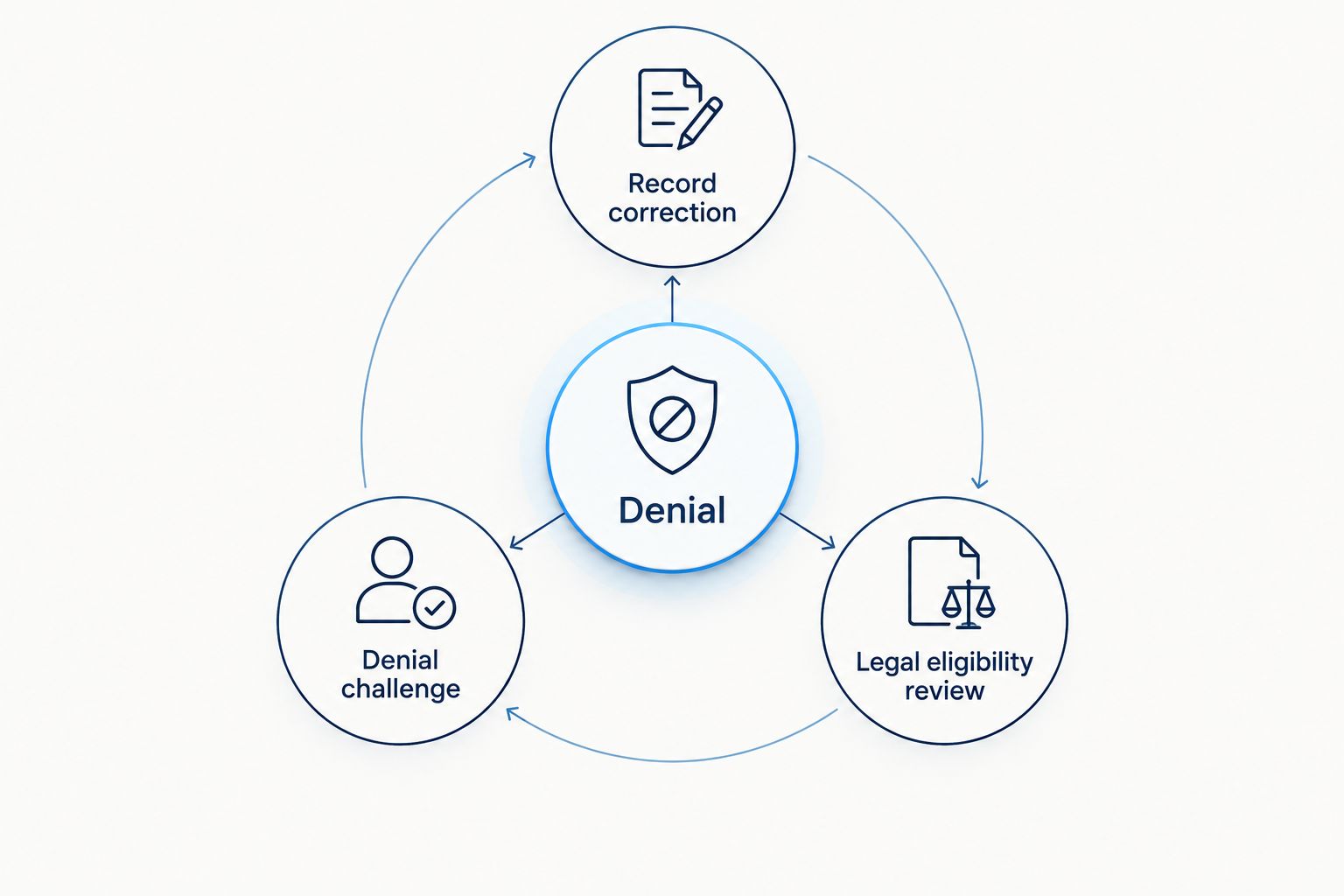
A lawyer can explain whether a reporting problem and a legal restriction both need attention. A corrected record is not the same thing as restored eligibility. That distinction should remain clear even when the court order is valid and the record-clearing work was successful.
When the record does not reflect the court order
A government criminal-history record can be incomplete or fail to reflect a later court action. An arrest entry without its final outcome, for example, does not tell the same story as a complete case record.
The relevant question is whether the information used in the background check accurately represents your case. The existence of a dismissal order does not prove that every record reviewed during the transaction contains that order’s effect.
A record-correction review compares the court’s documented action with the disputed entry. It is not an opportunity to rewrite the facts of the case or remove information simply because it is unwelcome.
The expected outcome is a clear explanation of any discrepancy and the agency responsible for the information. Whether correcting that discrepancy changes the denial depends on the remaining record and applicable firearm restrictions.
When identity information is the problem
A background-check dispute can also involve someone else’s record or confusion between people with similar identifying information. That is different from disagreement about the effect of your own conviction.
The FBI’s NICS guidance recognizes identity-related problems and describes its Voluntary Appeal File as a way to help distinguish eligible people from prohibited individuals with similar information. That process does not override a firearm prohibition.
For a 2026 consultation, identity confusion should be evaluated as its own issue rather than treated as evidence that another expungement is necessary. A lawyer can help distinguish a matching problem from a question about the legal effect of your actual record.
When the record is accurate but the restriction remains
An accurate record can still produce a denial after expungement. California’s ordinary dismissal relief does not authorize firearm possession that would otherwise be prohibited, and federal law separately governs firearm eligibility.
A felony reduction also needs careful review. A change in the classification of a conviction is not a universal answer to every state or federal firearm restriction, and a different conviction or order can independently affect eligibility.
Certain domestic-violence convictions and qualifying protective orders raise separate federal firearm issues. Those questions require review of the underlying facts and current legal status, not just the title of an expungement order.
The guide to expungement and gun rights restoration explains the broader distinction between clearing a record and addressing firearm restrictions. Contact Cole Law about the California record-relief side of your situation and whether separate firearm-law advice is needed.
Do not assume that possession or another attempted purchase is lawful because an expungement was granted. A denial should prompt a case-specific legal review, not an attempt to work around the background check.
Discuss your California record relief
Talk about your court order, denial notice, and the limits of your existing record relief.
A related situation: repeated delays rather than a denial
Repeated delays deserve attention, but they are not the same as repeated denials. A delay can involve the need to resolve information before a decision; it does not establish that the person is legally prohibited.
A legal review of repeated delays focuses on the recurring source of uncertainty. Missing case outcomes or identity confusion are different problems from a continuing prohibition, even when all involve the same background-check system.
The FBI’s Voluntary Appeal File is relevant to some recurring NICS identification problems. It is not a guarantee of approval, does not replace every state review, and does not make an otherwise prohibited person eligible.
For a California transaction in 2026, the actual notice and reviewing agency remain central. Advice aimed at an FBI denial should not be applied automatically to a California delay or a different state decision.
Common problems that keep the issue unresolved
“The case was dismissed, so the denial must be wrong”
A dismissal can be valid while a firearm restriction remains. The answer is a review of the restriction and the court order’s legal effect, rather than an assumption that a reporting agency ignored the court.
A lawyer’s explanation should distinguish what the dismissal changed from what it left untouched. That gives you a more useful answer than a general assurance that your record is clear.
“The dealer said it was my old conviction”
A verbal explanation does not establish the precise basis for the decision. The written denial information and relevant records provide the foundation for identifying whether that conviction caused the denial and why.
The dealer cannot change the legal effect of a conviction or court order. Questions about those effects belong in a legal consultation.
“My employment background check came back clear”
Employment screening and firearm eligibility checks have different purposes and rules. A favorable employment report does not establish that government firearm records are inaccurate or that a purchase must be approved.
The helpful comparison is between the court record and the information relevant to the firearm decision. An unrelated screening result cannot settle that question.
“The record was corrected, but I was denied again”
A correction can fix a real error without removing every reason for denial. Another conviction, an active order, or a remaining legal restriction can still matter.
A fresh review should examine the stated reason for the later denial rather than assume the correction failed. The result needs to be assessed on its own facts.
Focus the consultation on the unanswered question
You should leave a consultation understanding whether the problem concerns accuracy, identity, legal eligibility, or more than one of those issues. You should also understand what your existing relief does not accomplish.
For a 2026 review, useful questions include whether the denial came from the agency you expected, whether the record reflects all relevant court actions, and whether a separate restriction remains. These are questions for counsel, not a substitute for individualized advice.
Cole Law’s stated practice includes California expungements, record sealings, and felony-to-misdemeanor reductions. Ask about the fit for your record-clearing needs without assuming that record-clearing representation includes every federal firearm issue.
FAQ
Why was my NICS background check denied after expungement?
An expungement does not automatically remove every firearm restriction or resolve every record problem. The denial can involve inaccurate information, an identity mismatch, or a continuing legal prohibition; the actual reason needs case-specific review.
Does a California expungement restore my gun rights?
A California expungement does not, by itself, restore firearm rights. Your underlying conviction, other records, and both state and federal law need separate review.
Is a delayed background check the same as a denial?
No. A delay means the review has not produced a final approval or denial at that point, while a denial means the transaction was not approved. Neither outcome alone explains your legal eligibility.
Can correcting my criminal record reverse the denial?
A correction can address inaccurate information that contributed to a denial, but it does not guarantee approval. A valid restriction can remain even after the record accurately reflects your court order.
Does reducing a felony to a misdemeanor guarantee firearm eligibility?
No. A reduction must be assessed alongside the conviction, other possible restrictions, and state and federal law. The change in classification alone does not establish eligibility.
Can the FBI’s Voluntary Appeal File restore firearm rights?
No. The Voluntary Appeal File helps address certain recurring identification problems involving eligible people. It does not remove a valid firearm prohibition or guarantee approval.
Who should review a California firearm denial after expungement?
A lawyer should review the denial notice, court order, and relevant case history together. Contact Cole Law for California record-clearing questions and discuss whether separate firearm-law counsel is appropriate.
One last thing
An accurate record can still produce a lawful denial. That is the distinction that prevents wasted effort: a database dispute cannot solve a restriction that remains in force, and another court filing should not be treated as the answer before the problem is understood.
Your expungement can still have value even when it does not resolve firearm eligibility. Contact Cole Law for help understanding the California relief you received and the record-clearing questions that remain. This article provides general information, not a determination that you can lawfully possess or purchase a firearm.