
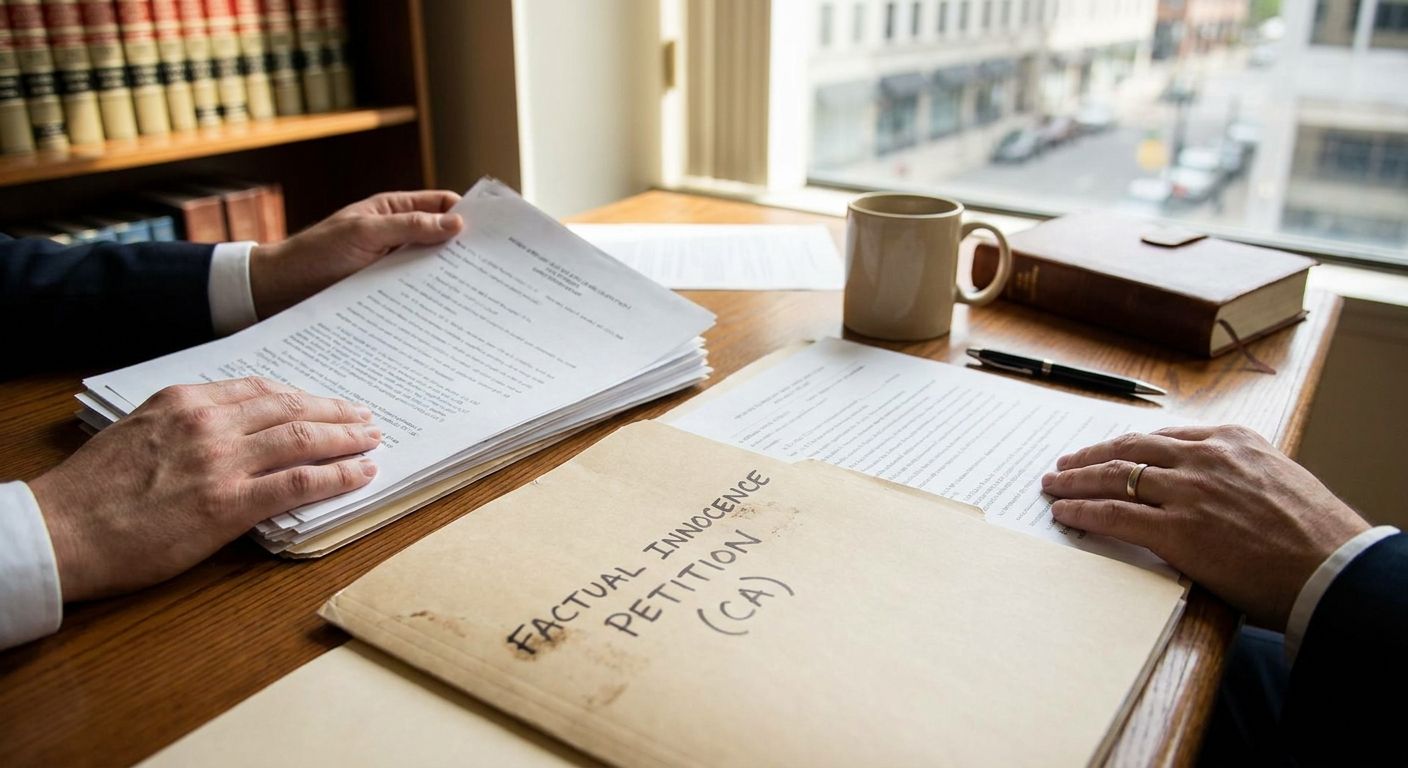
If you were arrested in California but never convicted — charges dropped, case dismissed, or you were acquitted at trial — a factual innocence petition under Penal Code 851.8 can seal and destroy that arrest record entirely, as if it never happened.
- A factual innocence petition california filing under Penal Code 851.8 seals and destroys arrest records with no conviction — file it.
- You generally have two years from the arrest or the DA's decision not to prosecute to file, with limited good-cause exceptions.
- The burden is on you to show no reasonable cause existed to believe you committed the offense — a higher bar than a standard record seal.
- File with the arresting agency or DA first when possible; a denial there still lets you petition the court directly.
Why this matters
A regular expungement under Penal Code 1203.4 leaves a conviction on your record with a notation that it was dismissed. A factual innocence finding under PC 851.8 is different — it treats the arrest as if it never occurred, and the arresting agency, the DOJ, and the court all destroy their records of it.
That distinction matters for background checks, licensing boards, and immigration proceedings, where even a dismissed case can still show up as an arrest. I've filed these petitions for clients who needed a clean slate for a nursing license, a real estate application, or a security clearance, and the difference between "dismissed" and "never happened" is often the deciding factor for an employer or a board. My factual innocence petition work in 2026 focuses on exactly these cases — arrests with no conviction where the record still follows the client around.
What you'll need
- A certified copy of your arrest record and any court disposition showing the case was dismissed, rejected by the DA, or resulted in acquittal
- Proof of the date of arrest and the date the DA declined to prosecute or the case was dismissed — this sets your filing clock
- A written declaration under penalty of perjury explaining why no reasonable cause existed for the arrest
- Any police reports, witness statements, or investigative notes that support your version of events
- Filing fee information from the relevant county clerk (fees vary by court)
- Time: expect several months from filing to a hearing date, longer if the DA opposes
If your case involved a conviction that was later reduced or dismissed rather than an arrest with no conviction at all, factual innocence is the wrong tool — you want a standard record seal or expungement instead, which I cover in the arrest record sealing guide.
The steps
1. Confirm you're eligible before you file anything
PC 851.8 only applies when there was no conviction — an arrest with charges never filed, charges dismissed, or a full acquittal. Check your court disposition first; filing the wrong petition wastes months.
Common mistake: clients confuse a dismissed conviction (PC 1203.4 territory) with an arrest that never led to conviction (PC 851.8 territory). These are not interchangeable, and courts will reject the wrong filing outright.
2. Calculate your filing deadline
You generally have two years from the date of arrest, or from the date the district attorney declined to file charges, to submit your petition. Courts can grant relief past that window only for good cause — a documented reason you couldn't file sooner.
Missing this window without a strong good-cause argument is the single most common reason these petitions get denied before a judge even reviews the merits.
3. Decide whether to file with the DA or the arresting agency first
When no accusatory pleading was ever filed, you can petition the district attorney or the arresting law enforcement agency directly. This route is faster and less formal than going straight to court, and many agencies will grant it without a hearing when the facts are clear.
If the agency denies your petition, or if charges were filed and later dismissed, you file with the superior court in the county where the arrest occurred instead.
4. Draft the declaration proving no reasonable cause
This is the substantive core of the petition and the part that separates a granted petition from a denied one. You need to show, in writing and under penalty of perjury, that no reasonable person in law enforcement's position would have believed you committed the offense.
Weak declarations restate "I didn't do it" without addressing the specific facts the officer relied on at arrest. Strong declarations walk through each piece of the officer's stated probable cause and explain why it doesn't hold up.
5. File the petition and serve the district attorney
Submit your petition, declaration, and supporting documents to the correct court clerk, then serve a copy on the DA's office in that county. The DA has the right to respond and can oppose your petition in writing before any hearing.
Expect a response window measured in weeks, not days — 2026 court calendars in busier counties like Los Angeles and San Diego run backlogged, so build that into your timeline expectations.
6. Attend the hearing and address the DA's objections directly
If the DA opposes, you'll need to counter their specific arguments at the hearing, not just repeat your original declaration. Judges want to see you engage with the actual evidence the arrest was based on.
If the DA does not oppose, many judges will grant uncontested petitions on the papers without requiring you to appear, though local practice varies by county.
7. Get the order and confirm destruction of records
Once granted, the court issues an order directing the arresting agency and the DOJ to seal and destroy the arrest record. Follow up in writing with the DOJ's records unit to confirm the destruction actually happened — orders sometimes sit unprocessed for months without a follow-up.
A finding of factual innocence also lets you legally answer "no" to questions about the arrest on most applications, since the law treats it as if it never occurred.
Talk through your case before you file
A short consultation can confirm whether PC 851.8 fits your record.
Troubleshooting
The DA denied my agency-level petition. You still have the right to file directly with the superior court — an agency denial is not the end of the process, just the first step some petitioners skip in the future.
I'm past the two-year deadline. Courts can hear late petitions only with good cause, such as newly discovered evidence or a documented reason you couldn't act sooner — vague explanations rarely satisfy a judge in 2026 filings.
My case involved a conviction, not just an arrest. PC 851.8 doesn't apply here. Look at a felony reduction or a standard expungement instead, or if the conviction is older, a certificate of rehabilitation may fit your situation better.
The arresting agency says it has no record to seal. Request written confirmation of that from the agency's records division — you still want that in writing for future background checks, even without a formal petition.
I'm not sure which county has jurisdiction. File in the county where the arrest occurred, not where you currently live — this trips up people who moved after the arrest.
Tools and resources
- Certified court disposition records from the county clerk where you were arrested
- The arresting agency's records unit contact information for direct petitions
- A factual innocence petition attorney to draft the declaration and handle DA opposition
- Your DOJ criminal history summary (California DOJ Live Scan report) to confirm exactly what's on file before you petition
What to do next
Once your arrest record is sealed and destroyed, check whether any other entries remain on your record — old convictions, related charges, or separate arrests won't be touched by a single 851.8 order. If you have a conviction sitting alongside the dismissed arrest, look at how long a standard expungement typically takes in California before you plan around both processes finishing at once.
FAQ
What is a factual innocence petition in California?
A factual innocence petition under Penal Code 851.8 asks a court or agency to seal and destroy an arrest record when no conviction resulted and no reasonable cause existed for the arrest. It's stronger than a standard expungement because it treats the arrest as if it never happened.
How long do I have to file a factual innocence petition in California?
Generally two years from the date of arrest or the DA's decision not to prosecute, whichever applies to your case. Courts allow late filings only with documented good cause.
Is a factual innocence petition better than an expungement?
For arrests with no conviction, yes — it destroys the record rather than just noting a dismissal. Expungement under PC 1203.4 applies to convictions and doesn't erase the record, it modifies its status.
Can I file a factual innocence petition if charges were filed and later dismissed?
Yes, but you file with the superior court rather than the arresting agency once an accusatory pleading has been filed. The same two-year clock and burden of proof still apply.
What happens if the district attorney opposes my petition?
The case proceeds to a hearing where you address the DA's specific objections with evidence and testimony. Uncontested petitions are often granted without a hearing, but opposed ones require you to appear.
Does a factual innocence finding show up on background checks?
No — once granted, the arresting agency and DOJ are ordered to seal and destroy the record. You can legally answer that the arrest never occurred on most applications.
Can I file a factual innocence petition without a lawyer?
You can file it yourself, but the declaration proving no reasonable cause is the part most petitions fail on without legal drafting experience. A denied petition can be harder to refile successfully.
What's the difference between PC 851.8 and PC 1203.4?
PC 851.8 applies to arrests with no conviction and destroys the record entirely. PC 1203.4 applies to convictions and dismisses the case while leaving a record of the original conviction.
One last thing
The two-year filing window catches more people than the substantive standard does — I've seen strong cases die on a missed deadline before the facts ever got argued. If you're even close to that window, file the petition first and refine the declaration after; a timely weak filing beats a late strong one every time.


