

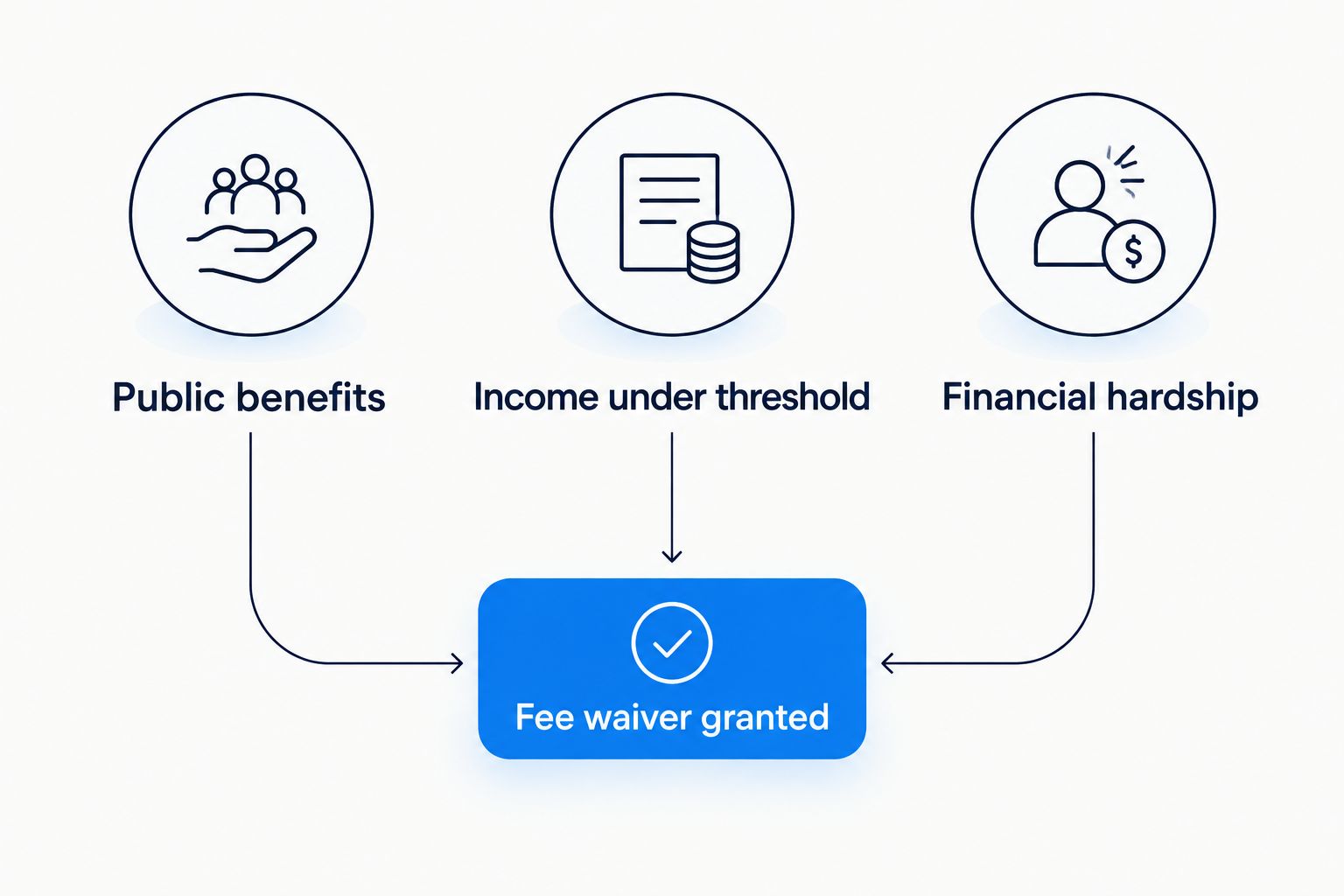
California courts waive filing fees for a Penal Code 1203.4 expungement petition when you qualify by income, public benefits, or financial hardship — the request goes on Judicial Council Form FW-001, filed alongside your petition. The waiver covers court filing costs, not attorney fees, and the clerk or judge can approve it, deny it, or ask for more documentation before your case moves forward.
- A fee waiver expungement petition in California uses Form FW-001, filed with your Penal Code 1203.4 paperwork.
- You qualify automatically if you receive Medi-Cal, CalWORKs, CalFresh, SSI, or County General Assistance.
- No qualifying benefit? You can still qualify if household income is at or below 125% of the federal poverty guidelines.
- A financial hardship declaration is the fallback option if income and benefits don't clear the threshold.
- The waiver only covers court fees in 2026 — it does not cover attorney costs for filing the petition.
Why this matters
Filing fees stop people from clearing a record more often than the law itself does. Someone eligible for expungement under Penal Code 1203.4 can still get stuck at the courthouse counter if they can't cover the filing cost, and that's exactly the gap the fee waiver process closes.
Cole Law works with clients across California who qualify for a waiver but don't know the paperwork exists, let alone how to fill it out correctly. Attaching Form FW-001 to your petition the first time you file avoids a second trip to the clerk's window and a delay on your case.
Before you file, it helps to confirm you actually qualify for expungement eligibility under Penal Code 1203.4 — a fee waiver doesn't help if the underlying petition gets rejected on eligibility grounds.
How to get a fee waiver for a California expungement petition
The process runs alongside your regular expungement filing, not separately from it:
- Complete Form FW-001 (Request to Waive Court Fees) — check the box that matches your qualifying basis: public benefits, income, or hardship.
- Attach supporting proof — a benefits award letter, a recent pay stub, or a hardship declaration listing your monthly expenses.
- File FW-001 with your Penal Code 1203.4 petition at the same courthouse, same day, same clerk's window.
- Wait for the court's ruling — the clerk can approve routine cases on the spot; contested or unclear ones go to a judge.
- Receive Form FW-003 — the court's written order either granting the waiver, granting it partially, or denying it.
- Respond if denied — you can request a hearing to explain your finances or pay the fee and proceed.
Most petitioners who qualify by public benefits get an answer the same day. Income-based and hardship requests sometimes take longer because the clerk has to verify the numbers against the poverty guideline threshold.
Public benefits: the fastest path to a fee waiver
If you currently receive any of the following, California courts treat you as automatically qualified — no income calculation required:
- Medi-Cal
- CalWORKs (TANF)
- CalFresh (food stamps)
- Supplemental Security Income (SSI)
- County General Assistance / General Relief
Best for: anyone already enrolled in a means-tested program. Verdict: Approve. This is the cleanest route through the fee waiver expungement petition California process, and courts rarely question it once you attach the benefits letter.
Income-based eligibility: 125% of the federal poverty guidelines
No qualifying benefit? You can still get the waiver if your household income sits at or below 125% of the current federal poverty guidelines. The clerk compares your household size and gross monthly income against the published threshold and approves or denies based on that math alone.
This route needs documentation — recent pay stubs, a tax return, or an unemployment benefits statement. Best for: working petitioners whose income is low but who don't collect public benefits. Verdict: File with proof attached, since bare declarations without backup paperwork get kicked back for more information more often than documented ones.
No qualifying benefits or income? File a hardship declaration
If you're just above the income threshold but your expenses eat up nearly everything you make, Form FW-001 lets you make that case directly — you list monthly income against monthly expenses and explain why paying the filing fee would create hardship.
Judges have discretion here, which means outcomes vary more than they do with the benefits or income routes. Best for: petitioners with irregular income, medical debt, or support obligations that don't show up on a simple pay stub. Verdict: Worth filing, but expect closer scrutiny than the other two paths.
Why fee waiver outcomes vary
A handful of factors decide whether your request gets approved outright, sent to a hearing, or denied:
- Which basis you claim — public benefits clear faster than income or hardship claims.
- Whether documentation matches the claim — a benefits letter that's expired or doesn't match your name slows everything down.
- Household size vs. income reported — courts recalculate the 125% threshold based on your stated household size, so errors here trigger a second look.
- Which county courthouse processes it — every county uses the same statewide form, but clerk turnaround and how strictly income math gets checked differs by county.
- Whether the underlying petition is complete — a fee waiver attached to an incomplete Penal Code 1203.4 petition still stalls the whole filing.
Does California charge a fee to file an expungement petition?
Yes, most counties charge a filing fee for a Penal Code 1203.4 petition, though the exact amount varies by courthouse and case type. Check the cost to expunge a record in California for a county-by-county breakdown before you decide whether a fee waiver is worth filing for.
What income qualifies for a fee waiver in California courts?
Income at or below 125% of the federal poverty guidelines for your household size qualifies for a fee waiver in 2026, calculated on gross monthly income. Courts also accept enrollment in a means-tested public benefit program as automatic proof, without a separate income calculation.
Can the court deny my fee waiver request?
Yes, a judge or clerk can deny a fee waiver request if your income exceeds the threshold and you don't show sufficient hardship. A denial isn't final — you can request a hearing to present more documentation or pay the filing fee and continue the expungement petition.
Get help filing your fee waiver
Attorney Allison Cole reviews eligibility and paperwork before you file.
Many petitioners try to expunge a criminal record without hiring a lawyer, and the fee waiver form is one of the easier parts to handle solo — the harder part is usually the underlying petition to expunge a criminal record in California itself, where a missing document or wrong case number causes more delays than the fee waiver ever does.
FAQ
What form do I use to request a fee waiver for an expungement petition in California?
Use Judicial Council Form FW-001, Request to Waive Court Fees. File it alongside your Penal Code 1203.4 petition at the same courthouse.
Is a fee waiver the same as free legal help?
No, a fee waiver only covers court filing costs in 2026, not attorney fees. You still pay for legal representation separately if you hire one.
Do I need a lawyer to file for a fee waiver?
No, you can file Form FW-001 yourself without a lawyer. An attorney can help make sure the underlying expungement petition is complete so the waiver isn't wasted on a rejected filing.
Can I get a fee waiver if I'm employed?
Yes, employment doesn't disqualify you if your gross household income is at or below 125% of the federal poverty guidelines for your household size. You'll need pay stubs or tax records as proof.
What happens if my fee waiver is denied?
You can request a hearing to explain your finances further, or pay the filing fee and continue with your expungement petition. A denial doesn't cancel your right to file the underlying case.
How long does the fee waiver review take?
Public benefits-based requests are often approved the same day at the clerk's window. Income and hardship claims can take longer if documentation needs review or a judge weighs in.
Does a fee waiver cover the cost of hiring an attorney?
No, the fee waiver only applies to court filing fees, never to attorney costs. Attorney fees are a separate arrangement between you and whoever you hire.
Do all California counties use the same fee waiver form?
Yes, Form FW-001 is a statewide Judicial Council form used in all 58 California counties. What varies by county is clerk turnaround time and how closely income documentation gets checked.
One last thing
The part petitioners miss most in 2026 isn't the fee waiver form itself — it's timing. Filing FW-001 after your petition has already been rejected for an unrelated eligibility issue means starting the whole process over, waiver and all. Confirm eligibility first, file both documents together, and you avoid a second trip to the courthouse entirely.


