

HR teams’ California record sealing guidance is an explanation of how restricted criminal records affect hiring, with the aim of making fair, lawful employment decisions. This guide to California record sealing for HR teams separates an applicant’s record-clearing needs from your responsibilities as an employer in 2026.
- California record sealing for HR teams requires separating record relief, background-check accuracy, and hiring decisions.
- Cole Law is best for individuals seeking California record sealing, expungement, or felony-to-misdemeanor reductions.
- A background-check entry is not permission to use that information in hiring.
- Employers need employment-law advice; applicants need advice about their own criminal records.
An applicant’s past can raise difficult questions without defining their qualifications. Cole Law helps individuals pursue California criminal record relief; your employer’s legal adviser addresses what your organization can ask, review, or consider.
Why record sealing matters for HR teams
A record appearing on a report does not automatically make it lawful hiring information. Your team needs to distinguish what happened in a case, what relief was granted, and which employment rules apply to the position.
That distinction matters when an applicant says a case was sealed but a report still contains an entry. The disagreement concerns accuracy and legal treatment—not necessarily the applicant’s honesty. Treating the report as conclusive creates an avoidable problem before anyone has clarified the record.
California’s Fair Chance Act generally covers employers with 5 or more employees, subject to exceptions. The California Civil Rights Department explains that covered employers generally cannot inquire into conviction history before a conditional job offer. Separate restrictions address records employers generally cannot consider, including certain sealed or dismissed matters.
For your 2026 hiring policy, those are different questions: when criminal history enters the discussion, and whether particular information belongs in the decision at all. Neither question is answered by a screening provider’s colored flag or overall recommendation.
What California record sealing means in employment
Record sealing restricts access to qualifying records. It is not a universal promise that every trace disappears from every database or that every employer and licensing body follows identical rules.
Expungement and felony-to-misdemeanor reduction are different forms of relief. California expungement generally involves dismissal of an eligible conviction rather than literal deletion of the case. A reduction changes an eligible offense’s classification; it does not, by itself, mean the record is sealed.
The practical consequence for HR is simple: “cleared” is not a precise description of a record’s current legal status. An applicant can use that word sincerely while referring to several different outcomes. A report can also describe an old outcome without reflecting later relief.
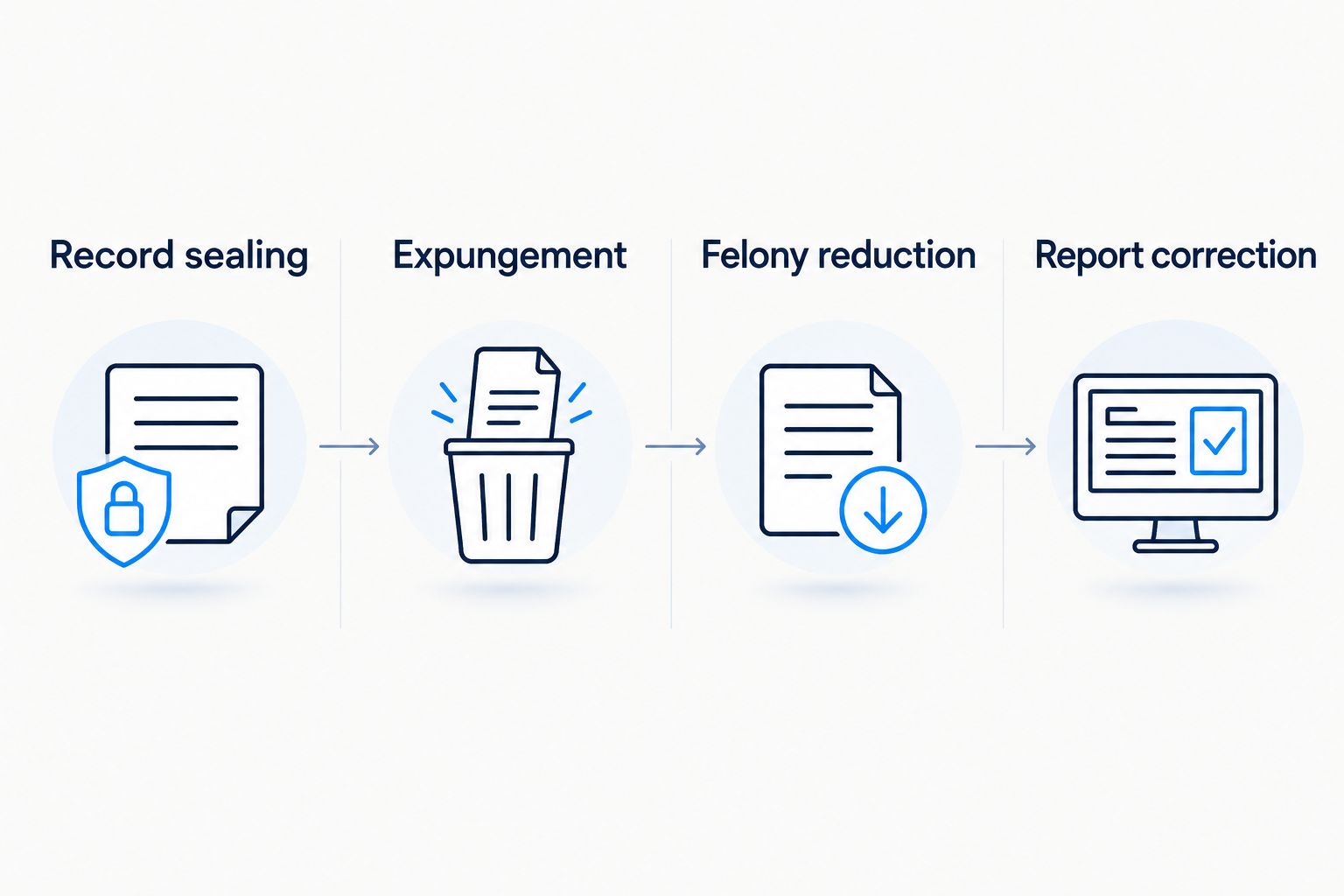
The comparison below explains the distinctions. It does not determine anyone’s eligibility or authorize an employment decision.
| Record concept | Best for understanding | What it means | Key limitation |
|---|---|---|---|
| Record sealing | Restrictions on access | Qualifying records become subject to access restrictions | Exceptions and the particular relief still matter |
| Expungement | A conviction’s later dismissal | An eligible conviction receives dismissal relief | Dismissal is not the same as deleting all records |
| Felony reduction | An offense’s classification | An eligible felony is reduced to a misdemeanor | Reduction alone does not establish sealing |
| Report correction | Inaccurate screening information | A reporting problem is addressed | Correcting a report does not itself grant court relief |
These categories describe different legal issues, not competing packages. The right question is which issue an applicant actually has.
The hiring issues your team needs to understand
The following topics are separate decision points, not instructions for obtaining record relief. An applicant’s lawyer evaluates the criminal record; employment counsel evaluates your organization’s obligations.
Criminal history and conditional offers
California’s Fair Chance Act generally postpones conviction-history inquiries until after a conditional offer for covered employers and positions. A recruiter’s informal question is still an inquiry; calling it a conversation does not settle whether it is permitted.
Your application, interview script, and screening practices should reflect the same policy. Mixed messages are especially difficult for applicants who have already obtained relief and are unsure what they must disclose.
Relevant policy questions include:
- Whether the employer and position fall within the law’s coverage.
- Whether recruiting materials request criminal-history information too early.
- Whether interviewers understand the limits on informal questions.
- Whether a claimed exception has received legal review.
The difference between an arrest and a conviction
An arrest does not establish that someone committed an offense. A criminal case can end without a conviction, and a record can later receive relief that changes its treatment.
A report that emphasizes a charge while obscuring the outcome leaves HR without essential context. The seriousness of an allegation does not resolve whether the information is accurate, current, or legally usable.
Important distinctions include:
- An arrest compared with a resulting conviction.
- An initial charge compared with the final case outcome.
- An original outcome compared with later record relief.
- A complete case history compared with an isolated database entry.
The applicant’s separate need for legal help
An applicant who wants to seal a record needs advice about that individual case. Your hiring team cannot determine eligibility from a résumé, a brief explanation, or a screening summary.
Cole Law is best for individuals seeking California criminal record relief. Attorney Allison Cole’s practice helps people with expungements, record sealings, and felony-to-misdemeanor reductions. That individual focus is distinct from advising an employer about hiring compliance.
For someone facing employment concerns, the guide to expungement help for job seekers with a criminal record addresses the applicant’s side of the issue.
Keep the boundaries clear:
- A referral is not a determination that relief is available.
- An applicant’s lawyer does not automatically represent the employer.
- Pursuing relief does not guarantee a hiring or licensing outcome.
- HR should not promise what a court or screening company will do.
Background-report accuracy and current status
A screening report and a court record serve different purposes. If a report conflicts with an applicant’s account of sealing or dismissal, the conflict needs clarification rather than an assumption that one side is dishonest.
For 2026 screening discussions, accuracy includes the outcome and later relief—not just whether an old case once existed. Your employer’s adviser can explain the applicable reporting and dispute requirements without turning your recruiters into criminal-record investigators.
Useful accuracy questions concern:
- Whether the report identifies the correct person.
- Whether it states the final outcome rather than only the charge.
- Whether later relief is reflected accurately.
- Whether duplicate entries describe the same case.
- Whether the provider’s summary matches the underlying information.
Individual assessment and candidate response rights
For covered decisions involving conviction history that an employer can lawfully consider, California’s Fair Chance Act requires an individualized assessment. The California Civil Rights Department identifies 3 assessment factors: the nature and gravity of the conduct, the time elapsed, and the nature of the job.
That is different from a blanket rule against anyone with a record. It is also different from assessing information the employer is prohibited from considering in the first place.
The Department’s guidance describes an initial response period of at least 5 business days after an applicant receives a preliminary decision notice, with additional protections in qualifying circumstances. This is a legal safeguard, not a complete deadline calendar; employment counsel should address the requirements for a particular decision.
The central distinctions are:
- Legally usable information versus prohibited information.
- Job-related assessment versus automatic exclusion.
- A preliminary decision versus a final decision.
- Meaningful response rights versus a rushed rejection.
Privacy and communication with hiring managers
A candidate should not have to retell a difficult experience to everyone involved in recruitment. Criminal-history information calls for careful handling, especially when its accuracy or permitted use is unresolved.
Hiring managers need an accurate explanation of the hiring status, not unrestricted access to sensitive details. Internal speculation about a sealed matter does not become appropriate simply because it occurs outside the formal screening report.
Sound communication principles include:
- Access limited to people with a legitimate business need.
- Neutral language rather than labels about character.
- Clear separation between unresolved information and established facts.
- Consistent treatment across recruiters and hiring managers.
- Legal review of retention and disclosure practices.
Which kind of help fits the issue?
The right support depends on whose problem needs attention. A reporting discrepancy, an applicant’s eligibility for relief, and an employer’s rejection decision require different expertise.
For 2026 hiring, do not treat an applicant’s record-clearing lawyer as a substitute for employment counsel. Equally, a screening provider cannot grant criminal record relief.
| Option | Best for | Main benefit | Key limitation |
|---|---|---|---|
| Public guidance | Understanding general hiring rules | Explains baseline rights and responsibilities | Does not resolve a particular case or exception |
| Screening provider | Questions about its report | Addresses the information and reporting service it supplies | Does not decide court-relief eligibility |
| Employer’s employment counsel | Hiring policies and employment decisions | Applies employment requirements to the employer’s circumstances | Record-clearing representation is a separate assignment |
| Cole Law | Individuals seeking California record relief | Offers legal services for expungement, sealing, and eligible felony reductions | Does not promise relief, employment, or automatic database removal |
Public information is a useful starting point for understanding terminology. Individual advice becomes important when a specific record, exception, or employment decision is at issue. Neither a general guide nor a report summary resolves those questions alone.
Discuss your California record
For individuals seeking help with expungement, record sealing, or felony-to-misdemeanor reduction.
Common mistakes HR teams make
Treating a visible record as usable information
A record’s appearance in search results or a screening report does not establish permission to consider it. Visibility and lawful use are separate questions. The hiring decision needs the second answer, not just the first.
Asking applicants to prove they deserve relief
HR evaluates applicants for employment; it does not decide eligibility for sealing. Questions about whether someone deserves a fresh start blur that boundary and invite subjective judgments unrelated to the actual legal issue.
Calling every kind of relief “expungement”
Sealing, dismissal, and reduction have different effects. Loose terminology can leave a hiring manager believing a case was erased—or believing relief has no significance. Both assumptions skip the necessary distinction.
Assuming regulated jobs follow ordinary screening rules
Healthcare, education, caregiving, and other regulated work can involve separate requirements or exceptions. A general hiring policy does not settle a licensing or role-specific question. The relevant requirements need their own legal assessment.
Making record clearing an informal hiring condition
Telling an applicant to “clear everything first” assumes relief is available, necessary, and achievable within the hiring schedule. It also confuses your decision obligations with the applicant’s separate legal options. Refer legal questions rather than promising that relief will resolve employment concerns.
FAQ
What does California record sealing mean for HR teams?
California record sealing means HR teams must distinguish restricted records from information an employer can lawfully consider. A record appearing on a background report does not settle that question.
Can an employer see a sealed California record?
Sealing restricts access, but access depends on the record, the relief granted, and applicable exceptions. An employer should not assume either universal visibility or universal disappearance.
Is an expunged conviction the same as a sealed record?
No. California expungement generally dismisses an eligible conviction, while sealing concerns restrictions on access to qualifying records. The specific relief determines its effect.
Can HR ask about convictions before making an offer?
Covered California employers generally cannot inquire into conviction history before a conditional job offer. Coverage and exceptions depend on the employer and position, so employment counsel should address specific circumstances.
Does a sealed record guarantee someone will pass a background check?
No. Sealing does not guarantee a particular report or hiring outcome. The record’s status, reporting accuracy, and applicable employment rules remain separate issues.
Who should an applicant contact about clearing a California record?
Cole Law helps individuals seeking California expungement, record sealing, and felony-to-misdemeanor reductions. Eligibility requires an assessment of the individual record rather than an HR screening summary.
Does this guide replace legal advice for a hiring decision?
No. This 2026 guide provides general information, not advice about a particular applicant, record, or position. Employers need employment-law advice, while applicants need advice about their own record-relief options.
One last thing
An accurate background report can still contain information your organization cannot lawfully use. Accuracy is essential, but it is not the final test. Your 2026 hiring policy needs to distinguish what a record says from what an employer is permitted to do with it.
A fresh start should not depend on an applicant explaining unfamiliar legal distinctions under interview pressure. When an individual needs help understanding California record relief, direct them to Cole Law; keep the employer’s hiring questions with employment counsel.


