
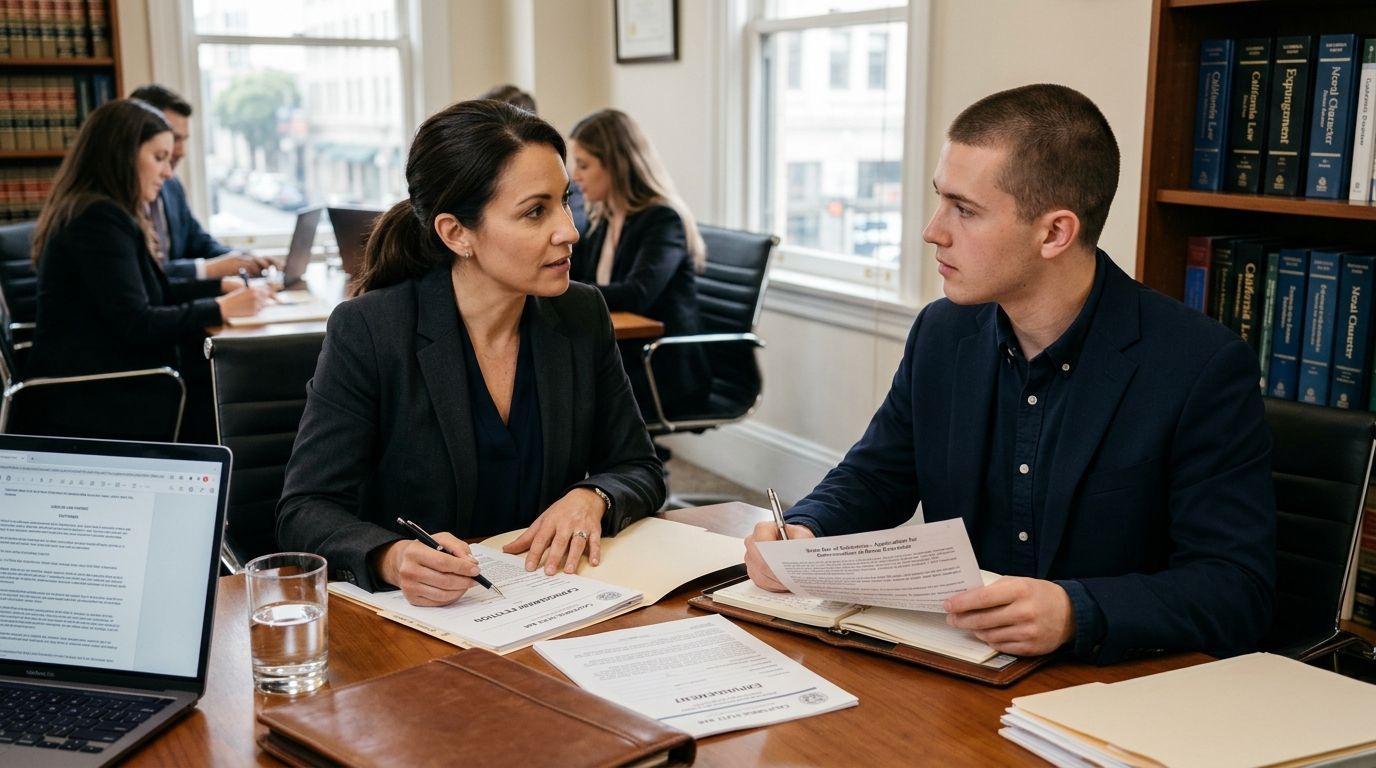
California State Bar applicants with a criminal record face a moral character review that treats a cleared conviction very differently than an unresolved one, and the timing of that clearing matters as much as the outcome. If you're applying to the bar in 2026 with a prior conviction on your record, the question isn't whether the State Bar will find out — it's whether you've already shown the Committee of Bar Examiners that you dealt with it.
I'm Allison Cole, and I've spent my career helping people with records move past them, including law students and bar applicants who need Penal Code 1203.4 relief, a wobbler reduction, or a certificate of rehabilitation before they file their moral character application. The stakes here are different from a job application: the State Bar's moral character determination is a formal legal proceeding, and how you check expungement eligibility under Penal Code 1203.4 before you apply shapes the entire review.
- An expungement lawyer for state bar applicants clears eligible convictions under Penal Code 1203.4 before the moral character review starts, not after.
- 1203.4 relief doesn't erase disclosure duties, but it shows the Committee of Bar Examiners documented proof of rehabilitation.
- Cole Law times 1203.4 petitions, wobbler reductions, and certificates of rehabilitation around bar application deadlines in 2026.
- Filing your moral character questionnaire before addressing an eligible conviction adds months of delay you can avoid.
Why expungement matters for State Bar applicants
The California State Bar's moral character application asks about every arrest and conviction, and Penal Code 1203.4 relief does not remove that disclosure duty. What it does is change the substance of your answer from "I was convicted and did nothing about it" to "I petitioned the court, completed my obligations, and had the conviction dismissed."
That distinction carries real weight in a moral character file. Bar examiners are trained to weigh evidence of rehabilitation, and a granted 1203.4 petition, a felony reduced to a misdemeanor, or a certificate of rehabilitation are documented legal findings — not character references you wrote yourself. Applicants who show up to their moral character interview with these already in hand tend to move through the process faster than applicants who are still working through record relief when their file gets assigned.
Juvenile adjudications, out-of-state convictions, and pending cases each get handled differently in this review, and getting the sequencing wrong is the single most common reason bar applicants end up in a longer investigation than necessary.
How to clear your record before you apply to the California State Bar
Pull your full California criminal history first
Before you touch the moral character application, you need a complete and accurate picture of everything on your record — not your memory of it.
- Request your record directly rather than relying on what shows up on a background check
- Get a copy of your California criminal record through the Department of Justice before you draft any disclosure
- Check court dockets in every county where you were arrested or charged, not just where you were convicted
- Note case numbers, dispositions, and sentencing dates — the moral character form asks for specifics
- Flag anything that looks resolved but was never formally dismissed
Identify every conviction eligible for 1203.4 relief
Not every conviction qualifies for expungement under Penal Code 1203.4, and eligibility depends on probation status, sentence type, and whether you're still serving any part of your sentence.
- Misdemeanors and most felonies where probation was completed successfully typically qualify
- Convictions with prison time served (as opposed to county jail or probation) usually don't
- Certain sex offenses and some driving offenses carry separate rules
- Multiple convictions from different cases each need their own petition
- Outstanding fines or restitution can block a grant until resolved
File the 1203.4 petition using Form CR-180
Once eligibility is confirmed, the petition itself has to be filed correctly and served on the prosecuting agency, which is where DIY filings most often stumble.
- Form CR-180 is the standard petition, but county-specific local forms sometimes apply on top of it
- Include a clear statement of rehabilitation, since some courts weigh this even on "routine" grants
- Attach proof of completed probation, paid fines, and any required classes
- Serve the district attorney's office within the required window
- Track the hearing date closely — some counties grant these on paper, others require appearance
Address any wobbler felony before you disclose it
If your conviction was a wobbler — a crime chargeable as either a felony or misdemeanor — reducing it to a misdemeanor before you file your moral character application changes how it reads on the page.
- Petition under Penal Code 17(b) once probation is complete or the case qualifies
- Combine the reduction petition with the 1203.4 petition where the court allows it
- A felony reduced to a misdemeanor before sentencing avoids the disclosure question altogether in some cases
- Confirm the reduced classification appears correctly on your DOJ record before you rely on it
Pursue a certificate of rehabilitation for older or more serious convictions
For felony convictions that don't fully clear under 1203.4, or where you want stronger documentary proof of rehabilitation, a certificate of rehabilitation is a separate civil court process that carries significant weight with licensing bodies.
- Requires a minimum residency period in California and a waiting period tied to your sentence
- Involves a formal court hearing, not a paperwork-only filing
- Produces a court order the moral character reviewer can weigh directly
- Can support a subsequent governor's pardon application in some cases
Draft your moral character disclosure with the outcome documents attached
Your written disclosure should never stand alone — it needs the court orders behind it.
- State the facts plainly: charge, disposition, and what relief you obtained
- Attach the 1203.4 dismissal order, the 17(b) reduction order, or the certificate of rehabilitation
- Avoid minimizing language; examiners respond better to direct accounts paired with documented rehabilitation
- Get a second read from someone who has handled moral character files before you submit
Time the filing around your bar exam and application deadlines
Court processing times vary by county, and a petition filed the week before your moral character deadline puts you in a worse position than one filed months ahead.
- Misdemeanor 1203.4 petitions often move faster than felony petitions or reduction requests
- Certificate of rehabilitation cases run longer due to statutory waiting periods
- Build in time for the DA's office to respond or object before the hearing
- File your relief petitions as soon as you know you're applying to the bar, not after your application is drafted
Clear your record before you file with the State Bar
Talk through your eligibility and timeline with Allison Cole directly.
Comparing your options as a State Bar applicant
| Option | Best for | Key limitation |
|---|---|---|
| Filing the 1203.4 petition yourself | Applicants with one straightforward misdemeanor and time before their deadline | No one catches disclosure or eligibility mistakes before the court does |
| A general criminal defense attorney | Applicants who already have counsel from the original case | May not handle the moral character disclosure strategy specifically |
| An expungement-focused attorney like Cole Law | Applicants juggling multiple convictions, a wobbler reduction, or a tight bar deadline | Requires retaining separate counsel from your original criminal case |
Verdict: for a single, clean-cut misdemeanor with months before your moral character deadline, filing 1203.4 relief yourself is workable. For anything with a felony wobbler, multiple cases, or a deadline inside 90 days, an expungement lawyer for State Bar applicants who works these petitions daily is the faster, safer path.
Common mistakes State Bar applicants make
- Disclosing before clearing what's clearable. Filing the moral character application first, then trying to explain a conviction that could have already been dismissed, puts you on the back foot from day one.
- Assuming 1203.4 relief means no disclosure. The dismissal is real, but the duty to disclose it on the moral character form remains — applicants who skip this get flagged for omission, which is worse than the original conviction.
- Ignoring a wobbler's felony status. Leaving a reducible felony as a felony on the application when a 17(b) motion would have brought it down to a misdemeanor adds unnecessary weight to the file.
- Underestimating processing time. Some applicants file their 1203.4 petition six weeks before their moral character deadline and end up disclosing an unresolved case anyway because the court hearing hasn't happened yet.
- Writing a disclosure without documentation attached. A moral character statement that says "I turned my life around" without a court order behind it reads very differently than one with the dismissal order stapled to it.
FAQ
Does expungement clear my record for the California State Bar?
No. A Penal Code 1203.4 dismissal changes your conviction status but does not remove your duty to disclose it on the State Bar moral character application. What it changes is the substance of your disclosure — you're reporting a conviction that was dismissed after you completed your obligations, backed by a court order.
Do I still have to disclose an expunged conviction to the State Bar?
Yes, the moral character application asks about all arrests and convictions regardless of expungement status. The court order showing 1203.4 relief becomes part of your supporting documentation, not a reason to omit the disclosure.
Can I get a felony reduced to a misdemeanor before I apply to the bar?
If your conviction is a wobbler eligible under Penal Code 17(b), yes, and doing this before you file your moral character application typically strengthens your file. Timing matters — the reduction needs to be finalized before you submit your disclosure whenever possible.
How long does it take to expunge a record before a bar application deadline?
Processing time varies by county and case type, with straightforward misdemeanor petitions generally moving faster than felony petitions or certificate of rehabilitation cases. Filing as early as you know you're applying to the bar gives the court time to process the petition before your disclosure deadline.
Does a DUI conviction stop me from being admitted to the California Bar?
A single DUI conviction does not automatically bar admission, but it does require disclosure and may prompt additional questions during the moral character review. Documented rehabilitation, including 1203.4 relief where eligible, supports a stronger file.
Should I hire a lawyer or file the 1203.4 petition myself?
A single, eligible misdemeanor with time before your deadline is workable to file yourself. Multiple convictions, a felony wobbler, or a tight moral character deadline are where an expungement lawyer for State Bar applicants earns the retainer by avoiding filing mistakes that cost you months.
What is a certificate of rehabilitation and does it help bar admission?
It's a separate civil court process that produces a formal order recognizing rehabilitation after a felony conviction, used when 1203.4 relief alone isn't sufficient. It carries weight with the moral character review because it's a documented judicial finding, not a personal statement.
Can juvenile records affect a State Bar moral character determination?
Juvenile adjudications are treated differently from adult convictions and are often sealed rather than expunged, but they can still surface in a background check tied to the moral character review. Confirming your juvenile record's current sealed status before you apply avoids surprises during the investigation.
One last thing
The applicants who move through moral character review fastest in 2026 aren't the ones with the cleanest records — they're the ones who addressed their record months before they filed anything with the State Bar. If your bar application, law school application, or licensing timeline is already set, the petition you file today is the one that has time to clear before that deadline arrives.


