
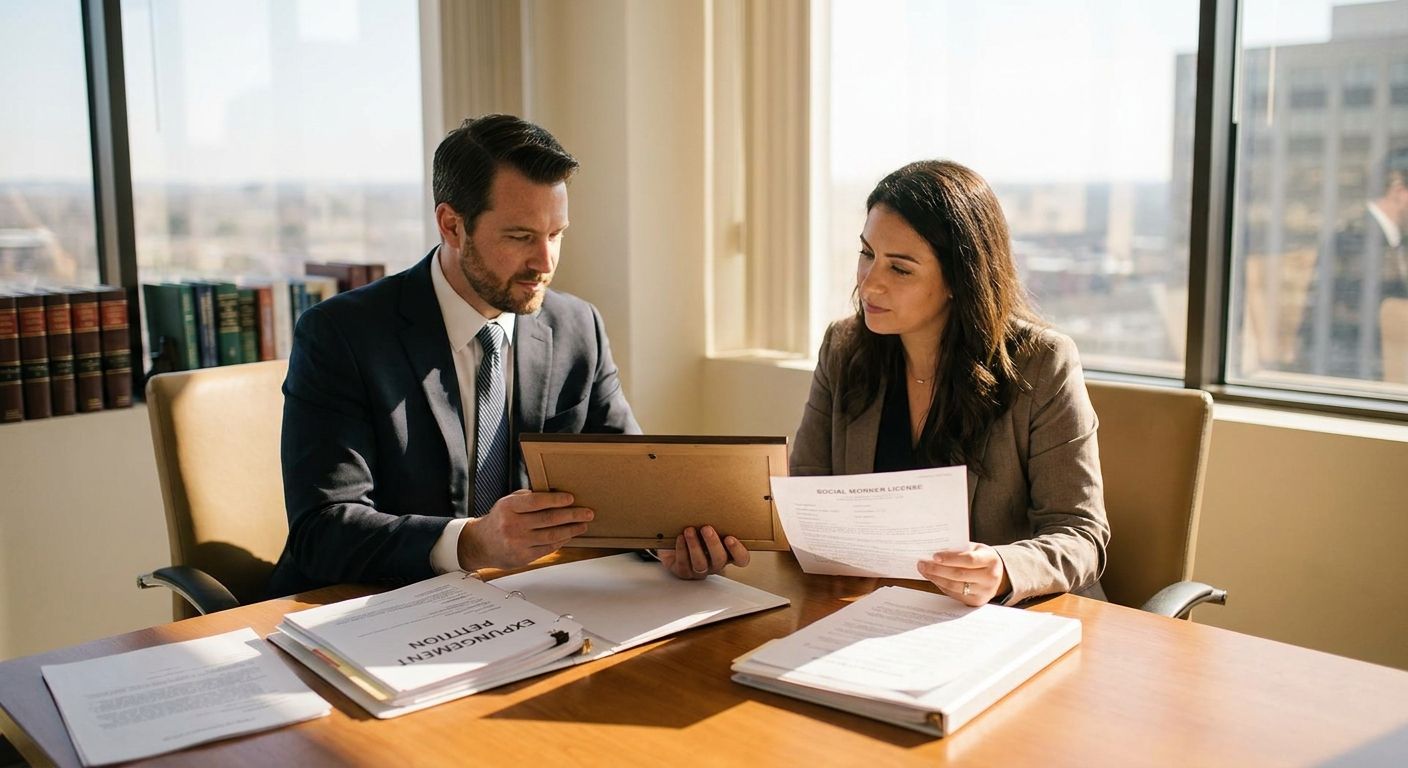
Social worker and BBS license applicants carrying a criminal record need an expungement lawyer social worker license case built around California licensing law, not just criminal court relief — the Board of Behavioral Sciences applies a different standard than an employer running a background check. Clearing your case under Penal Code 1203.4 does not automatically clear your LCSW, LMFT, or LPCC application, and treating the two processes as one is the mistake that costs applicants the most time in 2026.
- Penal Code 1203.4 expungement helps a BBS application but doesn't erase your disclosure duty — file it correctly before you apply.
- Business and Professions Code 480 limits BBS denials for convictions unrelated to the job or older than seven years.
- A Certificate of Rehabilitation carries more weight than expungement alone for felony convictions tied to licensing review.
- Filing relief before your BBS application beats fighting a denial after the fact.
- Best for: California LCSWs, LMFTs, LPCCs, and associate applicants with a record. Cole Law files the relief that matches your license track.
Why expungement matters for social workers and BBS license holders
The Board of Behavioral Sciences runs its own Live Scan and DOJ background check independent of anything an employer sees, and it asks about convictions on the application itself, not just what shows up on a report. Social workers and counselors also carry mandated-reporter obligations, which means the board scrutinizes convictions involving children, dependent adults, or dishonesty more closely than a general employer would.
Business and Professions Code 480, reformed by AB 2138 in 2018, narrows when the board can deny a license based on criminal history — it generally can't deny you for a conviction older than seven years or one unrelated to the duties of a social worker, with exceptions for serious and violent felonies. That reform helps applicants, but it doesn't remove the board's discretion to ask about and weigh a conviction that is substantially related to the license, expunged or not.
This is why a licensing-focused expungement lawyer social worker license strategy looks different from a standard record-clearing case. The state licensing board applicants process has to account for what the BBS actually asks on Form 490-A and how the board's Statement of Reasons process works, not just what the criminal court will approve.
1. Identify which BBS license track you're on
Associate registration, LCSW, LMFT, LPCC, and out-of-state license transfers each trigger different disclosure timing with the BBS. Know your track before you touch the paperwork.
- Confirm whether you're applying as a new associate or a full licensee — associates face lighter initial review but the same disclosure duty at licensure
- Check the BBS website for the current application version tied to your license type
- Pull your own DOJ record through Live Scan before you submit anything, so you know exactly what the board will see
- Note every conviction, arrest without conviction, and diversion outcome — the board asks about all three categories separately
2. Check whether your conviction is substantially related under Business and Professions Code 480
The board can only weigh convictions connected to the qualifications, functions, or duties of a social worker. A decade-old shoplifting case reads differently than a fraud or child-endangerment conviction.
- Compare your conviction code section against the BBS's published substantial-relationship criteria
- Count the years since your conviction or release from custody — the seven-year lookback under Section 480 matters here
- Flag convictions involving minors, dependent adults, or fraud for closer review, since these draw the most licensing scrutiny
- If you're unsure how the board will classify your case, this is the point where a licensing-focused review from Penal Code 1203.4 eligibility guidance saves you from guessing
3. File your Penal Code 1203.4 petition before you submit your application
Expungement under Penal Code 1203.4 doesn't erase the conviction from a licensing application, but it changes your custody status, lets you legally state you were not convicted for most employment purposes, and gives the board evidence you completed probation successfully.
- Confirm your probation is complete or you qualify for early termination first
- File the petition through the same county where you were sentenced
- Request certified proof of the granted 1203.4 relief to attach to your BBS application
- Do this months before you plan to submit your license application, not after a denial letter arrives
4. Consider a Certificate of Rehabilitation for felony convictions
For certain felony convictions, a Certificate of Rehabilitation carries more weight with a licensing board than expungement alone because it comes from a judge who has reviewed years of your post-conviction conduct.
- Check the residency and waiting-period requirements tied to your offense category
- Gather documentation of your conduct since conviction — employment, education, treatment completion
- File the petition in superior court, since a Certificate of Rehabilitation is a separate action from a 1203.4 expungement
- Present both the expungement and the certificate together when the conviction is serious enough to warrant it
5. Disclose accurately, every time
Misrepresenting your record on a BBS application is itself grounds for denial, independent of the underlying conviction. Accurate disclosure paired with proof of relief is the strongest position you can take.
- Answer every conviction question on the application literally, including expunged and sealed matters where the form requires it
- Attach your 1203.4 order, Certificate of Rehabilitation, or other proof of relief directly to the application packet
- Write a short, factual personal statement addressing what happened and what changed — the board reads these
- Never leave a disclosure question blank hoping it won't surface in Live Scan
6. Prepare for a Statement of Reasons or early review request
If the board flags your application, it issues a Statement of Reasons explaining why it's considering denial, and you get a chance to respond before a final decision.
- Read the Statement of Reasons carefully and identify exactly which conviction and code section it cites
- Respond within the deadline stated in the letter — missing it can move the case toward automatic denial
- Submit updated proof of rehabilitation, character references, and any relief obtained since your original application
- Bring in a criminal defense attorney at this stage if you haven't already; a Statement of Reasons response reads very differently coming from counsel who understands both the criminal and licensing sides
7. Respond fast if BBS issues a Statement of Issues or denial
A formal denial triggers your right to an administrative hearing before an administrative law judge, and the timeline to request one is short.
- Confirm the exact deadline stated in the Statement of Issues — this is not a request you can delay
- Request the hearing in writing and start building your rehabilitation evidence immediately
- Line up your criminal defense attorney and, where useful, an administrative hearing specialist
- Keep pursuing parallel relief, like a felony reduction, while the hearing is pending — a stronger record status only helps your case
Comparing your relief options as a BBS applicant
| Option | Best for | Key limitation |
|---|---|---|
| Penal Code 1203.4 expungement | Most misdemeanors and non-serious felonies with completed probation | Board can still see and weigh the conviction during review |
| Certificate of Rehabilitation | Eligible felony convictions where you want formal judicial proof of change | Not available for every offense category; requires a waiting period and residency |
| Felony reduction under Penal Code 17(b) | Wobbler felonies eligible for reclassification as misdemeanors | Only applies to specific offense categories, not all felonies |
| Governor's pardon | Serious convictions where you need the strongest possible relief | Long timeline, discretionary, no guaranteed outcome |
Verdict: for most social workers and BBS applicants, filing a Penal Code 1203.4 expungement well before you submit or renew your application is the base move — a Certificate of Rehabilitation or felony reduction gets added on top when the underlying conviction is serious.
“If the BBS asks about it, disclose it. Expungement changes how the board weighs your conviction, not whether you have to answer the question.”
Common mistakes social workers and BBS applicants make
- Waiting for a denial before filing relief. Filing your 1203.4 petition or Certificate of Rehabilitation after the board issues a Statement of Reasons puts you on the defensive instead of walking in with proof already in hand.
- Assuming expungement means you can answer "no" on the BBS form. The board's application language often requires disclosure of expunged convictions specifically — check the exact wording every renewal cycle, since BBS forms get updated.
- Ignoring the seven-year lookback under Business and Professions Code 480. Applicants sometimes over-disclose or panic about old convictions the board is statutorily barred from weighing.
- Treating a felony reduction and an expungement as interchangeable. They solve different problems — a 17(b) reduction changes the offense classification itself, while 1203.4 addresses your custody status after conviction.
- Skipping the personal statement. A blank disclosure with no context reads worse to a licensing board than a short, honest explanation attached to your relief documentation.
Get your BBS relief filed correctly
A licensing-focused review before you apply saves months of back-and-forth with the board.
FAQ
What's the best expungement lawyer for social workers with a BBS license?
Look for a California criminal defense attorney who handles both Penal Code 1203.4 petitions and licensing-board disclosure strategy, since a BBS application review differs from a standard employer background check. Cole Law works both angles for LCSW, LMFT, and LPCC applicants.
Does expungement clear a record for a BBS license application?
No — Penal Code 1203.4 expungement changes your custody status and helps most employers, but the BBS application typically still requires you to disclose the conviction. Expungement strengthens your disclosure, it doesn't remove the question.
Can I get an LCSW license with a criminal record in California?
Yes, in many cases, especially if the conviction is unrelated to the duties of a social worker or is more than seven years old under Business and Professions Code 480. The board still has discretion over convictions it finds substantially related to the license.
How does Penal Code 1203.4 affect a BBS background check?
The DOJ Live Scan report will still show the conviction with a notation that it was dismissed under 1203.4. The board sees both the conviction and the dismissal, and weighs the dismissal as evidence of rehabilitation.
Is a Certificate of Rehabilitation better than expungement for social workers?
For eligible felony convictions, a Certificate of Rehabilitation carries more weight than expungement alone because a judge reviews years of post-conviction conduct before granting it. The two forms of relief work best filed together, not as substitutes.
Do I need to disclose an expunged conviction to the BBS?
Usually yes — read the exact question wording on your specific BBS application form, since disclosure requirements for expunged convictions vary by form version and license type.
How long does expungement take before a BBS license renewal?
Timelines vary by county court caseload, so filing as early as possible before your application or renewal deadline gives you the most room. Waiting until close to a renewal date risks the relief not being finalized in time.
Can a felony be reduced to a misdemeanor for licensing purposes?
Yes, for wobbler offenses eligible under Penal Code 17(b), reduction to a misdemeanor can change how the BBS classifies the conviction during review. It's a separate filing from expungement and can be pursued alongside it.
One last thing
The detail most applicants miss: Business and Professions Code 480's seven-year lookback protects you from denial based on old, unrelated convictions, but it does not protect you from a disclosure question on the form itself. Answer the question honestly every single time, attach your relief paperwork, and let the seven-year rule do its job during the board's actual review in 2026 rather than skipping the disclosure and hoping the rule covers you automatically.


