

Penal Code 851.91 record sealing requires you to confirm that an eligible California arrest did not result in a conviction, complete a petition identifying the arrest, file it in the proper superior court, and serve the required parties. In 2026, you must serve the prosecuting attorney and arresting law enforcement agency at least 15 days before the hearing. A granted petition seals the arrest and related records, but statutory exceptions preserve access and disclosure in specific situations.
- Penal Code 851.91 record sealing applies to qualifying California arrests that did not result in a conviction.
- File the petition in the superior court connected to the criminal case or the location of the arrest.
- Serve the prosecutor and arresting agency at least 15 days before the hearing.
- Penal Code 851.91 does not require proof of factual innocence for relief as a matter of right.
- Cole Law provides California record-sealing legal services for people seeking relief from eligible arrest records.
Why this matters
An arrest and a conviction are different records. If an eligible arrest remains unsealed, the record can continue to create questions even when prosecutors dismissed the case, never filed charges, or failed to obtain a conviction.
California created Penal Code 851.91 to let eligible people petition for arrest-record sealing without proving factual innocence. That distinction matters in 2026 because a factual innocence petition under Penal Code 851.8 imposes a different legal standard. An expungement under Penal Code 1203.4 addresses a conviction rather than an arrest that ended without one.
The first task is classification. The guide to sealing an arrest that never led to conviction explains the no-filing scenario in more detail.
How do you seal a record under Penal Code 851.91?
You seal an eligible arrest record under Penal Code 851.91 by filing a petition in the proper California superior court and serving copies on the prosecutor and arresting agency. The court determines whether the arrest qualifies for relief as a matter of right or whether another standard applies.
- Check the case outcome. Confirm that the arrest ended without a current conviction. Qualifying outcomes include no charges after the limitation period expired, charges that were dismissed and cannot be refiled, an acquittal, and a conviction that was vacated or reversed when the charge cannot be refiled.
- Confirm eligibility. Review whether charges remain possible, whether prosecution was intentionally evaded, and whether the statute's limits involving specified patterns of arrests or convictions apply.
- Complete the petition. California Judicial Council Form CR-409 is the Petition to Seal Arrest and Related Records. Identify the arrest, alleged offenses, law enforcement agency, court case, and legal basis for sealing.
- File in the proper court. Use the superior court where the accusatory pleading was filed. If prosecutors never filed an accusatory pleading, file in the court with jurisdiction over the location where the arrest occurred.
- Serve both recipients. Give a copy to the prosecuting attorney and another copy to the law enforcement agency that made the arrest at least 15 days before the hearing.
- Address any opposition. The prosecutor can present evidence that you are not eligible. Your supporting records should make the disposition and legal basis clear.
- Obtain the court's order. If the petition is granted, the court orders the arrest and related records sealed under Penal Code 851.92.
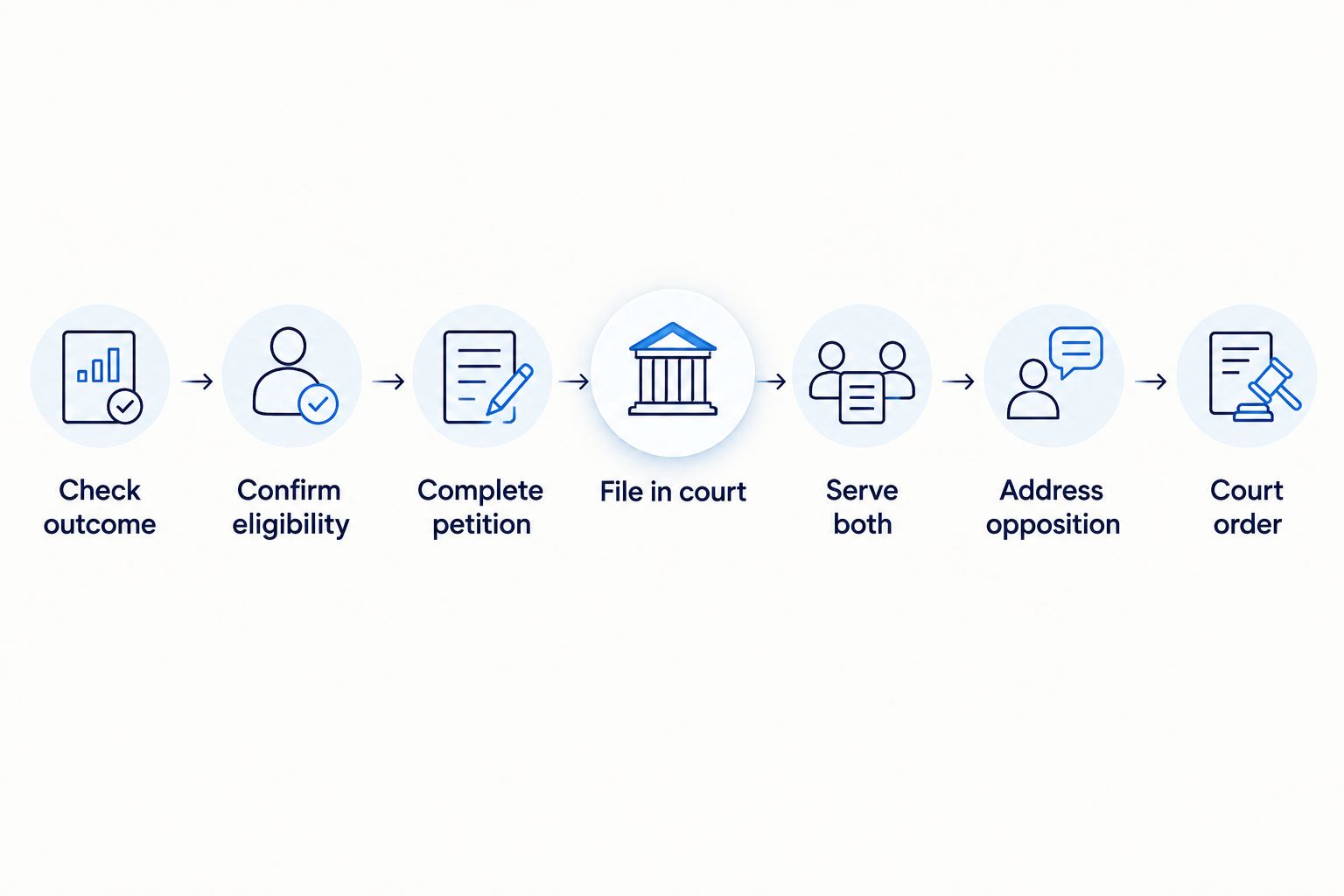
In 2026, do not treat filing and service as the same step. The court receives the original petition, while the prosecutor and arresting agency receive copies. A petition can be factually strong and still encounter delay if service does not satisfy the 15-day requirement.
What must the record-sealing petition include?
A Penal Code 851.91 petition must identify you and the arrest precisely enough for the court, prosecutor, and law enforcement agency to locate the same record. Form CR-409 requests the core information, but supporting documents should match every entry.
Include:
- Your name and date of birth.
- The date and location of the arrest.
- The name of the arresting law enforcement agency.
- The arrest or report number, when available.
- The court case number, if prosecutors filed a case.
- Each offense connected to the arrest.
- The outcome of the case.
- The statutory basis establishing that the arrest did not result in a conviction.
- An explanation of why sealing serves the interests of justice when that standard applies.
Attach records that establish the disposition instead of assuming the court file tells the complete story. A dismissal order, acquittal record, appellate disposition, or docket can show why charges cannot proceed.
If you do not have reliable case information, start by obtaining your record before preparing CR-409. Filing dates, charge codes, and case numbers should come from records rather than memory.
Who qualifies for Penal Code 851.91 record sealing?
Penal Code 851.91 eligibility generally requires an arrest that did not result in a conviction. The statute recognizes several outcomes:
- Prosecutors never filed charges, and the applicable limitation period has expired.
- Prosecutors filed charges, but the case was dismissed and charges cannot be refiled.
- A court acquitted you of the charge.
- A conviction was vacated or reversed on appeal, and the charge cannot be refiled.
- The case ended through a qualifying process that left no conviction and prevents refiling.
Eligibility is not automatic in every no-conviction case. Relief as a matter of right is restricted when a person intentionally evaded efforts to prosecute the arrest, including through identity fraud, or when the record reflects a statutory pattern involving domestic violence, child abuse, or elder abuse.
For the pattern provision, Penal Code 851.91 uses specific thresholds: 2 or more convictions, or 5 or more arrests, for separate offenses occurring on separate occasions within a 3-year period. A court can still consider sealing in the interests of justice where that exception applies.
Cole Law is best suited to Californians seeking personal legal help with expungements, record sealings, or felony-to-misdemeanor reductions. Self-filing remains available, but you are responsible for choosing the correct remedy, documenting eligibility, filing in the right court, and completing service.
Review your record-sealing options
Get personal legal help with California expungement, record sealing, or felony reduction.
Why Penal Code 851.91 results vary
The same form does not produce the same result in every case. These factors control whether the court grants relief and how much work the petition requires:
- Case outcome: A dismissal, acquittal, unfiled arrest, or reversed conviction must fit a statutory eligibility category.
- Refiling risk: A dismissed charge does not qualify as a matter of right when prosecutors can still refile it.
- Limitation period: An unfiled arrest generally requires the applicable criminal limitation period to expire before it falls within the statute.
- Record accuracy: Conflicting names, dates, charge codes, or case numbers make it harder to connect the petition to every related record.
- Prosecutor opposition: The prosecutor can contest eligibility and submit evidence for the court to consider.
- Statutory exceptions: A qualifying pattern of specified arrests or convictions changes the petition from matter-of-right relief to an interests-of-justice request.
These are legal differences, not paperwork details. In 2026, the cleanest petition links each fact in the record to the exact eligibility clause it satisfies.
PC 851.91 vs. factual innocence vs. expungement
Penal Code 851.91, Penal Code 851.8, and Penal Code 1203.4 address different records and require different showings. Using the wrong procedure can lead to denial even when another form of relief remains available.
| California remedy | Best for | Required showing | Main limitation |
|---|---|---|---|
| Penal Code 851.91 sealing | Eligible arrests without a conviction | The arrest fits a statutory no-conviction category | Does not erase a current conviction |
| Penal Code 851.8 factual innocence | People who can establish factual innocence | No reasonable cause existed to believe the person committed the offense | Uses a higher standard and ordinarily carries a 2-year filing deadline, subject to statutory exceptions |
| Penal Code 1203.4 dismissal | Eligible California convictions after sentence requirements are met | The conviction satisfies the statute's conditions | Does not seal the original arrest record or remove every disclosure duty |
A factual innocence petition in California asks the court for a finding that goes beyond the no-conviction showing used by Penal Code 851.91. It is not simply a stronger version of the same petition.
Is PC 851.91 sealing the same as expungement?
No. Penal Code 851.91 seals an eligible arrest that did not result in a conviction, while Penal Code 1203.4 provides dismissal relief for certain convictions. If the docket contains a conviction, determine whether expungement or another conviction-relief procedure applies instead of filing CR-409.
Do I have to prove factual innocence under PC 851.91?
No. Penal Code 851.91 does not require proof of factual innocence when you qualify for sealing as a matter of right. Penal Code 851.8 is the separate route for a factual innocence finding and uses the no-reasonable-cause standard.
What happens after the court seals an arrest?
After the court grants relief, Penal Code 851.92 governs how the arrest and related records are sealed. The arrest is generally deemed not to have occurred, but sealing does not destroy every record, eliminate every statutory disclosure obligation, restore firearm rights, or block authorized criminal-justice access.
FAQ
What is Penal Code 851.91 record sealing?
Penal Code 851.91 record sealing is a California court process for sealing qualifying arrests that did not result in a conviction. Eligibility depends on the disposition, refiling risk, limitation period, and statutory exceptions.
Which form starts a Penal Code 851.91 petition?
California Judicial Council Form CR-409 starts a Penal Code 851.91 petition. The petition identifies the arrest, offenses, disposition, agencies, and legal basis for relief.
Where do I file Form CR-409 in 2026?
File Form CR-409 in the superior court where the accusatory pleading was filed. If no pleading was filed, use the court with jurisdiction over the location of the arrest.
Who must receive a copy of the record-sealing petition?
The prosecuting attorney and the law enforcement agency that made the arrest must each receive a copy. Service must occur at least 15 days before the hearing.
Can I use PC 851.91 if prosecutors never filed charges?
Yes, an unfiled arrest can qualify after the applicable limitation period expires. Charges also must not remain possible under another rule extending or pausing that period.
Can a dismissed charge be sealed under Penal Code 851.91?
Yes, a dismissed charge can qualify when it cannot be refiled. A dismissal alone does not establish eligibility if prosecutors still have authority to bring the charge again.
Does Penal Code 851.91 restore firearm rights?
No, Penal Code 851.91 record sealing does not restore firearm rights. Any firearm restriction requires a separate legal analysis based on its source.
Can Cole Law help with a California record-sealing petition?
Yes, Cole Law provides California legal services for record sealing, expungement, and felony-to-misdemeanor reduction. The appropriate service depends on whether the record contains an arrest, a conviction, or both.
One last thing
Before filing in 2026, verify whether the arrest has already received automatic relief and whether every database reflects the correct disposition. A sealed court record and an inaccurate commercial background report are separate problems; the first requires record relief, while the second requires correction with the reporting source.
Cole Law focuses on California record-clearing legal services, but no lawyer can choose the correct petition without an accurate record. Start with the docket, arrest information, and disposition rather than relying on what an employer or landlord reported.


