

College applicants’ record relief is a change to an eligible criminal record aimed at reducing barriers to education, but it does not guarantee admission or erase every disclosure obligation. California record relief for college admissions requires attention to your case outcome, the school’s actual questions, and any separate screening connected to your degree.
- California record relief for college admissions does not guarantee acceptance or remove every disclosure obligation.
- Cole Law provides California expungement, record sealing, and felony-to-misdemeanor reduction services.
- College admission, clinical placement, and professional licensing are separate decisions.
- Expungement and record sealing have different effects; neither should be treated as universal erasure.
Why record relief matters for college applicants
A criminal record can make an already demanding application feel personal and uncertain. The concern is not always admission itself: a degree can also involve a clinical placement, an internship, or a later professional license with its own background questions.
Cole Law is best for California college applicants seeking legal help with expungement, record sealing, or felony-to-misdemeanor reduction. Attorney Allison Cole leads the solo criminal defense practice. You can contact Cole Law for help understanding which type of relief fits your record and educational plans.
For your 2026 applications, the useful question is not simply whether you can clear your record. It is what a particular form of relief would change—and what would remain relevant to the school, program, or licensing body reviewing you.
Record relief is not an admissions strategy by itself. It addresses the legal record; your academic preparation, application materials, and the institution’s requirements remain separate parts of the decision.
What college applicants need to understand
The subjects below are considerations for a legal conversation, not instructions for handling a court case. Your record and the exact application language determine which issues need attention.
An arrest and a conviction are different records
An arrest does not establish that someone was convicted. A case that ended without a conviction raises different relief questions from a case involving a conviction, and a juvenile matter is not interchangeable with an adult criminal case.
This distinction also matters when a school asks about criminal history. A question about convictions is not the same as a question about pending charges, and neither automatically tells you how a dismissed or sealed matter should be treated.
You do not need to turn your personal statement into a legal explanation of every contact with the justice system. You do need advice that matches the question actually being asked.
Relevant distinctions include:
- An arrest without a conviction.
- A pending criminal case.
- A conviction with a later dismissal.
- A juvenile court matter.
- A record that has already received relief.
Expungement is not the same as erasure
In California, relief commonly called expungement generally involves dismissal of an eligible conviction after the required legal conditions are met. It does not mean that every trace of the case disappears from every record or that every future question can be answered as though the case never happened.
That limitation does not make expungement meaningless. A dismissal changes the legal status of an eligible case, but the effect on an educational application depends on the application’s wording and the rules that apply to that review.
An expungement decision and an admissions decision answer different questions. A court’s grant of relief does not require a college to admit an applicant, and it does not resolve every later professional screening issue.
Important boundaries include:
- The distinction between dismissal and sealing.
- The wording of the school’s disclosure question.
- Exceptions affecting particular background reviews.
- The difference between pending relief and completed relief.
Admission is separate from program participation
A college acceptance does not settle every question about participation in a degree program. Programs involving patient care, work with children, or other regulated activities can involve additional screening by a placement provider or licensing authority.
For example, a student pursuing nursing can face an admissions decision, a clinical placement decision, and a later licensing decision. Those reviews serve different purposes; a favorable result in one does not guarantee the same result in another.
For a 2026 application, this distinction belongs in the discussion before you rely on a general statement that a school accepts students with records. The school’s overall policy does not necessarily explain a particular program’s placement requirements.
Separate reviews can include:
- General college admission.
- Admission to a specific academic program.
- Clinical or field placement participation.
- Internship screening.
- Professional licensing after graduation.
Disclosure depends on the actual question
There is no responsible universal answer to whether you must disclose an expunged conviction on every college application. The answer depends on the record, the relief granted, the wording of the question, and the legal rules governing that request.
An application that excludes certain dismissed or sealed matters differs from one that asks a broader question. Advice written for employment applications should not automatically be carried over to a graduate program, clinical placement, or professional license application.
Cole Law’s record relief services address expungement, sealing, and reduction issues. The limitation is equally important: a court order alone is not a universal script for every educational or licensing form.
The disclosure discussion should distinguish:
- What the question expressly includes.
- What the question expressly excludes.
- Whether relief has actually been granted.
- Whether the request concerns admission or another review.
- Whether specialized legal advice is also needed.
Application timing and court timing are different
Your application calendar and a court’s handling of record relief operate independently. An approaching college deadline does not guarantee that a court will decide a matter first, and a request for relief is not the same as an order granting it.
For 2026 entry, a careful legal discussion needs to account for the decision you face now rather than assume that a future outcome will arrive in time. Avoid treating an expected dismissal, sealing, or reduction as an accomplished fact.
Timing also matters after an order. The legal result and the information appearing in a particular background report are related, but they are not interchangeable evidence of what happened in court.
Timing concerns include:
- The application submission deadline.
- A separate program screening deadline.
- Whether a relief request is pending or resolved.
- The effective language of any existing order.
- A later placement or licensing review.
Your educational goal belongs in the legal discussion
The purpose of record relief is not identical for every student. Someone returning to a general undergraduate degree has different concerns from someone entering a program tied to a regulated profession.
A useful legal assessment connects the criminal case to the educational goal without promising an admissions outcome. It also recognizes limits: California relief does not automatically resolve an out-of-state case, an immigration concern, or every consequence of a conviction.
Applicants looking for a closer discussion of this audience can read about expungement representation for college and graduate school applicants. Personal advice still needs to account for your individual case rather than the label on your intended degree.
Your educational context can involve:
- Undergraduate or transfer admission.
- Graduate or professional school admission.
- A degree requiring supervised placements.
- A career requiring a professional license.
- A separate immigration-related concern.
How the main record relief options differ
Expungement, record sealing, and felony reduction are not interchangeable services. Each addresses a different feature of a criminal record, and eligibility depends on the underlying matter.
The comparison below identifies the purpose and limitation of each option. A “best for” label describes the issue an option addresses—not a finding that you qualify or that a college will accept a particular result.
| Option | Best for | Main benefit | Key limitation |
|---|---|---|---|
| Expungement | Applicants with an eligible conviction seeking dismissal | Changes the disposition of an eligible conviction through dismissal | Does not erase the entire record or eliminate every disclosure obligation |
| Record sealing | Applicants whose eligible records qualify for restricted access | Limits access to covered records | Exceptions remain, and not every record qualifies |
| Felony reduction | Applicants with an eligible felony that can become a misdemeanor | Changes the classification of an eligible offense | Is not the same as dismissal or sealing and does not resolve every consequence |
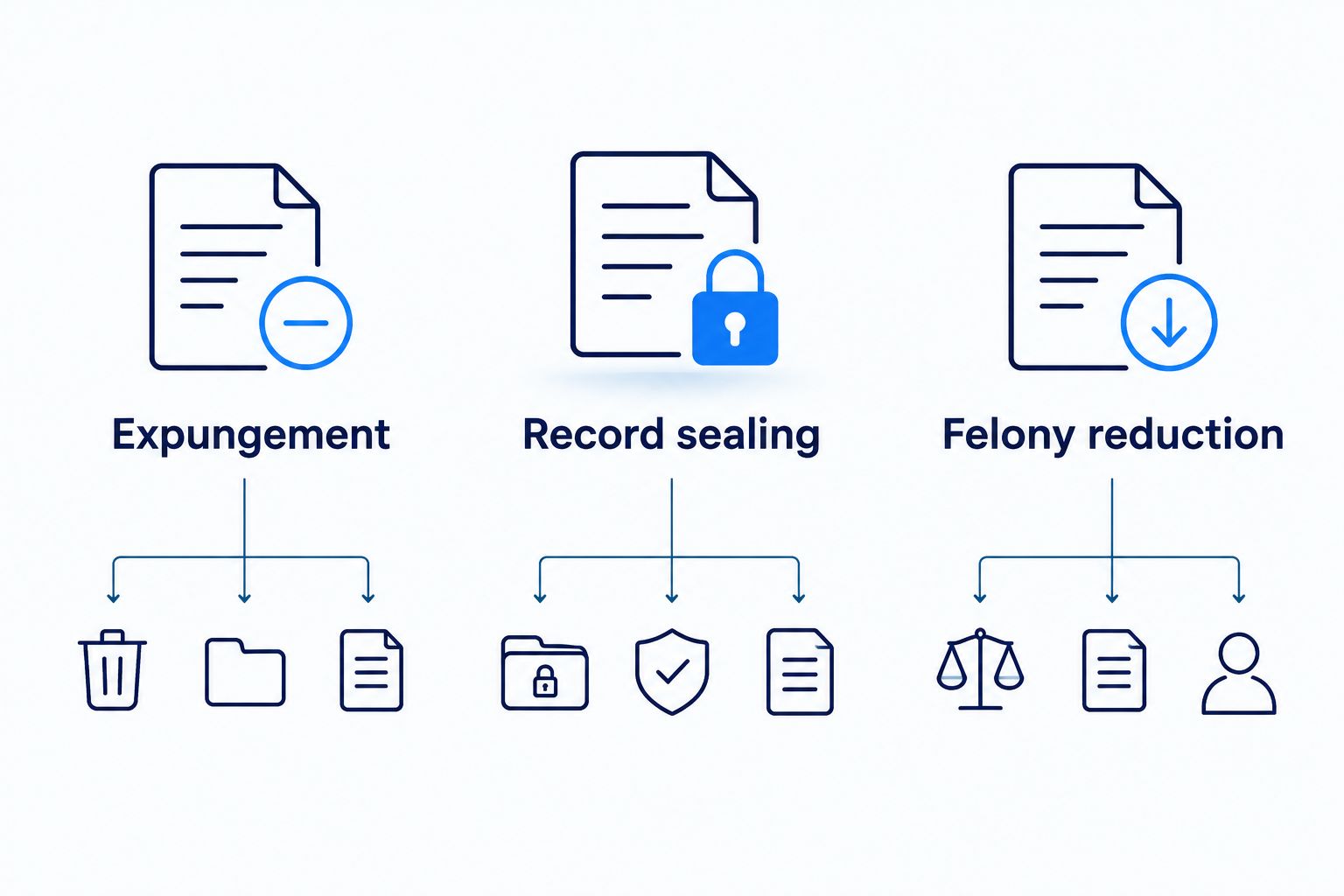
More than one form of relief can be relevant to a case, but that does not make every combination available. The right comparison starts with the existing record and the effect you need to understand, not the option with the most reassuring name.
For a 2026 admissions decision, the strongest question is specific: what would this relief change about this record, and how does that relate to this application? A general promise of a clean slate does not answer it.
What legal help can and cannot do
You can read a school’s published admissions requirements without hiring a lawyer. That information helps identify what the school says it reviews, but it does not determine your eligibility for criminal record relief or resolve an ambiguous disclosure question.
Cole Law provides legal services for California expungements, record sealings, and felony-to-misdemeanor reductions. That scope is relevant when your educational plans raise questions about an existing California criminal record.
Legal representation is not a guarantee of relief, admission, or professional eligibility. A useful consultation explains the available options and their limits rather than promising that a criminal history will never matter again.
The distinction protects your plans. You deserve to understand both the legal change you are seeking and the educational decisions that remain outside a lawyer’s control.
Discuss your record and college plans
Talk with Cole Law about California record relief and the limits relevant to your educational goals.
Common mistakes college applicants make
Treating expungement as permission to answer every question “no”
Expungement does not create a universal answer for all admissions, placement, and licensing forms. The precise question and the legal effect of the relief still matter. An answer about your record needs to fit the actual request.
Assuming acceptance settles future screening
A general admission offer does not determine a clinical provider’s or licensing board’s decision. This matters especially when the reason for choosing a degree is entry into a regulated profession. The degree pathway and the record relief discussion should address the same career goal.
Describing pending relief as completed relief
A hoped-for outcome is not a court order. Describing a case as expunged, sealed, or reduced before that result exists creates an avoidable accuracy problem. Your 2026 application should reflect the record’s actual status, not the status you expect later.
Sharing more personal history than the question requires
A desire to be honest can turn into an unnecessary account of painful events. Accuracy does not require treating every application as an invitation to disclose your entire history. Legal guidance can clarify the difference between a required answer and an optional personal narrative.
FAQ
Can California record relief help me apply to college?
California record relief can change an eligible criminal record, but it does not guarantee college admission. Its relevance depends on the relief granted, the institution’s questions, and any separate program screening.
Do I have to disclose an expunged conviction on a college application?
There is no single disclosure answer for every college application. The record, the court’s relief, the exact question, and the applicable rules determine what is required; contact Cole Law for advice about your situation.
Is record sealing the same as expungement?
Record sealing and expungement are different forms of relief. Sealing restricts access to eligible records, while relief commonly called expungement generally involves dismissal of an eligible conviction; neither should be treated as universal erasure.
Will an expungement guarantee admission to nursing or another licensed profession?
An expungement does not guarantee admission, clinical placement, or professional licensing. Those decisions involve separate reviewers and requirements, even when they are connected to the same degree.
Can I apply to college while record relief is pending?
Pending record relief is not the same as relief already granted. Whether and how it affects an application depends on the school’s requirements and your record; a pending request should not be described as a completed dismissal or sealing.
Does a juvenile record need the same treatment as an adult conviction?
A juvenile matter should not be treated as an adult conviction. Juvenile records have different legal rules, and the relevance of any sealing or disclosure question requires an assessment of the particular matter.
Who can help me understand record relief before graduate school?
Cole Law helps individuals with California expungements, record sealings, and felony-to-misdemeanor reductions. Contact the practice to discuss your criminal record alongside your graduate school plans, without assuming that relief guarantees acceptance.
One last thing
The most important record question can come after the acceptance letter. If your intended degree leads to a supervised placement or professional license, an admissions-only discussion leaves part of your goal unaddressed.
You do not need a promise that your past will disappear. You need a clear explanation of what relief changes, what it does not change, and how those limits relate to the future you are working toward.


